
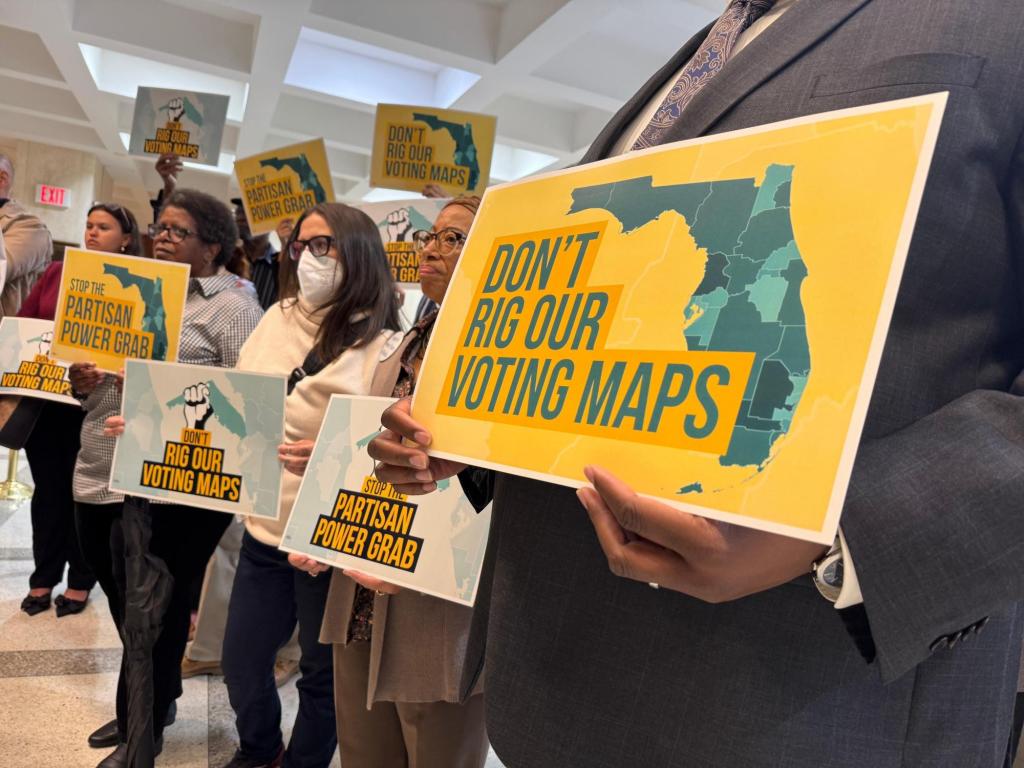
On Tuesday, Florida lawmakers will return to Tallahassee for a special session called by Ron DeSantis to redraw congressional maps that were just put in place a few years ago. There is no court order requiring it. There is no new census data justifying it. There is no legitimate trigger that would traditionally restart the process.
This is not a routine adjustment. It is a deliberate decision to revisit the rules midstream. Done this way, redistricting does not strengthen our system. It undermines our democracy.
I have been involved in Florida’s legislative process for nearly two decades, first as a legislative aide, then as a local elected official, and now as a state representative. Over that time, I have seen sharp disagreements on policy and priorities. But there was always a baseline respect for the process itself. Redistricting was not supposed to be something you revisited simply because the political moment made it advantageous.
Florida voters made that expectation unmistakably clear in 2010 when they passed the Fair Districts Amendments with more than 60% support. Those amendments were designed to stop partisan gerrymandering and require that maps not be drawn to favor or disfavor a political party or incumbent. Revisiting maps mid-decade for political advantage runs directly against both the spirit and the plain language of those protections.
What makes this push even more troubling is that the current maps were not the product of an independent commission or a divided government. They were driven by the governor himself. When the Legislature advanced its own congressional map during the last cycle, it was rejected. The governor’s map became the map.
If those maps were the right maps then, what changed now?
The answer is not new data or legal necessity. It is political opportunity.
 Dan Daley is Broward County’s state representative.
And now, with a special session set to begin, this effort is moving from theory to action.
This effort is part of a broader, Republican-led push across multiple states to revisit maps mid-decade in order to lock in advantage. While Democratic-led states have at times responded in kind, those efforts have largely been reactive attempts to preserve balance in the face of an escalating approach. That does not make it ideal. But it underscores how far the process has drifted from its original purpose.
At its core, redistricting is supposed to reflect population changes, not political calculations. When it is driven by timing and control rather than data and law, it sends a clear message that the goal is no longer representation, but advantage.
That should concern anyone who values stability in our elections, regardless of party. Reasonable Republicans, Democrats, and independents may disagree on policy outcomes. But there used to be agreement that the process itself should not be manipulated midstream. Once that line is crossed, it becomes much harder to restore.
The strength of our system has never come from what those in power can do, but from what they choose not to do.
The institutional implications are just as serious. Under Florida’s Constitution, my colleagues and I in the Legislature are tasked with drawing congressional districts. Yet once again, lawmakers appear to be waiting on direction from the executive branch before acting. When the body responsible for drawing the maps defers to another branch, the process is no longer independent. It is subordinate.
That is not how this system is supposed to function.
If mid-decade redistricting becomes normalized, there is no clear stopping point. Maps can be redrawn whenever those in power decide the moment is right. Elections become less about persuading voters and more about configuring the electorate.
That is not a partisan concern. It is a structural one.
Florida does not need to redraw its congressional districts now. It needs to exercise restraint and respect the process that voters expect to be followed. Because once that restraint is gone, the integrity of the system goes with it. And when that happens, voters are left to question whether the outcome of an election reflects their voice or the lines that were drawn around it.
If Tallahassee moves forward with this, voters should be paying close attention. And I expect they will respond accordingly.
Dan Daley has been a member of the Florida House of Representatives, representing Northwest Broward County, since 2019.