
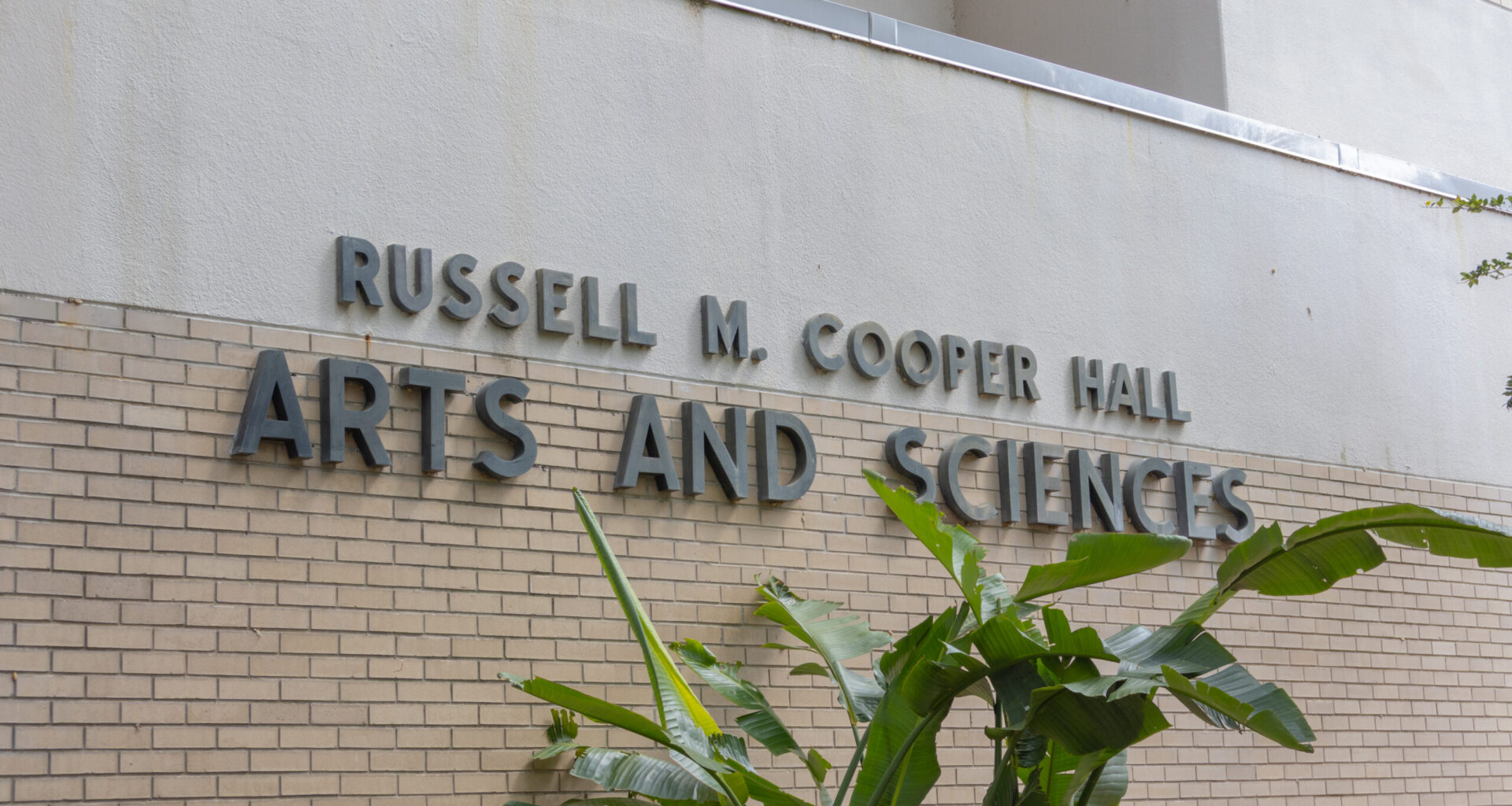
 The USF Department of Sociology, located at Cooper Hall, will see its Introduction to Sociology as an elective starting in the 2026-27 academic year. ORACLE PHOTO/MARIA DE ABREU PIRES
The Florida Board of Governors voted to remove introductory sociology courses from the general education curriculum in the state’s public university system starting in August.
The BOG approved the change during a March 26 meeting, reclassifying 1000- and 2000-level sociology general education courses as electives.
In November 2023, the BOG advanced a rule to remove Principles of Sociology from general education core options as part of Senate Bill 266’s overhaul.
SB 266 went into effect on July 1, 2023, and restricts diversity, equity and inclusion programs while giving the state more control over general education courses.
In 2024, the BOG removed Principles of Sociology from core courses required for graduation and replaced it with a history class. At USF, the class was substituted for Introductory Survey to 1877.
Following the March 26 meeting, sociology’s removal from the core curriculum applied to all 12 public universities, preventing students from taking it to fulfill a general education requirement.
On April 17, this decision was expanded to include Florida’s 28 public colleges, and the State Board of Education eliminated the course from its general education requirements, according to the Tampa Bay Times.
At USF, Introduction to Sociology — SYG 2000 — is the only course in the discipline that fulfills a general education requirement.
USF spokesperson Althea Johnson said the Introduction to Sociology class can still be taken as an elective starting in the 2026-27 academic year, in accordance with state policy.
Johnson added that the university had already planned to remove the course from its general education curriculum before the statewide vote, but did not say when.
Still, some USF faculty and students said removing sociology as a general education course raises concerns about accessibility, enrollment and interdisciplinary engagement.
Related: USF prepares for major changes to gen ed curriculum by 2026
Raymond Rodrigues, the Chancellor of the State University System of Florida, recommended the change at the March 26 vote despite it not being part of the BOG’s agenda.
Rodrigues said the reasoning for his recommendation was that faculty were resisting previous revisions to sociology content and materials.
The BOG approved a revised textbook and course framework — which removed race, ethnicity, gender, sexuality, social stratification and global inequality from sociology — in mid-January, reducing the widely used OpenStax Introduction to Sociology textbook from 665 to 267 pages.
“Sociology as a discipline is now social and political advocacy dressed in the regalia of the academy,” Rodrigues said at the BOG meeting.
S.L. Crawley has taught interdisciplinary social sciences at USF since 2003, and said the state’s removal of introductory sociology from general education misrepresents what sociology teaches.
Crawley said the textbook revisions largely removed discussions of power — a central point of the discipline — and now limit how much classes can talk about inequality in social systems.
“They removed an entire school of thought by reducing this textbook,” they said.
Crawley said the framing of the decision mischaracterizes what happens in sociology classrooms — particularly the idea that students are being “indoctrinated” with a specific ideology.
“That’s entirely disingenuous,” they said. “Students could still pick any of the social science courses they wish to take.”
USF’s social science requirements include six courses — Introductory Survey to 1877, Introductory Survey Since 1877, Introduction to Anthropology, Macroeconomics, American Government and Introduction to Psychology.
Before the March vote, Introduction to Sociology could be taken to fulfill the social science general education requirement.
Related: Commencement speakers, cap contest — Graduation Edition 2026
Byron Miller has taught sociology at USF since 2016 and said he learned about the vote to make introductory sociology an elective the day it happened.
He said removing sociology from general education will likely reduce the number of students taking sociology and affect how students interpret and understand social issues.
“Students in every discipline will be affected negatively if we get rid of sociology,” Miller said. “And when they are in their professions, it’s going to impact their clients, the community, whomever they’re interacting with.”
Miller said he does not feel the state has clear evidence to support statements that sociology courses are too ideological or non-academic.
“It’s not just one side or the other,” he said. “If there are a couple of professors who teach in a way that the state doesn’t like, then that doesn’t give them the right to go after all professors.”
Miller said broad policy changes based on limited examples risk affecting an entire discipline, and reflect a larger concern about the direction of Florida’s higher education programs.
Related: USF students oppose proposal to remove sociology as general education requirement
Lily Demkovich, a junior interdisciplinary social science major, said she is minoring in sociology and was introduced to the discipline through Introduction to Sociology, which she took as a general education class.
After the textbook change, Demkovich said she noticed class discussions on certain topics started requiring greater caution.
“Teachers kind of do have to walk on eggshells when they go around these more contentious topics,” she said. “They’re afraid to be accused of, quote unquote, indoctrinating students.”
Demkovich said losing sociology as a general education option limits opportunities for future students who may not have taken interdisciplinary courses before.
“Students won’t experience a discipline… if they don’t already have a vested interest,” she said.
Meanwhile, Crawley said the changes reflect a growing effort by state leaders to restrict how topics like inequality and social systems are taught in college classrooms.
“In an undergraduate university environment, we are talking about legal adults,” Crawley said. “Open and free conversation should be the standard. Any attempts to legally control that strikes me as uneducated and un-American.”