
Following WESH 2’s reporting on a Sumter County landfill’s plans to haul thousands of tons of Miami garbage via rail per week to Bushnell, we’re now digging into the landfill’s on-site drilling for a deep injection well to dispose of leachate.Leachate, in the simplest terms, is a sort of ‘trash tea’ that’s made up of stormwater runoff and the byproduct of trash, which can include harmful chemicals.Heart of Florida, located within the limits of the City of Bushnell, is owned by a company called Waste Connections.The plan is for a disposal well to inject the leachate into the ground, rather than the current method being used by the landfill of trucking the leachate to be treated off-site.”It’s basically an underground storage tank that’s made by nature, if I had to explain it,” said Malak Anshassi, an assistant professor in the Department of Environmental Engineering at Florida Polytechnic University.But neighbors of the landfill are in an uproar over the plans, vowing to fight it at every county commission or city council meeting.They’re being joined by surrounding county commissions and even local state legislators who have raised concerns as well.What is leachate?People have various names for it, but all can agree: it could potentially be harmful and landfill operators need to approach it’s handling with caution.”It’s a cocktail of all these chemicals, and they have very high levels of biological matter, it changes over time,” Anshassi said.Anshassi said there are examples of innovative ways of getting leachate to the levels where it doesn’t pose an environmental risk, like in Polk County where she said a combination of wetlands and an evaporator reduce leachate to a sort of landfill sludge that ends up back in the landfill.Heart of Florida tried an evaporator last year, but had to shut it down due to residents’ complaints of noxious odors led to the city creating a corrective action plan due to violations of the landfill’s permit.WESH 2 attempted to contact Heart of Florida last year and multiple times for these stories, but has not heard back.“There are concerns for landfill leachate and how to address them,” Anshassi said. “Typically, landfills will be able to contract with a wastewater treatment facility, and they’ll be able to use them as a source.”“This is just one example of landfill leachate treatment that is definitely more on the emerging side because, right now, we’re still trying to figure out what is the best solution.” Anshassi said our waste produces various types of heavy metals that percolate with rainwater.“A pre-treated landfill leachate is going to end up being pretty bad in terms of anything you can find in it because it’s a cocktail of all the chemicals we throw away and rainwater,” she said.What’s the plan?The landfill, in meeting with county and city officials, said it plans to drill down to a depth permitted by the Florida Department of Environmental Protection (or FDEP) of 3,200 feet.In March, it said its test well had gone down to 2,100 feet.Heart of Florida also told officials it should reach the depth of 3,200 feet by the “last quarter of 2026,” which at that point it would go to FDEP to get permitted to begin operations.FDEP classifies Class I wells, which this would be, as: “Wells used to inject hazardous waste (new hazardous waste wells were banned in 1983), nonhazardous waste or municipal waste below the lowermost Underground Source of Drinking Water (USDW).”The leachate that would theoretically be injected, the landfill told officials, would be “pre-treated non-hazardous.”It said the state prohibits the injection of hazardous materials and that its operation would be well-regulated and its integrity would be monitored throughout usage.“There’s so much regulations and requirements and monitoring that FDEP does in order to ensure that whatever facility is doing X, Y, Z is in compliance, that it’s not going to be a risk to the environment or to human health, not short-term but also long-term,” Anshassi said.Nevertheless, neighbors in the area are up in arms over the proposed well and voicing concerns both for their private wells and for municipal wells that draw water from the Floridan Aquifer.Bushnell has not taken a stance on the well and said it is prohibited from regulating it because the well is on-site at a private landfill.”In the event of issues such as well failures, collapses, or suspected impacts, residents are advised to contact FDEP, which is the appropriate agency to investigate and respond,” said Assistant City Manager Morgan Wilson.”Should a permit be granted and an issue arise, responsibility for response and mitigation would be handled in accordance with FDEP regulations and enforcement authority.”Push to end the drillingFor Sumter County residents, the thought of injecting leachate into the ground and the risks involved in doing so are enough to keep them up at night.”It’s not if, it’s when it’s going to leak,” said Debra Arcus who’s lived in Lake Panasoffkee for decades. Lake Panasoffkee, or Lake Pan as locals call it, is a small community sitting just across I-75 from the landfill.Arcus said she moved here from Indiana at the turn of the century for a quiet life.”Back when this was a small, rural area,” she said.The traffic’s gotten worse, development has started to encroach, but she said her biggest concern is for the future of her water.“The issue is what gets into the aquifer, and the aquifer, we’re talking benzene, we’re talking xylene, we’re talking chloride,” Arcus said.Neighboring Citrus County has weighed in, sending a letter to FDEP expressing concern about the well.”As you are aware, the proposed project raises questions related to subsurface conditions, including the region’s karst geology and the potential for contaminant migration,” wrote Citrus County Chairman Diana Finegan. “Available information indicates that there remains limited data on deep groundwater flow patterns, including the direction, rate, and ultimate destination of injected materials. These uncertainties present challenges in evaluating long-term containment and potential impacts to regional groundwater resources.”Likewise, at least one state legislator from the area, Rep. Samantha Scott, has also expressed concerns over the well to the state.”Families, farms and small businesses rely directly on the Floridan Aquifer as their primary source of drinking water. Any threat to that resource carries real and lasting consequences,” Scott wrote.”A key concern is the limited predictability of deep groundwater flow patterns, including uncertainty regarding the direction and rate of mitigation of injected materials over time.”Scott cites federal regulations which require injection activities not to allow the movement of contaminants into underground sources of drinking water, and she asks FDEP to evaluate alternative treatment methods already in use in other parts of the state.”My biggest concern, it goes back to my water,” said Sumterville resident Hoss Hacker, who’s on a private well.”I don’t want to have to have my water trucked in, I don’t want to have to hook to the city for water. I’m happy with my well.”Sumter County has not taken a formal stance on the well, but said it is working to gain support from FDEP to hold informational sessions.“There are other landfills throughout the state of Florida that have alternate programs that are not putting leachate into the aquifer and that do not generate odors,” Arcus said. “There are a multitude of ways to handle what is coming out of that landfill.”What’s at stake?The Floridan Aquifer, where drinking water is pulled from, is roughly 2,000 feet below the surface.As noted, opposition has centered on the natural flow of the aquifer and how any leakage could impact water quality in various regions of Central Florida.According to a presentation to the Withlacoochee Regional Water Supply Authority (or WRWSA), the well is being designed with concentric rings of seamless steel casing, cemented in place with final fiberglass reinforced plastic liners.But any mistakes made during construction or in operation could have catastrophic consequences.WESH 2 has contacted FDEP to ask about how the permitting process changes due to the well’s proximity to WRWSA’s wellfield, whether FDEP has any models replicating worst-case scenarios and whether a third-party agency will be brought on to analyze the landfill’s work outside of the very regulatory agency (FDEP) that would be permitting the well.As of this story’s publishing, we have not heard back.“It’s not for our benefit, not for our welfare,” Hacker said.“The only thing I keep hearing is it comes back to money. The only reason they would do it is for money.” Arcus said she believes it’s time for the entire region, not just Sumter County, to become aware of what’s happening at the Heart of Florida.“Once it’s in there, you’re done,” she said.
BUSHNELL, Fla. —
Following WESH 2’s reporting on a Sumter County landfill’s plans to haul thousands of tons of Miami garbage via rail per week to Bushnell, we’re now digging into the landfill’s on-site drilling for a deep injection well to dispose of leachate.
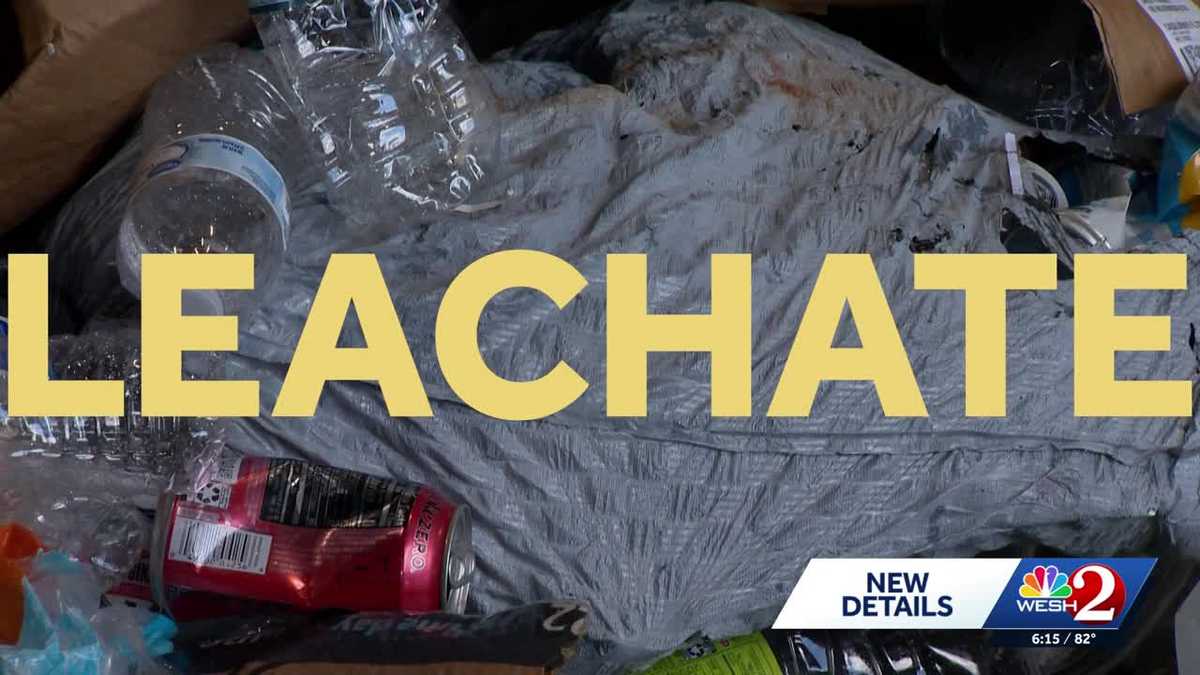
Leachate, in the simplest terms, is a sort of ‘trash tea’ that’s made up of stormwater runoff and the byproduct of trash, which can include harmful chemicals.
Heart of Florida, located within the limits of the City of Bushnell, is owned by a company called Waste Connections.
The plan is for a disposal well to inject the leachate into the ground, rather than the current method being used by the landfill of trucking the leachate to be treated off-site.
“It’s basically an underground storage tank that’s made by nature, if I had to explain it,” said Malak Anshassi, an assistant professor in the Department of Environmental Engineering at Florida Polytechnic University.
But neighbors of the landfill are in an uproar over the plans, vowing to fight it at every county commission or city council meeting.
They’re being joined by surrounding county commissions and even local state legislators who have raised concerns as well.
What is leachate?
People have various names for it, but all can agree: it could potentially be harmful and landfill operators need to approach it’s handling with caution.
“It’s a cocktail of all these chemicals, and they have very high levels of biological matter, it changes over time,” Anshassi said.
Anshassi said there are examples of innovative ways of getting leachate to the levels where it doesn’t pose an environmental risk, like in Polk County where she said a combination of wetlands and an evaporator reduce leachate to a sort of landfill sludge that ends up back in the landfill.
Heart of Florida tried an evaporator last year, but had to shut it down due to residents’ complaints of noxious odors led to the city creating a corrective action plan due to violations of the landfill’s permit.
WESH 2 attempted to contact Heart of Florida last year and multiple times for these stories, but has not heard back.
“There are concerns for landfill leachate and how to address them,” Anshassi said. “Typically, landfills will be able to contract with a wastewater treatment facility, and they’ll be able to use them as a source.”
“This is just one example of landfill leachate treatment that is definitely more on the emerging side because, right now, we’re still trying to figure out what is the best solution.”
Anshassi said our waste produces various types of heavy metals that percolate with rainwater.
“A pre-treated landfill leachate is going to end up being pretty bad in terms of anything you can find in it because it’s a cocktail of all the chemicals we throw away and rainwater,” she said.
What’s the plan?
The landfill, in meeting with county and city officials, said it plans to drill down to a depth permitted by the Florida Department of Environmental Protection (or FDEP) of 3,200 feet.
In March, it said its test well had gone down to 2,100 feet.
Heart of Florida also told officials it should reach the depth of 3,200 feet by the “last quarter of 2026,” which at that point it would go to FDEP to get permitted to begin operations.
FDEP classifies Class I wells, which this would be, as:
“Wells used to inject hazardous waste (new hazardous waste wells were banned in 1983), nonhazardous waste or municipal waste below the lowermost Underground Source of Drinking Water (USDW).”
The leachate that would theoretically be injected, the landfill told officials, would be “pre-treated non-hazardous.”
It said the state prohibits the injection of hazardous materials and that its operation would be well-regulated and its integrity would be monitored throughout usage.
“There’s so much regulations and requirements and monitoring that FDEP does in order to ensure that whatever facility is doing X, Y, Z is in compliance, that it’s not going to be a risk to the environment or to human health, not short-term but also long-term,” Anshassi said.
Nevertheless, neighbors in the area are up in arms over the proposed well and voicing concerns both for their private wells and for municipal wells that draw water from the Floridan Aquifer.
Bushnell has not taken a stance on the well and said it is prohibited from regulating it because the well is on-site at a private landfill.
“In the event of issues such as well failures, collapses, or suspected impacts, residents are advised to contact FDEP, which is the appropriate agency to investigate and respond,” said Assistant City Manager Morgan Wilson.
“Should a permit be granted and an issue arise, responsibility for response and mitigation would be handled in accordance with FDEP regulations and enforcement authority.”
Push to end the drilling
For Sumter County residents, the thought of injecting leachate into the ground and the risks involved in doing so are enough to keep them up at night.
“It’s not if, it’s when it’s going to leak,” said Debra Arcus who’s lived in Lake Panasoffkee for decades.
Lake Panasoffkee, or Lake Pan as locals call it, is a small community sitting just across I-75 from the landfill.
Arcus said she moved here from Indiana at the turn of the century for a quiet life.
“Back when this was a small, rural area,” she said.
The traffic’s gotten worse, development has started to encroach, but she said her biggest concern is for the future of her water.
“The issue is what gets into the aquifer, and the aquifer, we’re talking benzene, we’re talking xylene, we’re talking chloride,” Arcus said.
Neighboring Citrus County has weighed in, sending a letter to FDEP expressing concern about the well.
“As you are aware, the proposed project raises questions related to subsurface conditions, including the region’s karst geology and the potential for contaminant migration,” wrote Citrus County Chairman Diana Finegan. “Available information indicates that there remains limited data on deep groundwater flow patterns, including the direction, rate, and ultimate destination of injected materials. These uncertainties present challenges in evaluating long-term containment and potential impacts to regional groundwater resources.”
Likewise, at least one state legislator from the area, Rep. Samantha Scott, has also expressed concerns over the well to the state.
“Families, farms and small businesses rely directly on the Floridan Aquifer as their primary source of drinking water. Any threat to that resource carries real and lasting consequences,” Scott wrote.
“A key concern is the limited predictability of deep groundwater flow patterns, including uncertainty regarding the direction and rate of mitigation of injected materials over time.”
Scott cites federal regulations which require injection activities not to allow the movement of contaminants into underground sources of drinking water, and she asks FDEP to evaluate alternative treatment methods already in use in other parts of the state.
“My biggest concern, it goes back to my water,” said Sumterville resident Hoss Hacker, who’s on a private well.
“I don’t want to have to have my water trucked in, I don’t want to have to hook to the city for water. I’m happy with my well.”
Sumter County has not taken a formal stance on the well, but said it is working to gain support from FDEP to hold informational sessions.
“There are other landfills throughout the state of Florida that have alternate programs that are not putting leachate into the aquifer and that do not generate odors,” Arcus said. “There are a multitude of ways to handle what is coming out of that landfill.”
What’s at stake?
The Floridan Aquifer, where drinking water is pulled from, is roughly 2,000 feet below the surface.
As noted, opposition has centered on the natural flow of the aquifer and how any leakage could impact water quality in various regions of Central Florida.
According to a presentation to the Withlacoochee Regional Water Supply Authority (or WRWSA), the well is being designed with concentric rings of seamless steel casing, cemented in place with final fiberglass reinforced plastic liners.
But any mistakes made during construction or in operation could have catastrophic consequences.
WESH 2 has contacted FDEP to ask about how the permitting process changes due to the well’s proximity to WRWSA’s wellfield, whether FDEP has any models replicating worst-case scenarios and whether a third-party agency will be brought on to analyze the landfill’s work outside of the very regulatory agency (FDEP) that would be permitting the well.
As of this story’s publishing, we have not heard back.
“It’s not for our benefit, not for our welfare,” Hacker said.
“The only thing I keep hearing is it comes back to money. The only reason they would do it is for money.”
Arcus said she believes it’s time for the entire region, not just Sumter County, to become aware of what’s happening at the Heart of Florida.
“Once it’s in there, you’re done,” she said.