
One definition of “urban sprawl” describes it as “the rapid expansion of the geographic extent of cities and towns, often characterized by low-density residential housing, single-use zoning, and increased reliance on the private automobile for transportation.” That sounds an awful lot like several cities on the Gulf Coast. A 40-year time lapse of the satellite view of Lee County shows how much development has happened over that time. It’s hard to tell where one city ends and the next one begins. In such a fast-growing area, experts say urban sprawl is all around us and affects our everyday lives. “Really, it just goes back to the expansion of zoning. Not just in Lee County, but across the United States,” Shelton Weeks explained. “75% of the areas that are zoned are R-1 residential. So, only single-family homes.” “Really, the only way to grow is sprawl,” he continued. Weeks is a professor of real estate at Florida Gulf Coast University. He said urban sprawl affects everything from traffic to the environment to housing costs. It also impacts flood risk. In such a low-lying, heavily coastal area, how the area is growing — and how fast it’s happening — creates challenges. Hurricanes have exposed this in a whole new way in recent years. “This overexpansion tends to exacerbate the situation because, when you develop the land, it changes the topography and its ability to handle surface and runoff water,” Doug Nellans said. Nellans is president of The Insurancenter in Fort Myers. “The whole equation results in increased flood risk,” he said. “Homes that are located in these flood zones are going to be looking at increased damages.” In fact, a 2020 study found Cape Coral had the most properties in the country with “substantial” flood risk. And the problem isn’t going away. FEMA is updating its flood maps this year, and Nellans said the overall direction is clear. “Generally, over time, the long-term trend is that the flood insurance zone classifications are going to be moving in the higher-risk direction,” he explained. Lavonne Grant knows more about flood risk than she’d like to know. Hurricane Ian brought the river inside her home in southeast Cape Coral. “We only had 7 inches, but that means the sheet rock comes out. The trim comes out. You’ve got to repaint. The cabinets come out. So it’s basically a redo of the house,” she recalled. “I remember just the piles of everybody’s belongings on the road.” Since then, she and her husband have managed to redo their house — and not only that, but they also spent thousands of dollars on flood panels in case another big storm hits. “We’re counting on this being the solution,” Grant said. “We have a lot of faith that it will be the solution.” Flood panels are among the moves homeowners can make to lower their flood risk. But fighting back against urban sprawl on a bigger scale is a tall order. Florida’s Live Local Act was created to fix the affordability issues caused in part by sprawl. It allows for greater density: more building up instead of building out. But as a whole, urban sprawl isn’t something that can be stopped. At this point, it can only be slowed. “It’s going to be challenging,” Weeks said. “We’ve set our society up to live this way. And unraveling that will be a very lengthy process.” DOWNLOAD the free Gulf Coast News app for your latest news and alerts on breaking news, weather, sports, entertainment, and more on your phone or tablet. And check out the Very Local Gulf Coast app to stream news, entertainment and original programming on your TV.
LEE COUNTY, Fla. —
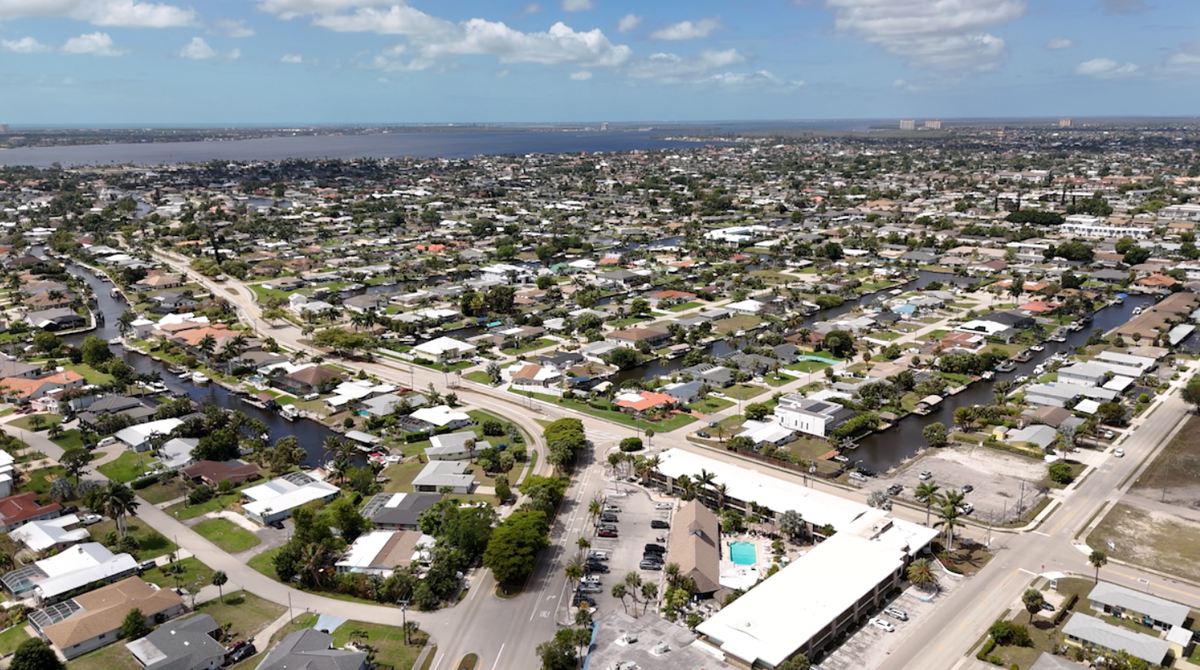
One definition of “urban sprawl” describes it as “the rapid expansion of the geographic extent of cities and towns, often characterized by low-density residential housing, single-use zoning, and increased reliance on the private automobile for transportation.”
That sounds an awful lot like several cities on the Gulf Coast.
A 40-year time lapse of the satellite view of Lee County shows how much development has happened over that time. It’s hard to tell where one city ends and the next one begins.
In such a fast-growing area, experts say urban sprawl is all around us and affects our everyday lives.
“Really, it just goes back to the expansion of zoning. Not just in Lee County, but across the United States,” Shelton Weeks explained. “75% of the areas that are zoned are R-1 residential. So, only single-family homes.”
“Really, the only way to grow is sprawl,” he continued.
Weeks is a professor of real estate at Florida Gulf Coast University. He said urban sprawl affects everything from traffic to the environment to housing costs.
It also impacts flood risk. In such a low-lying, heavily coastal area, how the area is growing — and how fast it’s happening — creates challenges.
Hurricanes have exposed this in a whole new way in recent years.
“This overexpansion tends to exacerbate the situation because, when you develop the land, it changes the topography and its ability to handle surface and runoff water,” Doug Nellans said.
Nellans is president of The Insurancenter in Fort Myers.
“The whole equation results in increased flood risk,” he said. “Homes that are located in these flood zones are going to be looking at increased damages.”
In fact, a 2020 study found Cape Coral had the most properties in the country with “substantial” flood risk.
And the problem isn’t going away. FEMA is updating its flood maps this year, and Nellans said the overall direction is clear.
“Generally, over time, the long-term trend is that the flood insurance zone classifications are going to be moving in the higher-risk direction,” he explained.
Lavonne Grant knows more about flood risk than she’d like to know. Hurricane Ian brought the river inside her home in southeast Cape Coral.
“We only had 7 inches, but that means the sheet rock comes out. The trim comes out. You’ve got to repaint. The cabinets come out. So it’s basically a redo of the house,” she recalled. “I remember just the piles of everybody’s belongings on the road.”
Since then, she and her husband have managed to redo their house — and not only that, but they also spent thousands of dollars on flood panels in case another big storm hits.
“We’re counting on this being the solution,” Grant said. “We have a lot of faith that it will be the solution.”
Flood panels are among the moves homeowners can make to lower their flood risk. But fighting back against urban sprawl on a bigger scale is a tall order.
Florida’s Live Local Act was created to fix the affordability issues caused in part by sprawl.
It allows for greater density: more building up instead of building out.
But as a whole, urban sprawl isn’t something that can be stopped. At this point, it can only be slowed.
“It’s going to be challenging,” Weeks said. “We’ve set our society up to live this way. And unraveling that will be a very lengthy process.”
DOWNLOAD the free Gulf Coast News app for your latest news and alerts on breaking news, weather, sports, entertainment, and more on your phone or tablet. And check out the Very Local Gulf Coast app to stream news, entertainment and original programming on your TV.