
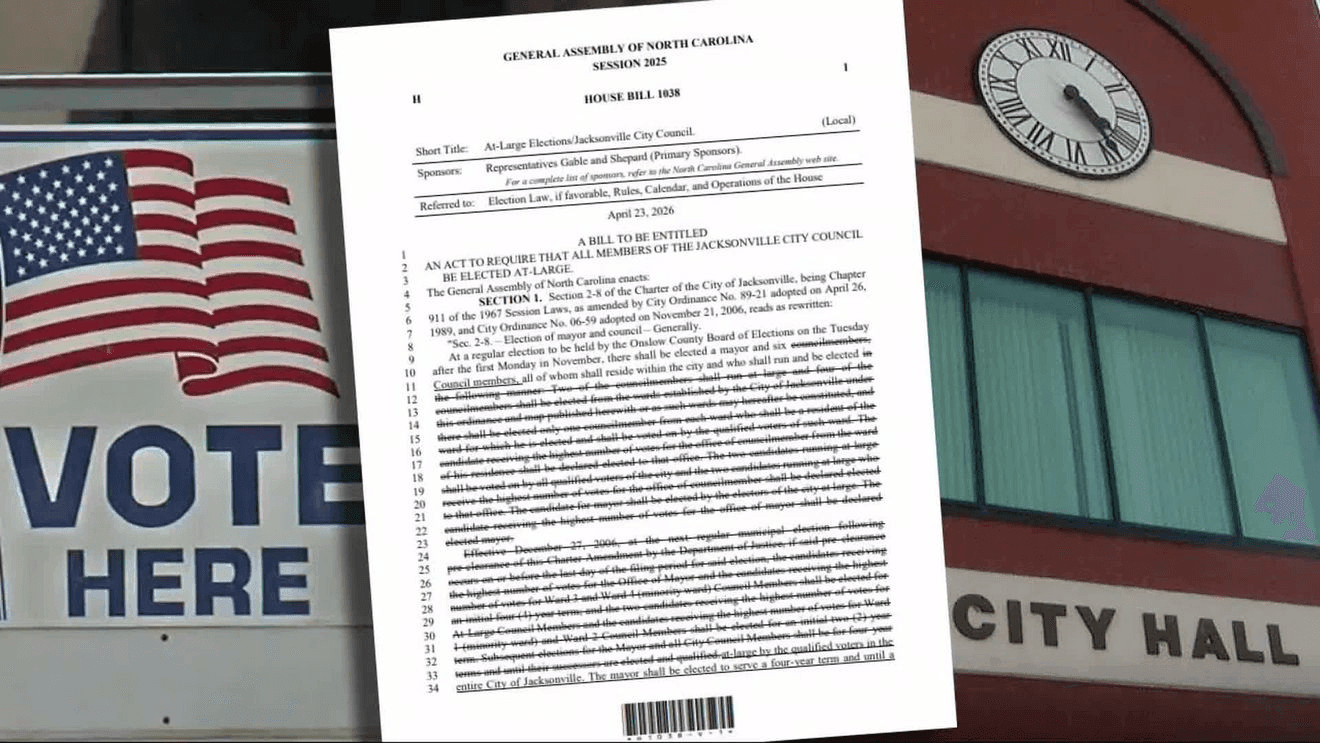
A new bill in the North Carolina legislature could shake up Jacksonville’s city council elections.
The bill would require all members of the Jacksonville City Council to be elected at-large.
Right now, four members represent different wards.
The potential overhaul has been met with a petition claiming it will limit representation.
HB 1038 would eliminate voting by Ward in the city of Jacksonville. Instead, voters would elect city representatives at-large.
Right now you have some wards that are about 1,200 votes in the total election and then other ones you only might get 200 people that vote and these discrepancies we feel are unfair to people when the go to vote.
Right now, the system is split.
Four council members are elected by district, or ward, representing specific parts of the city.
Two others are elected citywide.
Republican Representative Wyatt Gable joined Representative Phil Sheperd to introduce the bill on April 22nd.
It passed the first reading and is now being reviewed by the House Committee on Election Law.
He says this is a step to make representation fair for all.
With this new system with all the wards being at large, every councilman is going to be responsible for every citizen of Jacksonville and they have to answer to every citizen and not just a few handpicked that are happening in these small wards.
However, not everyone agrees, including Al Burgess.
The at-large system—it doesn’t guarantee what I would call proportional representation.
He started the social welfare organization A.C.T.I.O.N P.A.C in Jacksonville.
Burhess says it’s dedicated to keeping the community informed on all sides rather than by political party.
He started a petition against the House bill, which has more than 300 signatures.
If you have an at large system, you can have seven people from the same area of the community they can have seven people be elected and all of them be from the Commons. You have no one represented from Brynn Marr, New River, the Country Club area, the Bell Fork area, but all your elected officials will be in one area.
Council members would still serve staggered four-year terms — and the mayor would continue to be elected citywide.
The bill has several hoops before becoming law, including a full vote by the House, Senate, and signature from the governor.