
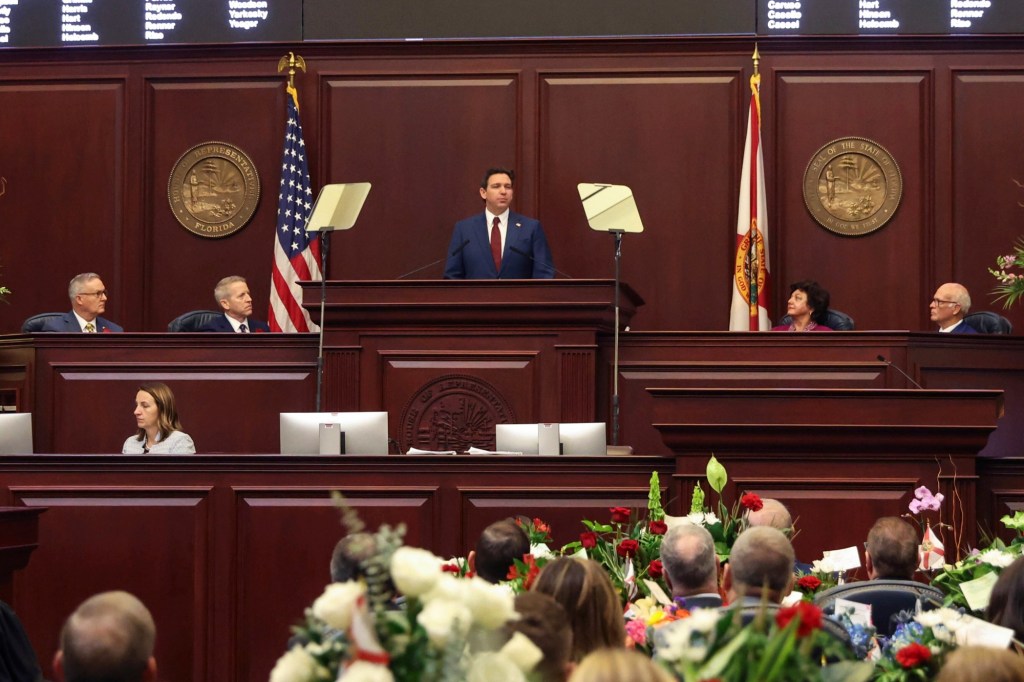
TALLAHASSEE –After hours of heated debate, the Republican-controlled Florida Legislature on Wednesday approved a new congressional map that favors the GOP in upcoming mid-term elections and seems nearly certain to spawn a flurry of lawsuits.
The map eliminates four Democrat-leaning districts, including one Hispanic majority district in Central Florida, and tilts the balance of the Florida delegation even more red. Florida’s current congressional delegation has 20 Republicans and eight Democrats.
The new map, proposed by Gov. Ron DeSantis, looks likely to make it 24 to four.
As lawmakers held hearings on the map Wednesday morning, the U.S. Supreme Court dropped its much-anticipated ruling in a Louisiana court case, striking down a majority Black congressional district in that state. The high court ruled unconstitutional part of the Voting Rights Act of 1965 and said that district was drawn with race too much of a consideration.
That ruling left Democrats opposed to the map arguing whether Florida’s Fair District amendments, which prohibit partisan gerrymandering, still made the DeSantis proposal improper. Fair Districts were approved by Florida voters in 2010.
DeSantis’ office had bet that the nation’s high court would rule against Louisiana’s district and against parts of the 61-year-old law. In fact, in a memo submitted to state lawmakers alongside the map released Monday, it argued that considering race when drawing congressional districts was unconstitutional. It also said Fair Districts shouldn’t be considered as it also required that race be taken into account during redistricting.
“Called this one months ago,” DeSantis posted on X after the court’s decision was released.
He also wrote that problems with Florida’s current congressional map would be corrected once the Legislature approved the new one.
The Senate voted for the redistricting bill, which included the map, 21-17, with all 12 Democrats, four Republicans and one independent voting ‘no.’ The House voted 83-28 to approve the same legislation, adopting it hours earlier after limited debate.
During the Senate debate, Democrats argued that voting for the map was a violation of the oath of office lawmakers took to uphold the constitution. They said it violated Fair Districts as it amounted to partisan gerrymandering.
But Sen. Don Gaetz, the Niceville Republican who sponsored the bill, said he was not convinced. “I am not persuaded that the map is necessarily beneficial to Republicans,” he said.
During Tuesday’s committee hearings, however, Jason Poreda, on the governor’s staff, said he drew the maps two weeks before the session began with no consideration for race. But he admitted that he did look at political data. The map DeSantis’ office released Monday was also color-coded in red and blue, with most of the map red, the color of the GOP.
“The governor’s office openly admitted they considered partisan criteria in drawing this map,” said Sen. Carlos Guillermo Smith, D-Orlando. “Those are pretty stunning assertions from my perspective.”
Smith said Fair Districts doesn’t allow that.
“It says NO plan shall be drawn with intent to favor or disfavor partisan or incumbent,” Smith said. “That is just the black and white text.”
The Florida Democratic Party, as soon as the map was released, said it was preparing lawsuits.
DeSantis spent months urging the Legislature to take up a rare mid-decade redistricting process leading up to the 2026 midterm elections, responding to a call from President Donald Trump that Republican-led states try to increase the number of GOP seats to hold onto Congress.
He said Florida’s population growth also justified redrawing the congressional districts.
Senate President Ben Albritton called a one-hour recess after the Supreme Court ruling was released.
“This is at the very heart of what we’re doing today,” said Senate Minority Leader Lori Berman, D-Boynton Beach.
The House leadership turned down a similar request and voted quickly to approve the map.
DeSantis’ post on X argued that the court’s ruling invalidated provisions of Fair Amendments that aim to protect the voting rights of minorities.
Several legal analysts disputed that interpretation, saying it merely narrowed down the scope of a provision that allowed race as a factor in redistricting as long as there is “strong” evidence of racial discrimination.
But Republican leaders said they were convinced the new map was rightly drawn.
“We have an evolving legal landscape in Florida,” said Rep. Jenna Persons-Mulicka, R-Naples, the sponsor of the House version of the redistricting bill. “This map is based on a strong and viable legal interpretation.”