
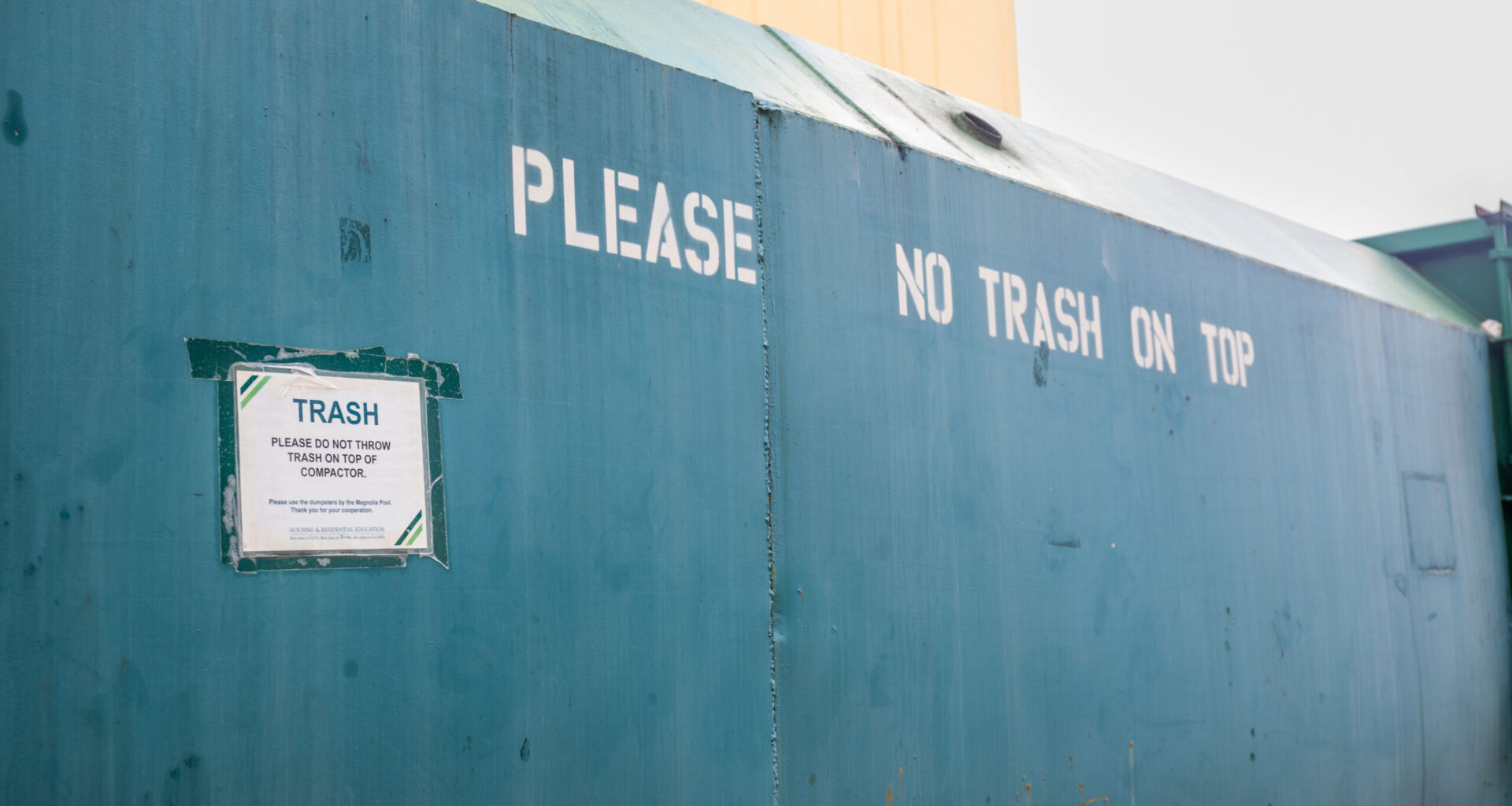
 Mosaic, a local fertilizer, phosphate-mining and agricultural company, wants to expand its waste pile in Riverview by 180 acres. ORACLE PHOTO/VIOLET VASQUEZ PIMENTEL
Mosaic, a Tampa-based fertilizer and agricultural company, is seeking federal approval to expand one of its waste piles by 180 acres — raising concerns among Tampa Bay environmental advocates and USF students.
Mosaic’s Riverview East Stack waste pile is a hundreds-feet-tall phosphogypsum stack that contains radioactive waste left over from fertilizer production, according to the U.S. Environmental Protection Agency. It is located about 20 miles south of USF’s Tampa campus.
In February 2026, Mosaic requested a Clean Water Act permit from the U.S. Army Corps of Engineers to fill nearby waters west of its Riverview facility, according to WUSF. Mosaic told WUSF the expansion would extend the stack’s use by about 16 years.
The phosphogypsum stack was expected to reach capacity around 2030 — but the proposed expansion would extend operations at the site to about 2046, according to The CLEO Institute.
Phosphogypsum is a waste byproduct from fertilizer production that contains radioactive materials, including radium, which can decay and increase cancer risk, according to the EPA.
Florida has about 25 phosphogypsum stacks across the state, holding roughly one billion tons of waste, according to the U.S. Geological Survey.
Mosaic has also supported USF in the past — donating $100,000 in 2025 to expand Feed-A-Bull’s main Tampa campus facility, now known as the Mosaic Pantry, according to USF.
Patricia Spellman, an assistant professor at USF, focuses on research topics including groundwater hydrology and agricultural sustainability.
Spellman said there is “no good way” to dispose of phosphogypsum, which is cancer-causing, adding that it must be contained and regulated for public safety.
She added that several environmental concerns and questions come with the expansion — including how phosphogypsum will be handled in the future, how it can be reused or recycled and what to do about the increasing piles of waste in the area.
“This could just be a never-ending process, and I think that the proximity to the coast, the vulnerability of that area, it could increase risk for human health and wildlife,” Spellman said. “So I’m not a huge fan of it.”
Related: USF environmental organizations petition to reinstate the Office of Sustainability
Skylar Chamberlain is a freshman environmental science major and treasurer of the Entomology Society at USF.
Chamberlain said many students are unaware of the proposed expansion and the potential environmental risks tied to phosphogypsum stacks, even though the site is in the Tampa Bay area.
She said Mosaic’s proposed expansion deserves more attention from students because of its potential effects on water quality, wildlife and nearby communities.
“It’s kind of crazy that this is just not really talked about,” Chamberlain said.
She said manatees stood out as one of her biggest concerns because they rely on clean waterways and are vulnerable to environmental changes.
“If this goes into our waterways, this could impact not just us, but animals a lot,” Chamberlain said. “Manatees are already so at risk. This stuff doesn’t just go away.”
If phosphogypsum escapes containment, it can harm water quality with radioactive material and lead to algal blooms and red tides that kill fish and other marine life, according to the EPA.
Similar to Chamberlain, Taylor Gallaway, a freshman social work major and member of USF’s Entomology Club, said the expansion could have local environmental impacts.
Gallaway said students should pay more attention to local environmental issues because pollution is not isolated and does not stay contained to one area.
She said she is worried the expansion could affect nearby water, food systems and wildlife if pollutants spread beyond the stack.
“Everything connects,” Gallaway said. “Our health, the animals’ health, the plants’ health. It’s [in] what we eat.”
She said students should care about and research the proposed expansion and its potential environmental impacts to help protest it before it becomes harder to address.
“As soon as they realize, ‘Oh, this is affecting me,’ it’s going to be too late,” Gallaway said.
Concerns about phosphogypsum stacks are not new. In 2021, about 215 million gallons of wastewater were released from Piney Point into Tampa Bay, according to the Tampa Bay Estuary Program.
This leak caused the largest red tide — an algal bloom that suffocates the water and marine life — in Tampa Bay, according to Bay News 9. It has also impacted water quality in the area, according to Ocean Conservancy.
Related: USF’s water has elevated chemical levels but still meets safety standards
In 2024, environmental groups raised concerns about phosphogypsum stacks as Hurricane Milton approached Florida, warning that heavy rainfall could increase the risk of wastewater overflows or leaks, according to the Associated Press.
Spellman said that because Mosaic’s Riverview is near the coast, any failures in storage or containment systems pose a serious threat to the surrounding community and ecosystem.
“If there’s a breach, if there’s storm surge, if something goes wrong, that could potentially cause some environmental contamination,” Spellman said.
Galloway said environmental education at USF often comes from student organizations and academic departments, but broader university-wide awareness could help more students learn about local issues.
“If USF itself actually put an event, information session, fundraiser, or flyers, I feel like it could actually benefit and help a lot,” Gallaway said.
Chamberlain said all large-scale, corporate companies should include environmental perspectives when making decisions that could affect public health and ecosystems.
“You have [to have] someone that’s able to advocate for the environment when these decisions are being proposed or made,” Chamberlain said.