
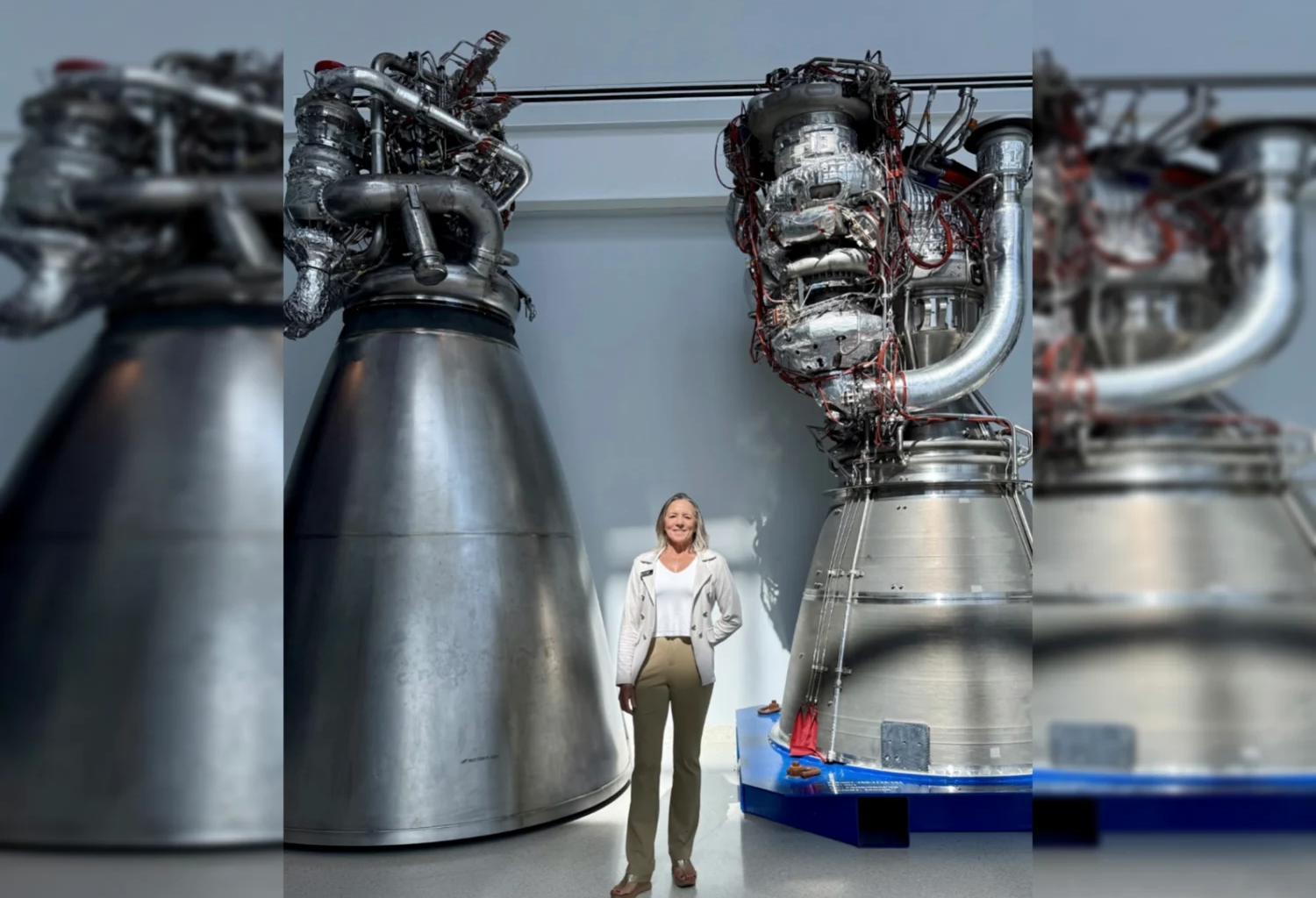

Dr. Amy Gregory stands among rocket engines during a visit to Blue Origin’s Space Coast facilities in Titusville, Florida, last summer.
Courtesy of Dr. Amy Gregory
A UCF professor is helping send student research to the International Space Station aboard a SpaceX mission scheduled for next summer.
Dr. Amy Gregory, endowed chair for space tourism programming and initiatives at UCF’s Rosen College of Hospitality Management, is a faculty facilitator on a student experiment selected for flight through the Student Spaceflight Experiments Program.
The selected experiment, “A Kidney Stone in Microgravity — Examining Physical and Chemical Properties of Calcium Crystals Formed in Microgravity,” will study how calcium crystals form in space conditions and compare those results to Earth-based samples. The proposal states the research focuses on crystal formation processes related to kidney stones in astronauts.
Gregory also worked with students on a second proposal, “Gelatin in Microgravity: Bridging Molecular Food Science and Hospitality,” which received honorable mention but was not selected for flight. That project examined how gelatin forms and behaves in space conditions and how texture develops differently outside Earth’s environment.
Gregory said student involvement in the program has helped build momentum for space-related research at UCF.
“Even though one of our food-based experiments didn’t go up on the rocket, we’ve started a really strong foundation,” Gregory said. “NASA is coming to me now to ask about our experiments and how they can help, and so it’s just very exciting.”
Gregory said she spent more than 25 years in the hospitality industry, including a career at Marriott International, where she advanced to senior leadership. She grew up in Miami and lived in Spain during high school because her father served in the Air Force.
She said she earned a degree in international business from the Thunderbird School of Global Management, where she studied language and culture.
After her industry career, Gregory said she pursued a doctoral degree and transitioned into academia.
“I asked the CEO if he would support me going back to get my doctoral degree,” she said. “After three years in the program, I realized there was an opportunity for people like me with industry experience to teach.”
Gregory said she joined UCF’s Rosen College as an adjunct professor focused on lodging and timeshare education.
She said her work helped expand hospitality education at Rosen College and broaden course offerings. Gregory also introduced coursework in emerging hospitality topics such as glamping, purposeful travel and space habitation.
Her involvement in space tourism began through UCF’s Space Council after she attended a meeting at Kennedy Space Center representing the college. She said those conversations helped connect hospitality concepts with space-related research and industry development.
Salma Tujjar, sophomore hospitality management major, enrolled in lodging operations, said Gregory’s classes emphasize real-world decision-making.
“These assignments have stood out to me because they push me to think critically and give me realistic ideas of the decisions hotel leaders have to make,” Tujjar said.
Tujjar said Gregory also introduced her to spaceport hospitality and encouraged her to explore related opportunities.
“I really would not have thought to pursue a role in spaceport hospitality if it were not for her,” she said.
Dr. Zaheer Ali, director of UCF’s Online Space MBA program and a professor of space strategy and commercialization, said he works closely with Gregory to align hospitality education with the university’s broader space initiatives, particularly in areas such as tourism, health and food.
Ali said her background in tourism provides insight into how new hospitality markets develop, adding that space tourism will likely begin with high-cost experiences before expanding to a broader audience. Gregory said she sees hospitality as essential to future space travel.
“I think we’re moving toward a future where people will live and work in space,” she said. “Hospitality will be part of that because it creates comfort and a sense of normalcy wherever people are.”