
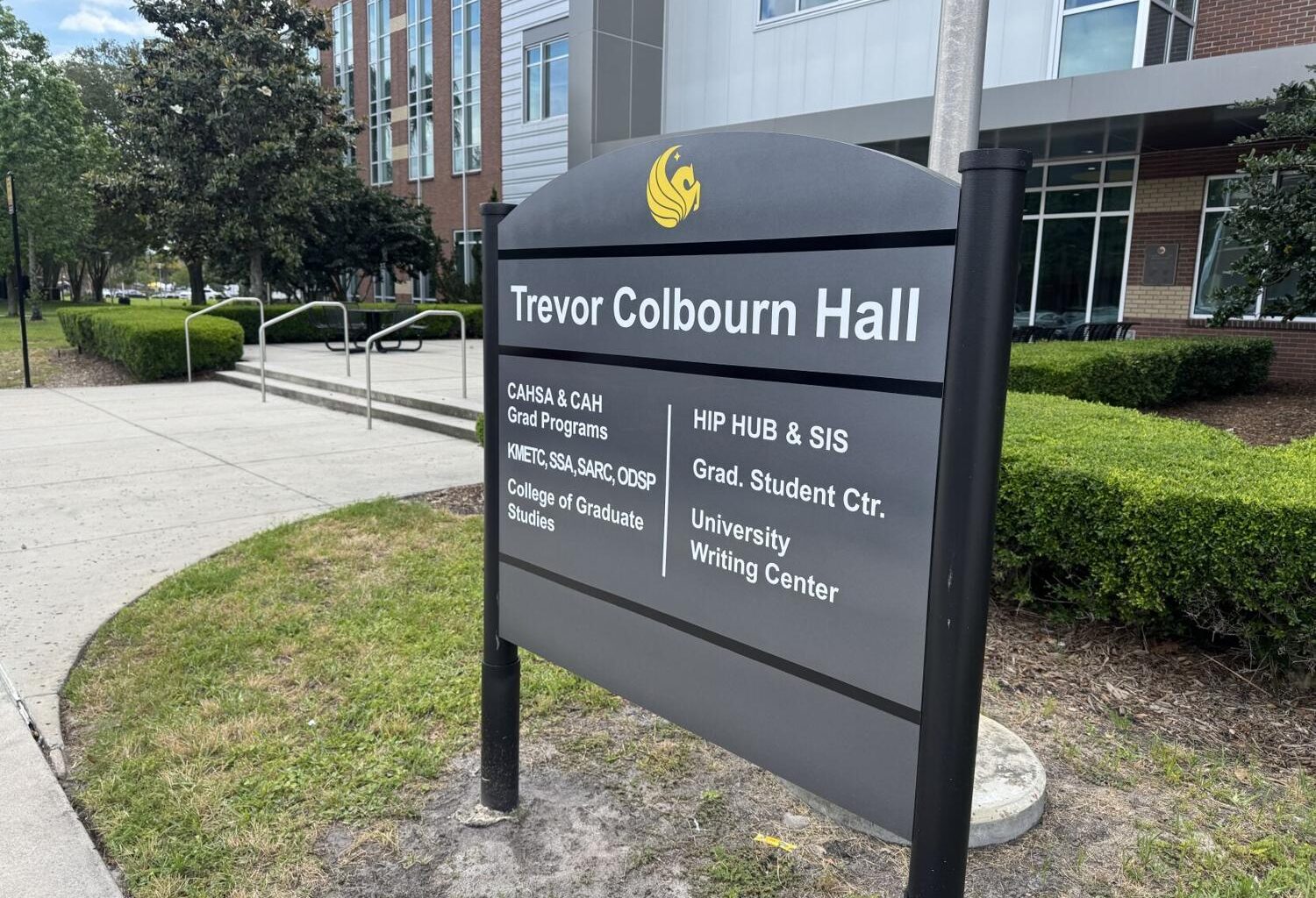

Trevor Colbourn Hall is the hub for graduate students, holding many of their resources. It serves students across disciplines, reflecting the university’s broader growth in enrollment, research activity, and national recognition of its graduate programs.
Leah Judah
Graduate enrollment at UCF has returned to pre-pandemic levels and is once again climbing, signaling a broader upward trajectory across programs that have gained national attention for research output, workforce alignment and student demand.
According to UCF Analytics, total graduate enrollment — including master’s and doctoral students — grew from 8,066 in fall 2016 to 9,555 in fall 2025, marking nearly a 19% increase over the past decade. The data shows steady growth through 2019, a pandemic-era dip beginning in 2020, and a gradual recovery that has returned enrollment to its highest recorded level in the dataset.
Fall 2019 marked a peak of 9,553 students before enrollment dropped to 9,250 in 2020 and continued declining to 8,657 in 2022, according to university analytics. Since then, numbers have steadily rebounded, reaching 9,095 in 2024 and surpassing previous highs in 2025.
That long-term trajectory reflects what Interim Dean of the College of Graduate Studies Dr. John Weishampel described as a reinforcing academic ecosystem built on faculty strength and student quality.
“The better faculty you get, the better students you get, the better students you have, the more productive the faculty,” Weishampel said. “So, you generate this feedback that allows your program to improve over time.”
He described graduate success at UCF as a self-sustaining cycle. “Success breeds success,” he said.
While enrollment dipped during the pandemic years, Weishampel noted the pattern was consistent with national behavior, as students reassessed academic and career paths during widespread uncertainty.
At the state level, trends have been uneven.
Data from the National Student Clearinghouse Research Center shows that graduate enrollment at Florida’s public four-year institutions has increased 12.6% since 2020, indicating a broader post-pandemic recovery. However, more recent figures show a slight slowdown, with Florida experiencing a 1.6% decrease in graduate enrollment from 2024 to 2025, suggesting that growth is not uniform across years or institutions.
Nationally, public four-year institutions saw a 4.6% increase in graduate enrollment from fall 2019 to fall 2020, according to the National Student Clearinghouse Research Center, highlighting the early pandemic-era surge in graduate education.
One factor shaping UCF’s resilience during this period is its long-standing approach to blended learning. According to a Deloitte analysis of post-pandemic higher education trends, institutions that had already integrated hybrid learning models were better positioned to adapt to major disruptions.
The report notes a hybrid approach “will allow institutions to become more resilient during future disruptions, whether pandemics or natural disasters; help institutional leaders better manage costs and pedagogical demands; and, ultimately, become more student-centered.”
While many universities rapidly shifted online during COVID-19, UCF had already been operating with blended learning structures for more than two decades, allowing for a smoother transition and recovery compared to many peer institutions.
That institutional adaptability is now reflected in program-level performance and national rankings.
One of the most visible examples is the Doctor of Nursing Practice program, which rose 34 spots in national rankings to No. 37 in 2026, according to U.S. News & World Report.
In a joint statement provided via email, Norma E. Conner, executive associate dean of the College of Nursing, and Jessica Simmons, assistant dean of students, said the program’s rise reflects sustained investment in faculty expertise, research, and clinical training.
“UCF has increased the number of high-quality full-time nursing faculty experts, has increased nursing research funding and continues to gain national exposure and recognition among our peers,” they wrote in their emailed statement.
The statement also highlighted hands-on training as a defining feature of the program.
“Students gain valuable hands-on learning with innovative technologies in UCF’s STIM Center and in healthcare settings across Central Florida alongside expert preceptors.”
They attributed the program’s recent ranking increase to continued institutional investment.
“This year’s results are reflective of UCF’s continued investment in academic rigor, faculty expertise, and hands-on clinical training and interprofessional collaboration to address the nation’s growing need for nurse practitioners.”
That growth aligns with broader workforce projections. The U.S. Bureau of Labor Statistics estimates a 46% increase in nurse practitioner jobs between 2023 and 2033, reinforcing the program’s expansion and national relevance.
They also noted that rising demand has directly impacted capacity.
“In the last five years, as the college has added faculty experts, we have doubled the seats available in these programs,” they wrote.
Across disciplines, students describe a graduate environment that is increasingly competitive, research-driven and professionally connected.
Brandon Cominsky, a graduate student in communications who also works as a NASA Lunar VISE communications specialist, said the academic environment has shifted noticeably toward higher performance expectations.
“Graduate students, because of where they’re working in the program and how their program ranks nationally, they want to contribute to that scientific research or overall research and contribute more to their program,” he said.
He added that internal competition among graduate students has intensified.
“It was a pretty low stakes environment but now you’re seeing graduate students who are being more competitive internally and they’re wanting to beat out their peers by getting published or getting the opportunity to go to conferences.”
He also emphasized the program’s structure and mentorship.
“The communication program here at UCF feels very natural and fairly tailored,” Cominsky said. “The professors really want you to be your best, and they’re always connecting you to opportunities.”
Kenneth Tremblay, doctoral candidate in Integrative Anthropological Sciences, describes a similar experience tied to applied research and professional preparation.
“One of the main strengths of the Ph.D. program is its focus on research methods, which prepare students for jobs in many different fields,” Tremblay said. “So, I feel confident in my ability to find a job that is both interesting and rewarding once I graduate.”
Weishampel also pointed to growth in the broader research ecosystem, including postdoctoral scholars, which has increased from roughly 50 a decade ago to nearly 300 today.
Looking forward, administrators and faculty say emerging technologies and global demand will continue shaping graduate education.
Weishampel noted that artificial intelligence is becoming embedded across disciplines. “I can find AI in every program if I really put my mind to it,” he said.
He also emphasized that international student participation remains a key component of graduate research capacity, particularly in STEM and space-related fields.
“A lot of the students, the majority of them are involved in the space industry around here,” he said. “But it will be internationally attractive, as space is not limited to the U.S.”
Despite fluctuations in enrollment and external pressures, including visa-related restrictions affecting international students, Weishampel said the long-term outlook remains positive.
As graduate enrollment returns to peak levels and programs continue to rise in national rankings, UCF’s College of Graduate Studies is positioning itself within a broader transformation in higher education, one defined by workforce alignment, research expansion, and increasingly competitive academic environments.
“Some of the rise in our programs really relates to the creativity of our faculty, who can see the future a little bit too,” Weishampel said.