
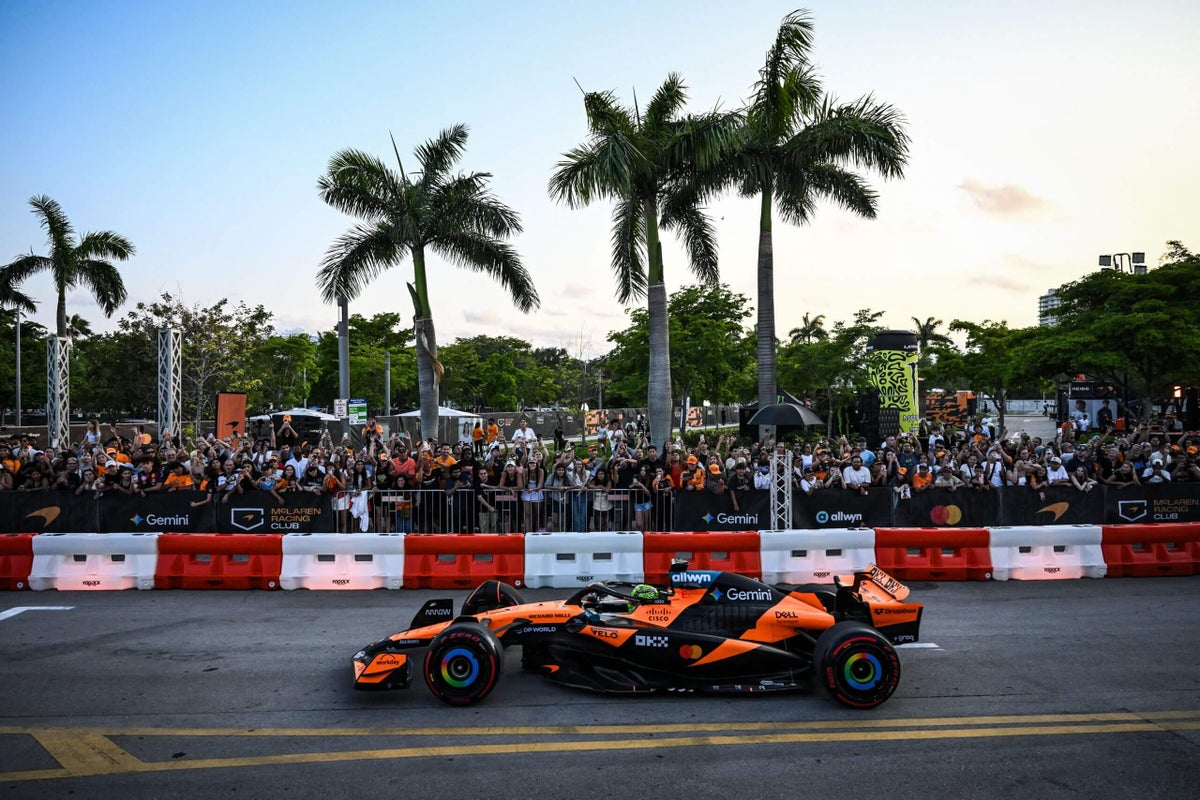
The Athletic has live coverage of the 2026 F1 Miami Grand Prix.
Formula 1’s long-awaited return this weekend in Miami after a five-week break will bring a shift compared to the opening three races of the 2026 season.
Not only have teams been working hard on their car upgrades to improve performance, but some rulebook tweaks are set to impact the on-track spectacle.
Last week, the FIA announced a set of changes for Miami that chiefly focused on the electrical energy delivered by the all-new engines for 2026. These followed three meetings involving technical staff and team principals from the entire grid, as well as discussions with a handful of drivers.
The cars for 2026 have proven controversial. Max Verstappen, Fernando Alonso and Lando Norris have been among the most vocal critics, with Verstappen, the four-time world champion, calling them “anti-racing.” His frustrations have only added to thoughts of walking away from F1 at the end of this year.
But the hope from the F1 organization (FOM), the FIA, and all 11 teams is that these tweaks will soothe some of these concerns starting in Miami.
“We are quite certain these changes will be a step in the right direction, and a reasonably significant one,” Nikolas Tombazis, the FIA’s single-seater director, told reporters this week.
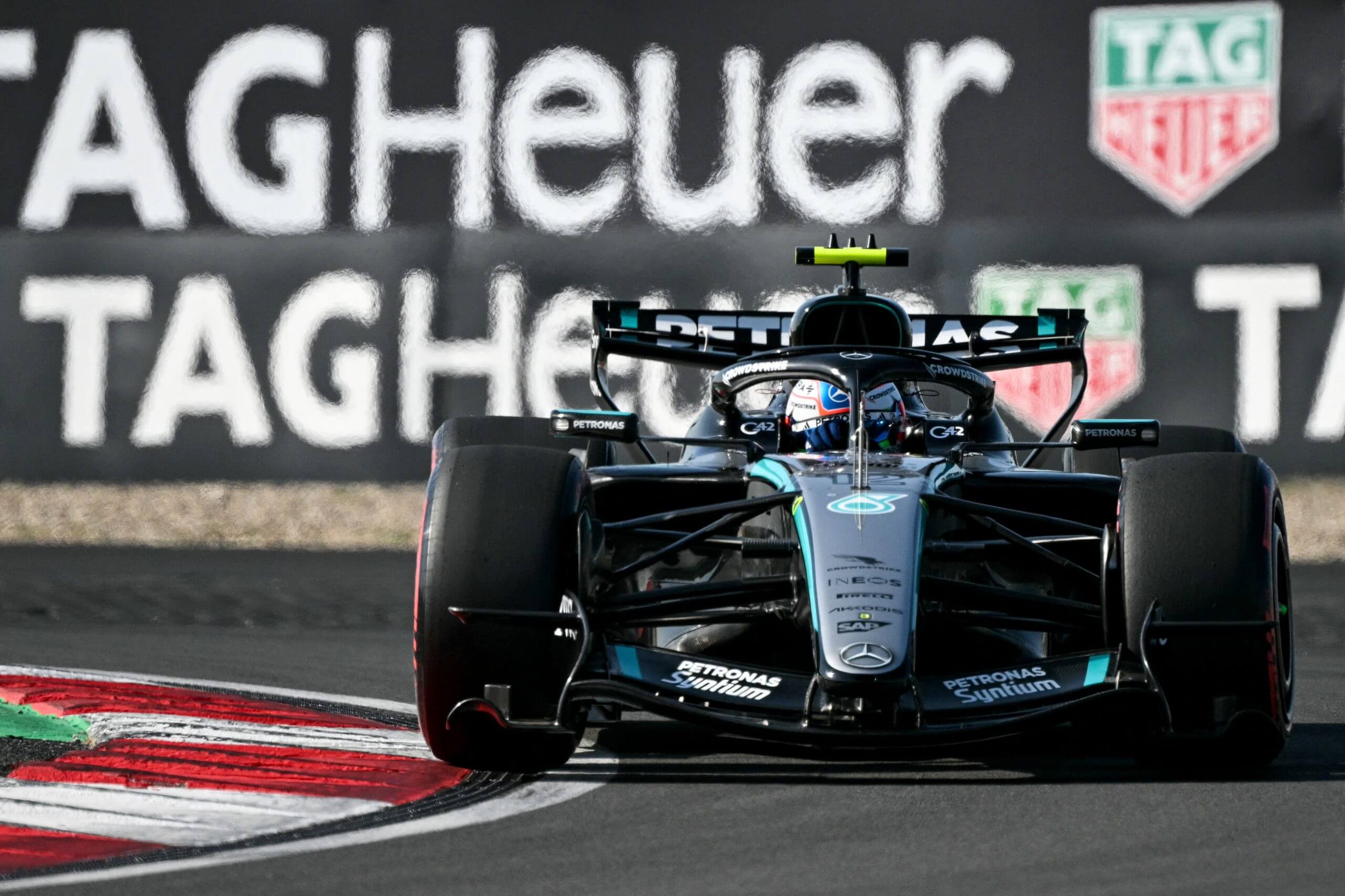
Mercedes driver Kimi Antonelli drives during qualifying ahead of the Chinese Grand Prix on March 14, 2026 (Greg Baker / AFP via Getty Images)
What’s changing in qualifying?
There was broad agreement that qualifying needed to be addressed after drivers experienced huge speed dips while recharging their batteries over a single lap to use the energy on the straights. For many, it took away the flat-out element through corners and made single flying laps less on the limit.
“We felt drivers had to do some slightly unintuitive or unnatural things to extract the best performance out of qualifying,” said Tombazis. “They couldn’t go flat out all the time.”
Drivers would recharge the batteries either by lifting off the throttle and coasting into the corners, or by ‘superclipping,’ where the battery automatically recharged and caused a drop in speed despite being at full throttle. By making superclipping more powerful and capping the recharge level, drivers should need to spend less time backing off in this way.
Mark Temple, McLaren’s technical director for performance, told reporters last week that qualifying should “feel much more natural to the drivers” by reducing or even removing the lift and coast phase, meaning they can stay at full throttle before hitting the brakes into corners.
Using Australia’s Albert Park as an example, Temple presented a graph outlining the anticipated impact of the Miami tweaks, with the green line showing reduced speed drop-offs at certain points on the track.
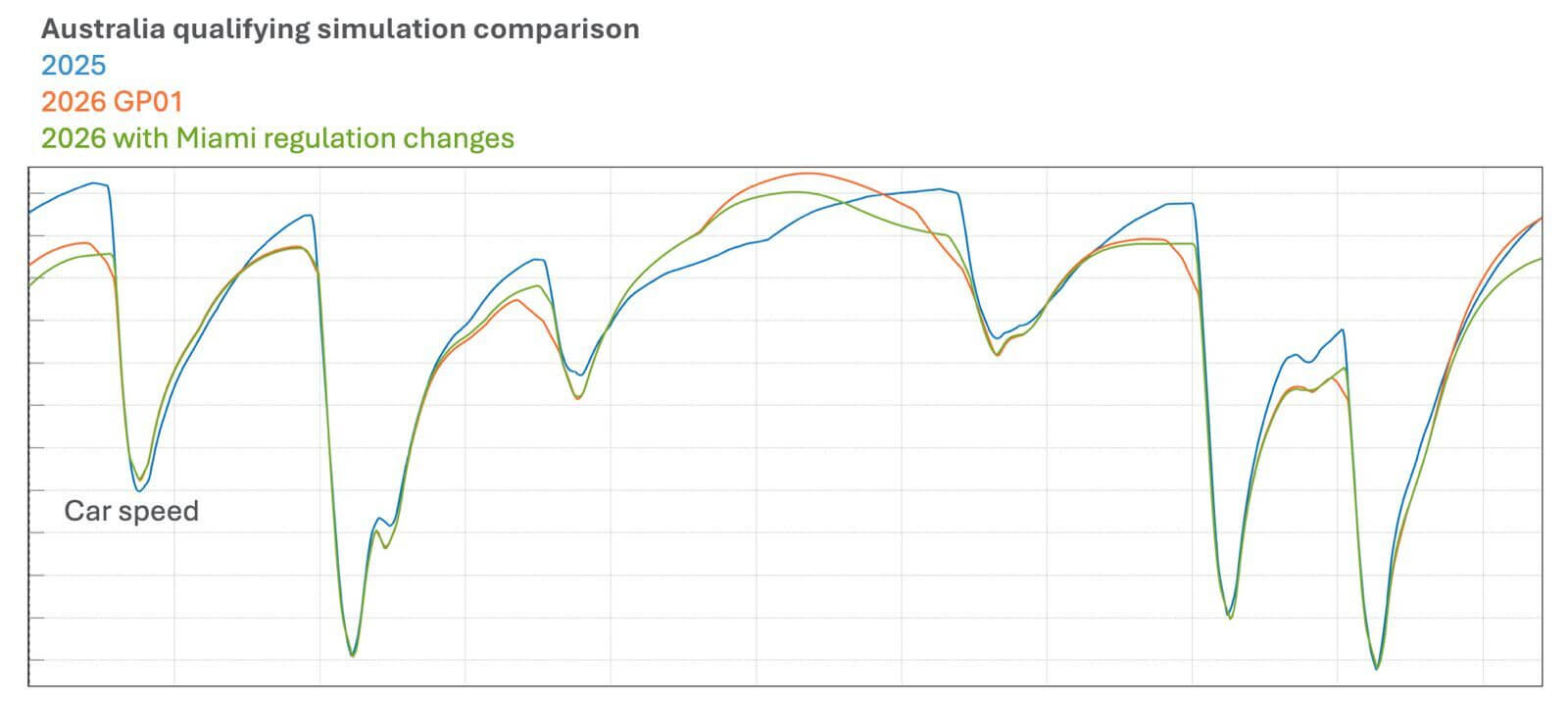
McLaren’s data shows the Miami regulation tweaks (green) smoothing out the 2026 car’s jarring speed drops during qualifying (via McLaren)
“There’s also some other more complicated rules that are around the energy deployment and some of the intricacies of the way the engines control, that just simplify certain things for the driver,” Temple added, saying there’d be less of a need for drivers to sit at ‘part throttle’ just before starting a lap to ensure the energy kicks in at the right time.
Temple estimated the lap time difference as a result of the changes in qualifying would be “relatively small, a few tenths (of a second), if that” due to the loss in how much of the battery can be used on the straights.
If qualifying laps become more about driving to the absolute limit of what the cars can do, it should again bring out the very best in the drivers and better separate the good from the great, especially by adding to the challenge of braking as late as possible.
McLaren team principal Andrea Stella said that while “the best drivers will always have the opportunity to prevail,” he thought “the changes to the regulation, if anything, will help as intended this kind of aim.”
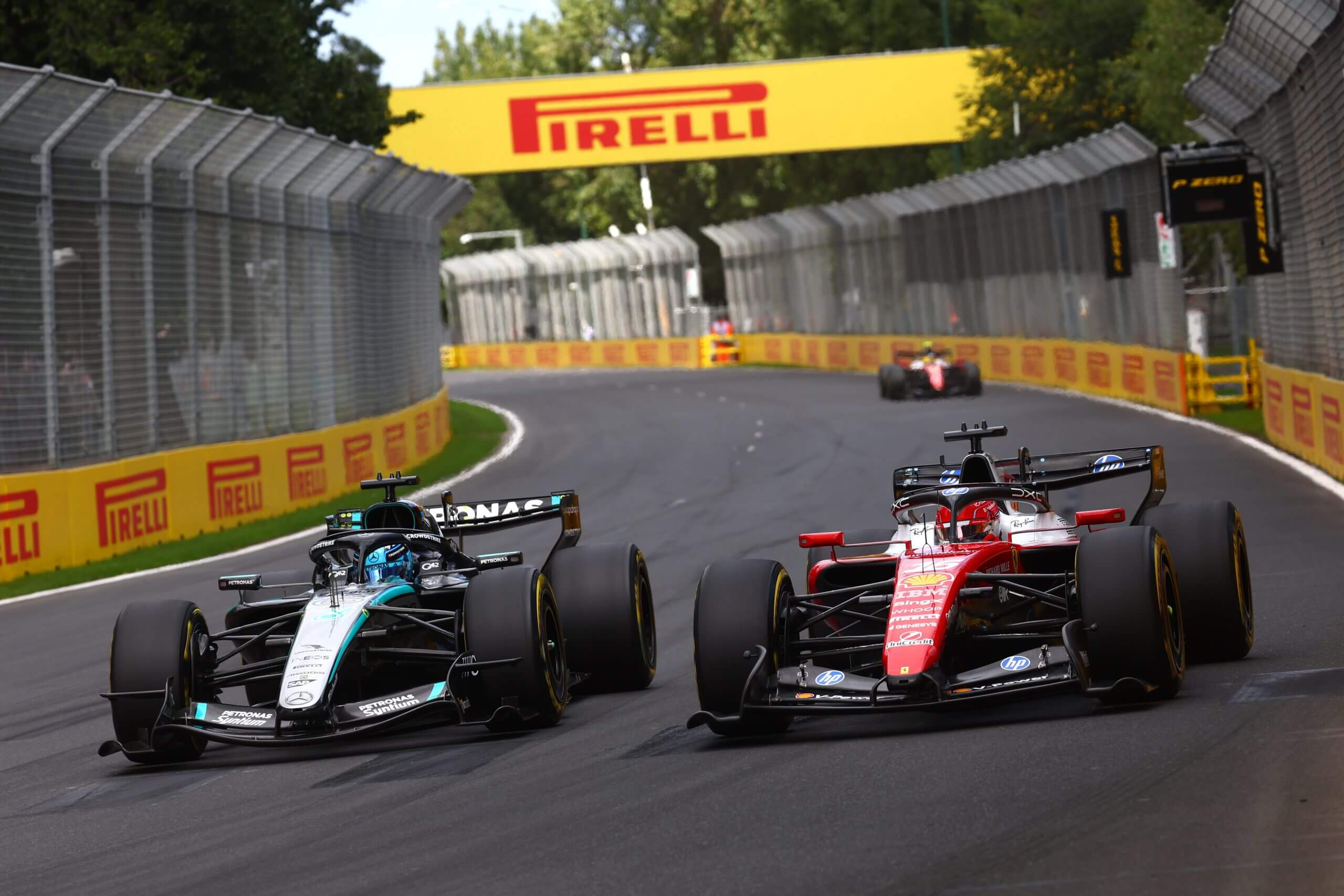
George Russell and Charles Leclerc battle for the lead during the Australian Grand Prix on March 08, 2026 (Joe Portlock / Getty Images)
Will overtaking dramatically change?
One thing Tombazis said all parties around the table agreed to, through talks, was not to “throw the baby away with the bathwater, as they say,” and to ensure the good of the new cars was preserved; i.e., the racing on Sunday.
There have been a handful of exciting wheel-to-wheel battles already this season. After spending much of the Chinese Grand Prix battling side-by-side with Ferrari teammate Charles Leclerc, Lewis Hamilton, the seven-time world champion, declared it “the best racing that I’ve ever experienced in Formula 1.” The smaller size and reduced weight of the new cars have helped encourage this.
Yet there has also been criticism over the quality and authenticity of overtaking through the ‘yo-yo’ battles, seen most clearly in the opening stages of the Australian Grand Prix. Drivers who use more energy to overtake a car ahead are then left exposed to be re-passed. In Japan, Lando Norris was compromised when the battery kicked in unexpectedly, leading him to pass Hamilton’s Ferrari without intending to, only to be overtaken back.
According to Tombazis, the main impact of overtaking is a focus on closing speed differences between cars, an issue highlighted by Ollie Bearman’s 191mph crash at Suzuka while avoiding Franco Colapinto’s Alpine.
To address this, the Boost — the extra battery power used to overtake, which Bearman was using at the time of his crash at Suzuka — has been capped to prevent sudden speed differentials. At the same time, new limits have been set on how much battery power is used in certain parts of the lap, again to stop the massive differences.
“We believe that the measures we’ve taken to address the level of boost and the level of power in certain parts of the circuit goes to some extent towards addressing this issue,” said Tombazis, referring to the moments of unintended overtaking.
Temple had prepared another graph — this time simulating a race lap in Miami — to show how the energy tweaks would affect the race. Because the difference between using Boost and not is smaller and the increase in speed is more gradual, overtaking should be slightly more difficult.
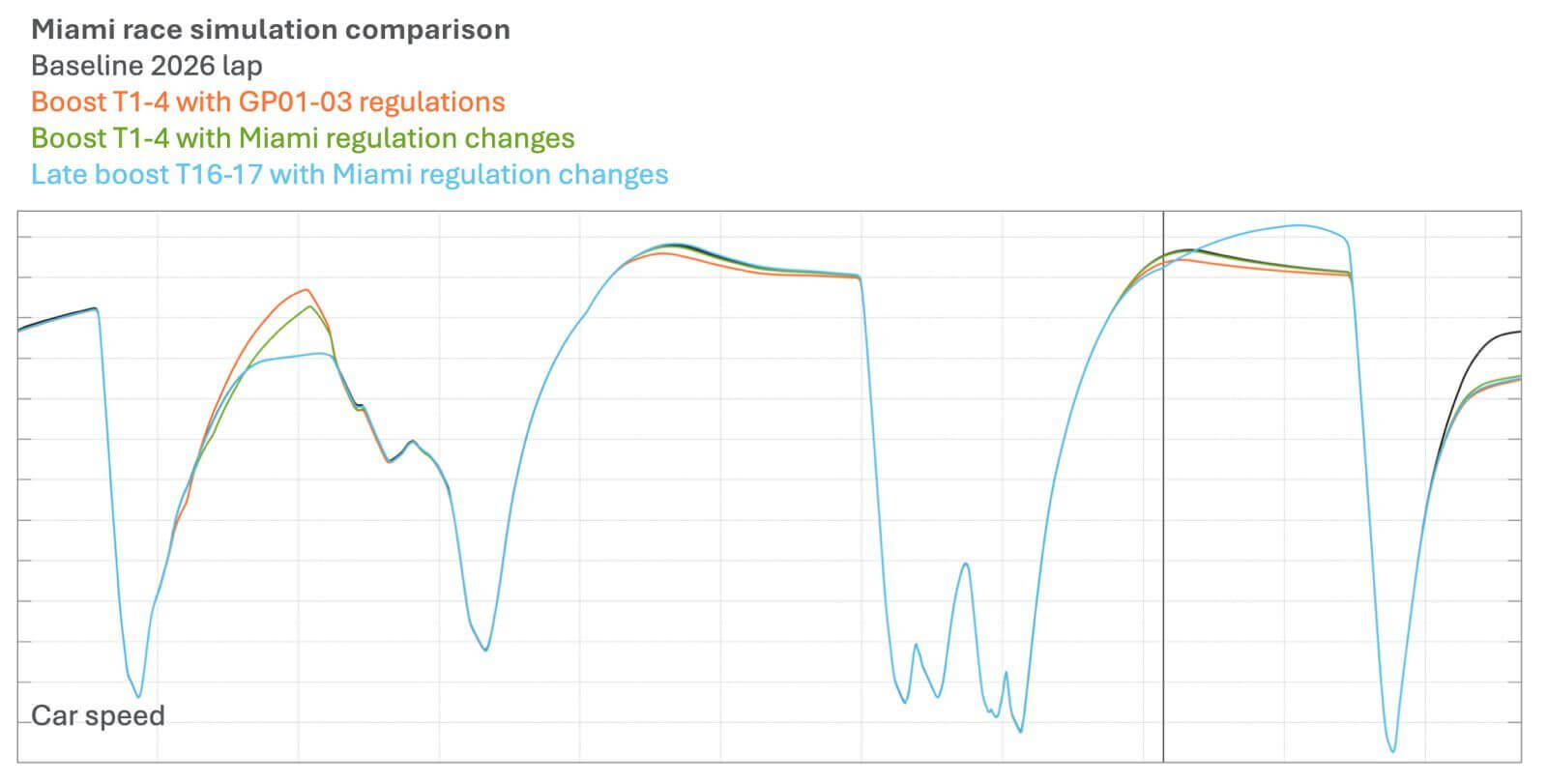
Per McLaren’s data, the revised rules narrow the Boost advantage in races, making overtaking harder but more strategic (via McLaren)
“I think we will see less chance of maybe opportunistic overtakes in some of the more unusual places, but I think that’s the right compromise for safety,” said Temple. Although there was a possibility of a driver being re-passed on back-to-back straights, he thought drivers would have to be more tactical from now on.
“It forces a little bit more of a strategic element to overtaking,” Temple said. “The driver has to think more, and it will reward the drivers, as Andrea said, who are thinking about and learning from and optimizing what they’re doing.”
Avoiding disaster starts
Another area the FIA addressed with its tweaks related to the start procedure. Pulling away from the grid has become much harder for drivers in 2026 as they can no longer rely on the battery until they reach 31mph. Verstappen has endured a couple of sluggish starts, while Colapinto narrowly avoided Liam Lawson off the line in Australia after the Racing Bulls car struggled to get away.
Now the FIA will test a “low power start detection” system in Miami that will measure cars experiencing low acceleration and allow the battery to kick in automatically, reducing the risk of cars stalling off the line. Tombazis said the FIA wants “to do a few more trial runs before we introduce it at the start of the race,” which will take place in practice.
But Tombazis made clear there’d be no sporting advantage to be gained by relying on the battery. “This is not supposed to be a mechanism whereby people would be, let’s say, even tempted to do it on purpose, if you know what I mean, to come up better off,” he said. “So what this would convert is a disastrous start to a bad one. It would not convert a bad one to a good one.”
As a possible deterrent, the FIA floated the idea of requiring any driver who used the system to complete a drive-through penalty at the end of Lap 1. Still, teams pushed back, saying they would already be penalized enough by the slow start.
“If we see that for whatever reason we’ve missed something and people started using it for advantage, then we would of course intervene,” Tombazis said. “But we don’t think that’s the case.”
Will more changes follow?
If the tweaks to the rules go the way those involved in the many weeks of talks and reviews intended, then we should see more flat-out qualifying and less sporadic ‘yo-yo’ overtaking in the races.
But the approach to the rules through these talks — to paraphrase Mercedes boss Toto Wolff, using a scalpel and not a baseball bat — is likely to persist through the coming weeks and months. If criticism persists and there is room for further refinement, it will, of course, be discussed and evaluated.
“Whether there will be enough (change) or whether we will need to take an extra step at some point, that is something we’re going to assess over the next few races,” said Tombazis. “We are open to continuing this discussion. We clearly engage with the teams, with FOM, with the drivers. We also listen to the fans. I think all of that put together is what helps us form our strategy.”
Stella said that F1 had to “remain quite open” in observing the impact of the changes in Miami and whether further tweaks are needed.
“We should have the openness and the proactivity to study this further improvement, and put them in place,” he said.