
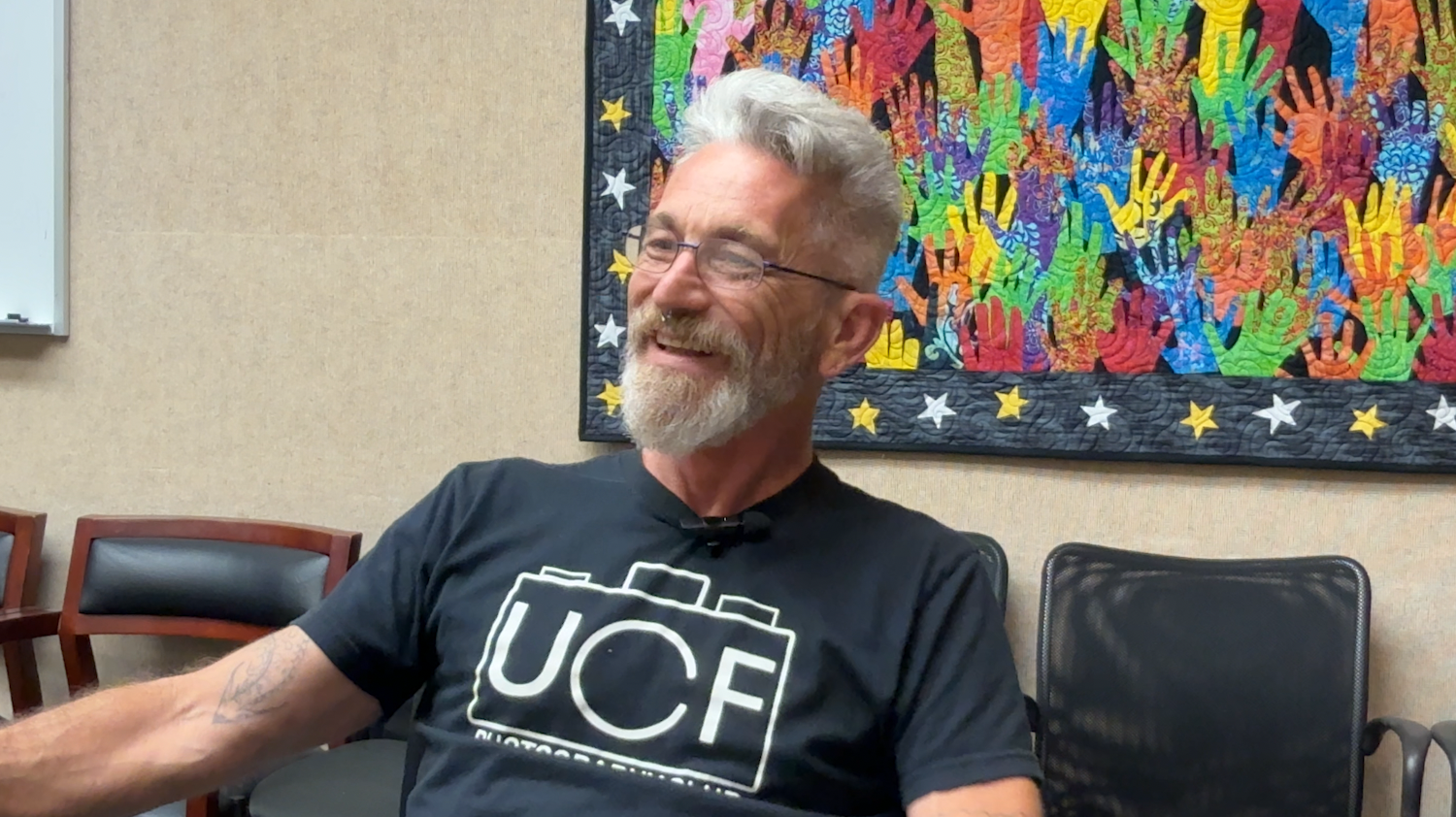

Jason Fronczek, machine shop manager for UCF’s School of Visual Arts and Design, explains his layered history with the university application process. As someone who is formerly incarcerated, he went through the process three times: first for an undergraduate degree, then a master’s, and eventually to teach.
Claire Macchiarola
For an estimated 70 million Americans, a criminal record is a shadow that follows every job interview, housing application and attempt at higher education.
At the University of Central Florida, that journey is governed by a “Non-Academic Admissions Clearance” process, or a mandatory review for any applicant who discloses a prior criminal record, pending charges or educational misconduct.
The mandate is rooted in Florida Board of Governors Regulation 6.001, which grants state universities the authority to deny admission if it is deemed in the “best interest of the university.”
At UCF, checking “yes” to disclosure questions triggers an automatic referral to the Office of Student Rights and Responsibilities.
According to university policy, the subsequent investigation may include OSRR officials contacting external parties, such as parole officers, prison wardens or officials from previous schools, to evaluate an applicant’s past behavior. In some cases, applicants are requested to participate in an interview to discuss the incident and any subsequent history.
Jason Fronczek, machine shop manager at UCF’s School of Visual Arts and Design, spent five years in prison before finding his way to campus to receive his bachelor’s and master’s degrees — and then began teaching at his alma mater.
Alongside other advocates, he has spent years petitioning the university to “ban the box,” arguing that the requirement acts as a significant psychological hurdle.
“I think the most important thing is to be brave. Claim it, check the box,” Fronczek said. “But our argument has always been: What about the people that stop there? How many students did we lose because that process is intimidating?”
The university maintains that the process is a routine safeguard rather than a barrier, often citing that the vast majority of applicants who disclose a record are eventually cleared.
Advocates argue the data does not track “application desertion.” This occurs when qualified individuals halt their application upon encountering the disclosure requirement and the prospect of a background investigation. Fronczek believes simply seeing the disclosure requirement can turn prospective students away.
The OSRR review concludes with one of three outcomes: cleared for standard admission, denied or “cleared with probation.” Students in the latter category are admitted, but placed on disciplinary probation for a set number of semesters or the duration of their enrollment.
Unlike academic admissions decisions, an OSRR recommendation of “not cleared” carries no formal path for appeal. If the executive director of OSRR deems a student a “safeguard” risk, the denial is final.
Walter Dunn, statewide coordinator for the Florida Coalition for Higher Education in Prison, displays his daily reminders and goals in his office inside the John C. Hitt Library. Formerly incarcerated and wrongfully convicted, he always tries to keep his eyes on the prize.
Claire Macchiarola
Walter Dunn, a statewide coordinator for UCF’s Florida Coalition for Higher Education in Prison, understands the weight of this scrutiny. Dunn spent nearly 13 years in state prison following a wrongful conviction. Today, he works for the same institution that requires disclosures he believes can foster unintended bias.
“We’ve got to change the status quo,” Dunn said. “We’ve got to rewrite history and start adding people who can add to the education, add to the discussion, by giving them a job.”
Dunn argued that the presence of justice-impacted employees and students provides an essential perspective. He noted that the requirement to disclose can often feel like giving an institution “a piece of evidence” to justify a denial before a candidate’s qualifications are even considered.
“True opportunity comes when we can sit down like people and discuss the job,” Dunn said. “Treat them like everybody else, but at least give them opportunities.”
While the university maintains that the process is necessary to identify potential risks, Fronczek and Dunn represent a growing number of Knights who argue that lived experience is a campus asset. For those currently navigating the application process, Fronczek’s advice is born of the current policy’s reality.
“Right now, you’re fighting for your life,” Fronczek said. “Just go for it.”