
UCF students and healthcare providers prepare for the impact of Florida’s SB 844, a new law mandating specialized training to improve pain management and care for sickle cell patients. This package aired in the May 1 Newscast, anchored by Edgar Rodriguez.
Claire Macchiarola
The sun reflects off the glass of the Student Union as thousands of students navigate the winding paths of UCF. Among the students walking to class, one of them often has to fight an invisible battle within her body.
You would never know her blood cells are sickled, crescent shapes that occasionally become stuck in the narrowest vessels of her heart and limbs. You wouldn’t know when junior visual communication major with a minor in event management, Ezinaye Ibiam, is in a pain crisis, because she still has to move through life as normal, and her pain is invisible.
“I’m not a big crier. I don’t really do stuff like that,” Ibiam said. “But sometimes, I have to, like, bring my mask down and really let them feel how much pain I’m in.”

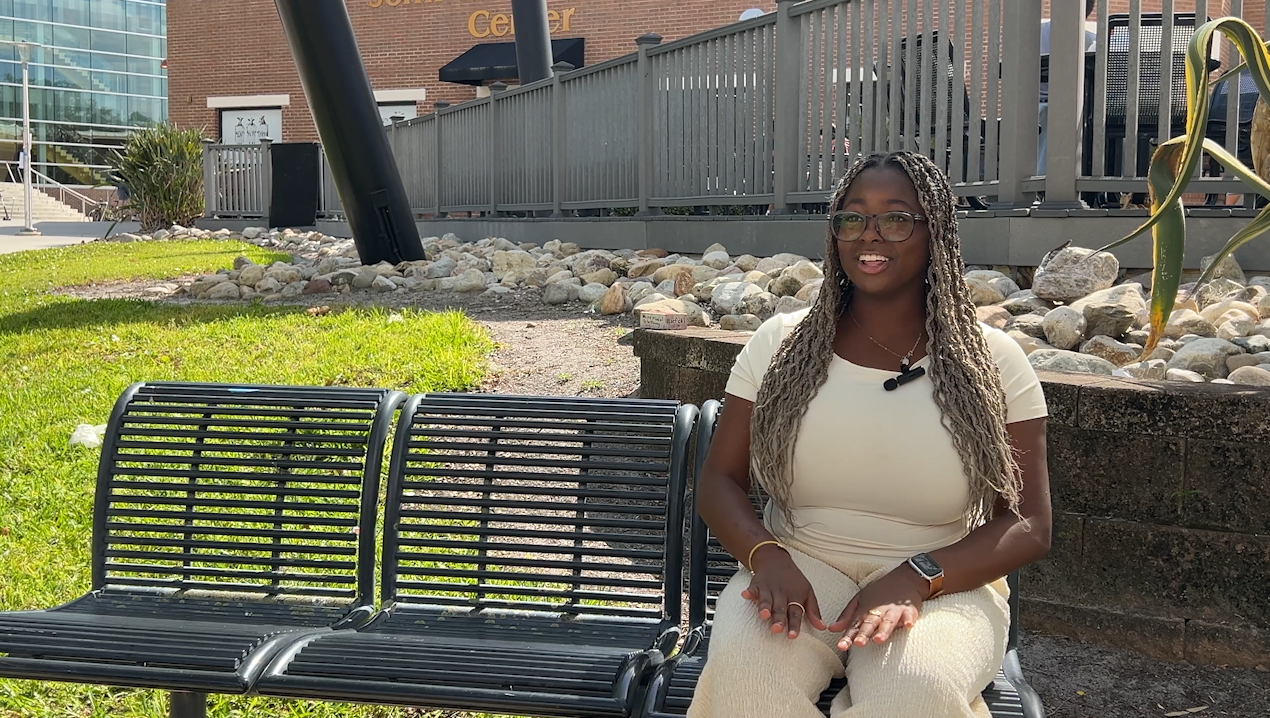
Junior visual communication major, Ezinaye Ibiam, experiences the challenges of navigating the healthcare system while living with sickle cell disease. A new Florida mandate, SB 844, aims to standardize pain management training for medical professionals, a move Ibiam says is vital for patients whose symptoms are often unseen.
Claire Macchiarola
Sickle cell disease is an inherited blood disorder where atypical hemoglobin molecules distort red blood cells into those rigid crescents. According to the National Institute of Health, this reduces oxygen flow and causes complications ranging from anemia to strokes.
It is a global struggle, affecting an estimated 7.74 million people worldwide. The impact is particularly acute in Florida, which has the highest number of sickle cell cases in the United States, with more than 14,000 individuals identified in state data.
While Florida is the national epicenter of the sickle cell crisis, Central and South Florida are verified regional “hotspots” for the disease. For the thousands of residents and students like Ibiam navigating this landscape, the physical pain is often compounded by a medical system that has historically lacked standardized training in SCD management.
However, a new state law, Florida Senate Bill 844, aims to bridge this gap by mandating specialized continuing education for healthcare providers, potentially shifting the standard of care on campus and beyond.
The need for legislative intervention is underscored by the state’s unique health profile. A Florida Medicaid study reveals that the prevalence rate of SCD in Florida Medicaid is twice the national average, with an average of 7,328 enrollees affected annually. The research highlights that the highest concentration of these patients lives in Central and South Florida, and the population is predominantly young, with a median age of 18, and Black, coming in at 63%.
Because the pain of a “crisis” is invisible, patients can often face a second battle in the emergency room. According to research cited in Florida Senate bill analyses, SCD patients frequently report delayed or inadequate care. National data has shown they may wait significantly longer for pain medication than those with other excruciating conditions, like kidney stones.
According to the 2023 Florida Medicaid Study of Enrollees with Sickle Cell Disease, “geographically, the highest number of Florida Medicaid recipients with SCD lived in Central Florida (AHCA Regions 6 and 7) and South Florida (AHCA Regions 10 and 11).”
Courtesy of Florida Medicaid
Since pain management requires high doses of opioids, patients who know their treatment plans may be labeled as “drug seekers.” Research hosted by the National Institutes of Health quantifies the severity of this crisis, revealing that roughly 48% of patients report being treated as drug seekers in emergency settings. This stigma causes many to avoid the emergency room, with 67% of adults with sickle cell disease reporting that they delay seeking emergency care specifically due to disease-related stigma.
This hesitation is often born from systemic bias within the medical field. Research shows that 63% of nurses incorrectly believe addiction is prevalent among this population, despite opioid misuse rates being no higher than those of other chronic pain groups.
This skepticism even manifests in official records; an NIH-funded study found that clinical notes for sickle cell patients are over twice as likely to contain negative descriptors like “refuse” or “noncompliant” compared to other Black patients, further cementing a barrier between the patient and life-saving care.
Signed into law in March, SB 844 requires allopathic and osteopathic physicians, physician assistants and certain nursing professionals to complete training on evidence-based treatment and pain management protocols. For Dr. Yung Siddiqi, executive director of UCF Student Health Services, this training is a vital tool for the university’s diverse student body.
“I think the idea behind this law is to make sure that we are educated and aware that yes, sickle cell patients are in a lot of pain,” Siddiqi said. “And let’s work together to help manage their symptoms. So that they don’t feel afraid to seek help… our goal is to help you do well here to ensure that you have good ways to succeed at UCF.”
Siddiqi noted that the health center often acts as the primary care source for out-of-town students.
“The ideal thing to do is to control the symptoms… and keep them out of the hospital for all sorts of reasons: costs, reduce missed time from class and work. And making it so that your pain is manageable,” she said.
For Ibiam, the law represents hope for a medical future where her history is understood at first glance. She believes the most significant aspect of SB 844 is that the training is integrated into licensure renewal, ensuring care remains up-to-date.
“I do think the training is good because a lot of people tend to like push sickle cell aside just because it isn’t like a physical thing that you can see… so I do think the training will be good and it being continuous is like the best part about that,” Ibiam said.
By the time the law takes full effect on July 1, Florida’s medical community will be mandated to turn this legislative effort into a new standard of compassionate, evidence-based care.