
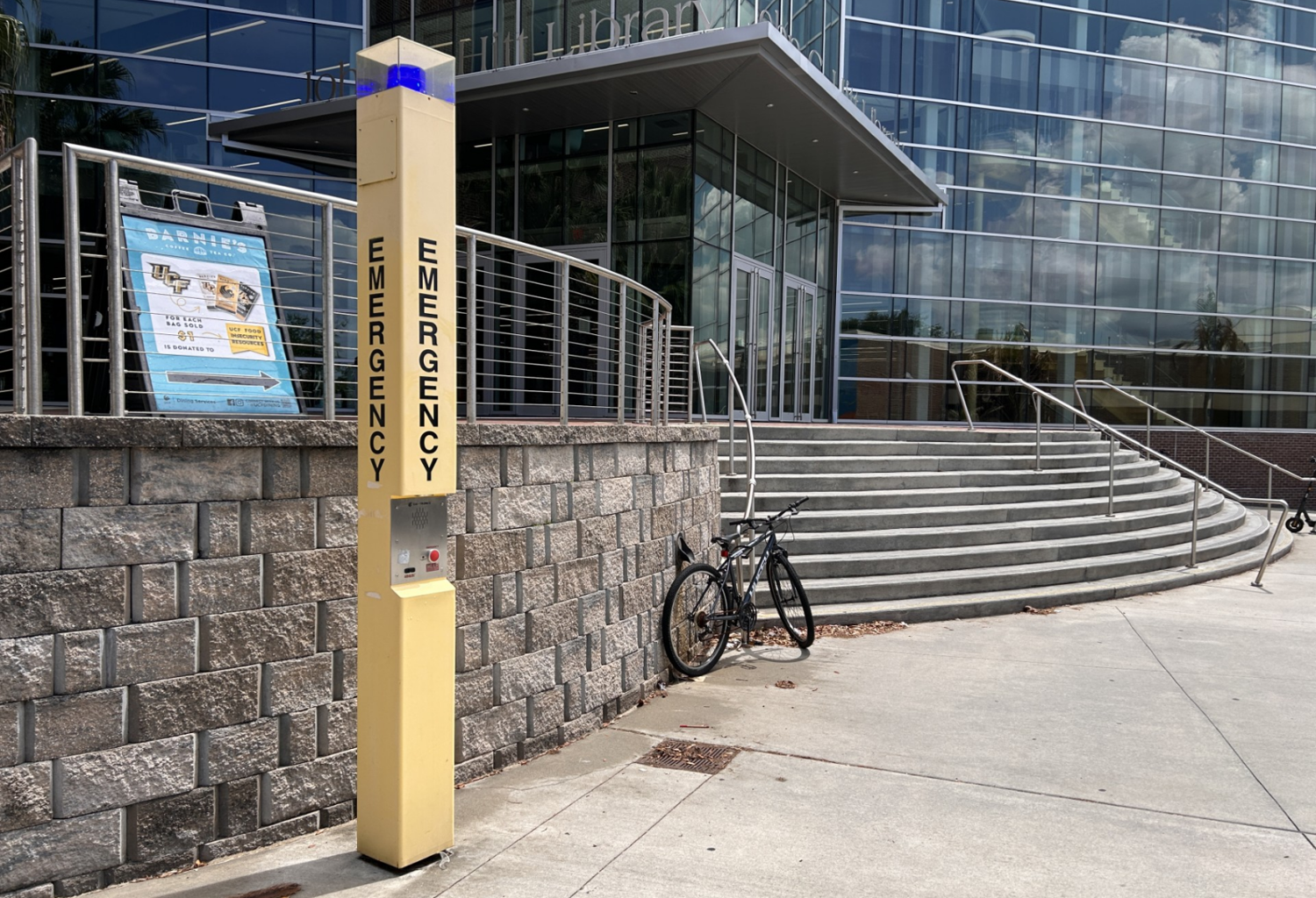

An emergency blue light phone located outside the John C. Hitt Library allows students to immediately connect to a UCF Police Department dispatcher.
Alejandro Romo
For two years, the messages were harmless. By the fall semester of 2024, that changed.
K, an undergrad student at UCF who requested her name be omitted since the police report is still pending, began to dread looking at her phone, as a former friend used Reddit posts and online messages to track and target her. What once felt like a normal connection turned into a source of constant anxiety, exposing a gap between UCF’s official safety statistics and the often unseen reality of technology-facilitated stalking.
Stalking is defined as “a pattern of behavior directed at a specific person that would cause a reasonable person to fear for the person’s safety or the safety of others; or suffer substantial emotional distress,” according to the Stalking Prevention, Awareness, & Resource Center.
This definition of stalking is similar to the university’s definition, according to its Annual Security & Fire Safety Report. According to UCF’s Daily Crime Log, in 2026, there were 12 documented reports of stalking on the main campus.
UCF has seen several cases of stalking throughout the years, with 47 in the 2022 academic year, 43 in 2023, 33 in 2024, and 26 in 2025, as stated in the annual safety report and confirmed by Amanda Sellers, public safety communications manager.
While physical safety measures like Victim Services and the emergency blue light phones are established fixtures on campus, the rise of digital-based threats presents a different set of challenges for student protection.
Nolan Enghardt, freshman mechanical engineering major, believes that these measures, particularly the blue-light phones, could bring students a false sense of comfort in a digital world.
“You can never really know who’s on your page, who sees what and what they’re doing with it,” Enghardt said. “As much as the lights and the cameras clearly help with safety, I think in a situation where a lot of it was digital, I think in that sense, it is a little bit of false security.”
UCF Victim Services is located in the Health Center. The service offers students round-the-clock, no-cost, confidential assistance if impacted by crime or harm, such as sexual assault, stalking or relationship violence.
Courtesy of UCF
While the crime log shows 11 documented reports of stalking on campus, the director of Victim Services, Dr. Laura Valle, said that the center sees higher numbers because many students choose confidential support over a police report.
“We are confidential, so someone can come and report their victimization to us and not report to the police,” Valle said. “I will say that we have higher numbers than law enforcement.”
“What is nice to see, though,” Valle continued, “Is that people are feeling ready and confident to report their incident to police so that they can start the criminal justice process.”
Valle also addressed a common trend in what is seen from modern-day stalking, which is the idea that stalking is more facilitated through technology rather than in person, while that still occurs.
However, modern-day stalking still exists in the same capacity, even online, Valle said.
“Almost all of them are facilitated through technology,” Valle said. “So, every year, as new, different types of technology emerge, we see that people who commit stalking are using different types of online platforms and online methods to stalk their victims.”
Around 80% of victims report being stalked with technology and 41% of undergraduate students have experienced technology-facilitated stalking, according to SPARC.
Among that 41% is K, who experienced the actions of technology-facilitated stalking over the course of two years by a former friend.
Most stalking victims are stalked by someone they know, with 40% being a current or former romantic partner and 42% being an acquaintance, according to SPARC.
Christopher Shemitz, freshman biomedical sciences major, said that the line between stalking and simple pestering is overlooked, allowing for the increase.
“It’s definitely a hard line to draw,” Shemitz said. “A lot of the time it can just be seen as annoying…you’ll complain to your friends about how annoying somebody is or if they won’t leave you alone, but they won’t actually define it as stalking and treat it like stalking.”
K said they had a relationship with a friend that was solely platonic until the acquaintance tried to push for a more romantic relationship.
About a month after K ended the relationship at the start of the fall 2024 term, following repeated pushback over rejection, she began receiving explicit and threatening messages from multiple phone numbers.
The messages included accusations, sexist slurs and threats of violence, which were traced back to impersonated numbers, she said.
“I started getting text messages from all these different numbers, and they were all, like, just explicit of, like, ‘you’re such a [sexist slur], you deserve to die,’” K said. “When I started getting these, I would get at least once a day, sometimes multiple.”
The stalking extended beyond K themselves, even going on to her current partner to spread rumors.
“There was a completely new Instagram that was created,” K said. “That was reaching out to my boyfriend, saying, you know, like, ‘I just want to let you know, like, [K] is cheating on you. Just ask them about it’.”
K said the rumors extended to her parents, with her father also receiving them.
They even detail the usage of social media, Reddit, and how it was used to spread more misinformation under the subreddit, “r/UCF.” Under that subreddit, K’s image was posted to promote suggestive actions toward her that were often explicit.
The number of documented stalking cases on UCF’s main campus against women from 2022 to 2025, according to UCF’s Annual Security and Fire Safety Report.
Alejandro Romo
K said this didn’t affect her sense of safety on campus, due to the nature of the stalking. However, it did increase her anxiety as she wondered who could have seen the posts in a subreddit used by several students at the university.
K reported the actions to the Orlando Police Department and eventually brought it to UCFPD in hopes of catching the stalker, but ran into a dead end when trying to identify them due to the commonality of their name.
While K chose not to utilize the resources provided by the university, she relied heavily on her own support system, like friends and family.
“It was like there was a lot on my plate, I was in school, and it was already just like mentally torturing that I was at a standstill,” K said. “I had a really great support system with me anyway, that I didn’t feel an intense need to use those services.”
Valle says that students who experience a form of stalking like this often feel the situation is too personal to report, leading to the underreporting of such crimes.
She also explained that there are four methods students can undergo if they wish to proceed beyond a confidential hearing.
According to Valle, beyond safety planning, students have four distinct paths for formal action, which can be pursued individually or simultaneously.
Those include reports to law enforcement, seeking a restraining order, pursuing a Title IX case for immediate protections like housing or schedule changes, or going through the Student Conduct office, which can lead to suspension or expulsion.
K offered advice as a victim of technology-facilitated stalking, telling those who have experienced it not to be afraid to talk about it and that students shouldn’t feel ashamed to talk about it.
The shift toward digital stalking means that physical barriers like walls or even blue light emergency phones can only provide an extent of comfort or protection. As digital stalking continues, and the university provides resources for assistance, the burden of seeking justice still largely rests on the victim’s shoulders.