
TALLAHASSEE — Now that the legislative battle is over and Gov. Ron DeSantis has his new congressional map, the fight over Florida’s redistricting efforts is headed to court.
Democrats and voting rights groups have announced plans to file lawsuits challenging the new map as an illegal and unconstitutional gerrymandering based on political considerations — an effort that diluted the voting strength of minority communities.
Their best shot might be to focus on the “cracking” of District 9, a once compact Hispanic majority seat that encompassed Osceola County and part of Orange County and leaned Democrat. It is now represented by Darren Soto, a Kissimmee Democrat of Puerto Rican descent.
That district’s voters were divvied up among five proposed districts, diluting both the Hispanic and Democrat voting strength.
But it’s a long shot if any legal arguments against the map win over a deeply conservative Florida Supreme Court, experts agree. Six of the seven justices were appointed by DeSantis.
Still on Florida’s books are the 16-year-old Fair District amendments, which prohibit discriminating against minority voters and also ban partisan gerrymandering. But the U.S. Supreme Court decision this week in a Louisiana voting case will likely be used to support an argument nullifying those rules.
The high court’s decision narrowed the scope of the 1965 Voting Rights Act, ruling that congressional district boundaries that rely too much on race are unconstitutional. DeSantis and his staff predicted that outcome and claim they drew Florida’s new map without considering race.
“The decision now emboldens DeSantis,” said Bob Jarvis, a law professor at Nova Southeastern University.
Jarvis said doesn’t think the Supreme Court’s ruling nullifies Fair Districts, which Florida voters approved in 2010, but DeSantis and his allies believe it does.
“I suspect that Florida Republicans will ignore Fair Districts, Florida Democrats will argue that Fair Districts is being violated, and the Florida Supreme Court will side with Florida Republicans,” he said.
Time may also be on DeSantis’ side: Candidates must qualify to run for Congress by June 12, and county election supervisors then have to quickly get ballots printed for the Aug. 18 primary, meaning the election will likely take place well before a court could take up a case against the map.
“At least for 2026, this is the map we have,” Jarvis said.
Under pressure from the White House to help keep GOP control of Congress during the 2026 midterms, DeSantis called last summer for a mid-decade redistricting, saying the state needed to adjust for Florida’s rapid population growth since the last map was approved in 2022.
The governor’s staff redrew the map to distribute new voters more evenly across the state, they said.
The map eliminates four Democrat-leaning districts, including Soto’s, and tilts the balance of the Florida delegation even more red. Florida’s current congressional delegation has 20 Republicans and eight Democrats and the new map could shift it to 24 to four.
The Democratic losses are in heavily urbanized Central Florida, Tampa Bay and Southeast Florida, targeting Soto and incumbents Kathy Castor, Jared Moskowitz and Debbie Wasserman Schultz.
The redistribution of voters in Soto’s Central Florida district is the most dramatic change and a textbook example of “cracking,” or splitting up both a minority majority and a party majority, said Matt Isbell, a Democratic consultant and mapmaker who analyzes election results.
And that’s why it might make the best case for overturning the new map, he said,
“That was not only a political decision to crack Democratic votes but also to crack a large Hispanic district and now that’s been destroyed,” Isbell said. “That was a targeted racial minority.”
District 9 goes from a compact district to one that sprawls 120 miles from Orlando International Airport to Moore Haven on the edge of Lake Okeechobee.
The percentage of Hispanic voters drops from over 50% to just 36%.
Soto, who first won election to the district in 2016, plans to run for the reconfigured seat, but political analysts say another win would be a long shot. The district has gone from one that supported Kamala Harris two years ago to one that would likely be an easy win for Trump, they said.
“It violates Fair Districts as political and racial gerrymandering,” Isbell said. And Fair Districts, he said, “is still the law of the land.”
But DeSantis’ office argued that considering race when drawing congressional districts is now unconstitutional, and that Fair Districts shouldn’t be considered.
David Axelman, the governor’s general counsel, said in a memo to lawmakers that they didn’t have to follow Fair Districts because the Supreme Court ruling against racial preferences negates the entire amendment, including any prohibition on partisan considerations.
Mo Jazil, an attorney for the firm Holtzman Vogel who worked on the maps, said Fair Districts requires “race-conscious sorting,” which runs afoul of the U.S. Constitution’s Equal Protection Clause and therefore should be rejected.
Jason Poreda, the DeSantis staff member who drew the maps, told lawmakers that he did not consider race but did take election outcomes into consideration in devising new congressional boundaries that favor the GOP.
Republican leaders in the Legislature who sponsored the new map said they supported the governor’s position while insisting they had not been involved in drawing it.
Rep. Jenna Persons-Mulicka, R-Naples, the House sponsor and an attorney, when asked if she had concerns about the map violating the constitution said, “It is not my job to answer legal constitutional questions or interpret the state or federal constitution.”
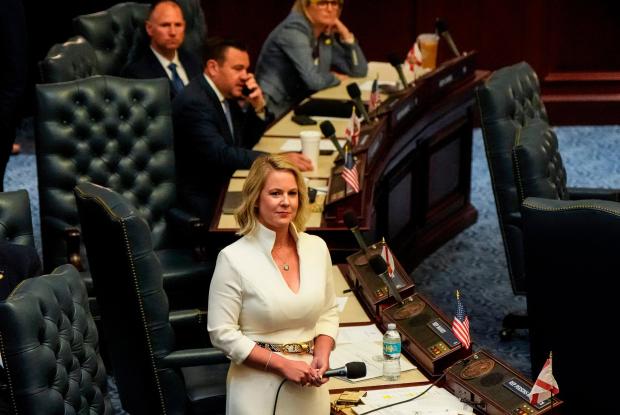 Rep. Jenna Persons-Mulicka, R-Fla., speaks on HB1D, a redistricting bill, during a special session of the Florida Legislature, Wednesday, April 29, 2026, in Tallahassee, Fla. (AP Photo/Mike Stewart)
But Rob Weiner, director of voting rights for the Lawyers Committee, a civil rights organization founded by President John F. Kennedy, said the Supreme Court didn’t invalidate all of the Voting Rights Act and any redistricting that intentionally dilutes or discriminate against minorities is still illegal.
Nor did the nation’s high court invalidate Florida’s ban on political gerrymandering, he said.
“Generally, if you have part of the law that you think is unconstitutional, the rest of the law continues,” Weiner said. “If you strike the racial aspect, it doesn’t mean the rest of the law that says you can’t have partisan gerrymandering is also eliminated.”
Voting rights groups succeeded in overturning a congressional map as unconstitutional in 2012 on the basis it violated Fair Districts. The courts said that map was poisoned by partisan considerations, forcing the Legislature to come up with a new map before the 2016 primary.
But the Florida Supreme Court in 2015 had a 5-2 liberal majority. The current court is very different.
“They have not seemed that warm to the Fair District Amendments and may not enforce them as tightly as the pre-DeSantis Court did when they struck down the U.S. House and State Senate plans prior to the 2016 election,” said Shawn Donahue, a political science professor at the University at Buffalo.
There is no question the new map is invalid, Jarvis said, but he also has no doubt that the current Florida Supreme Court will uphold it, saying lawmakers expressed the will of the people who elected them.
“Florida Democrats can huff and puff,” he said, “but in the end it will do them no good.”