
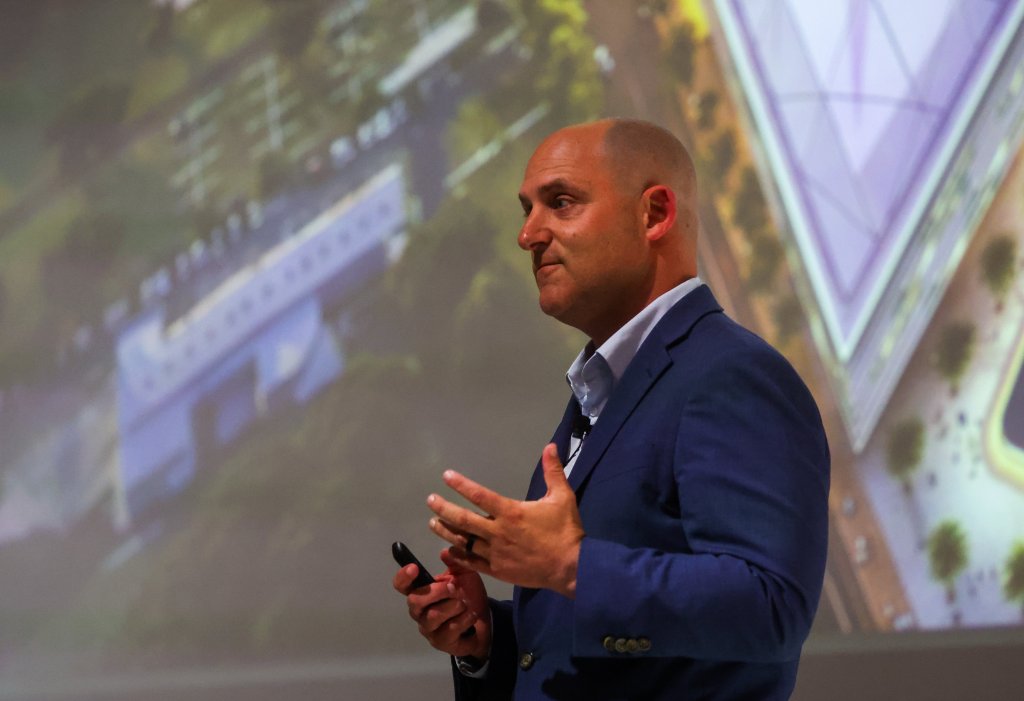
In February, Ken Hagan, the county commissioner who has tried to bring the Tampa Bay Rays to Hillsborough County for nearly two decades, presented the team’s latest, and possibly final, stadium pitch.
Negotiations between the Rays and the county were still in their infancy, but momentum for a deal was mounting. Gov. Ron DeSantis and Rob Manfred, the commissioner of Major League Baseball, had both cheered the team’s plan to stay in Tampa Bay.
The following morning, Hagan, seated at the dais where he has served since 2002, presented a memo outlining how a public stadium subsidy could take shape. It emphasized the deal would steer clear of the main county account that pays for the basics, like police and firefighters, and which largely comes from property taxes.
“From the beginning of these efforts, the intent has been to identify a ballpark financing option that does not use any general revenue funds,” the memo read.
“To be clear,” it read, “no general revenue funding is being considered.”
But the county found the Rays’ proposal leaned too optimistically on a sales tax known as the Community Investment Tax, which most commissioners said in 2024 would not go to a new stadium.
Hillsborough is now floating the possibility of tapping more than $100 million in rainy day money — reserves set aside as a cushion against hard times and that largely come from property tax dollars — as the Rays seek a billion-dollar public contribution to build a $2.3 billion stadium.
Another once-verboten funding source is under consideration.
“General fund revenue is taxpayer money meant for core services,” Commissioner Chris Boles said in a written statement.
“The bar for using those dollars here should be very high.”
Property taxes enter the picture
Tom Fesler, the county’s chief financial administrator, explained the potential shift in funding at a workshop last month.
“Basically, we looked in the couch cushions to see where we could find some revenue,” he said.
But that search, Fesler said, is not as harmless as scraping together enough quarters to buy an ice cream cone.
Hillsborough maintains reserves for budget flexibility, and keeping those reserves strong is recommended, Fesler said. Tapping them, he said, would reduce flexibility.
To what extent and with what consequence depends on the funding source. They are pots the county would likely look to if a hurricane strikes, the economy takes a downturn or state lawmakers roll back property taxes.
“Certain funds and forms of funds are more probable than others, and I think that’s what the public officials are working day and night to figure out, which is: What is the right composition of those ingredients?” said Rays CEO Ken Babby.
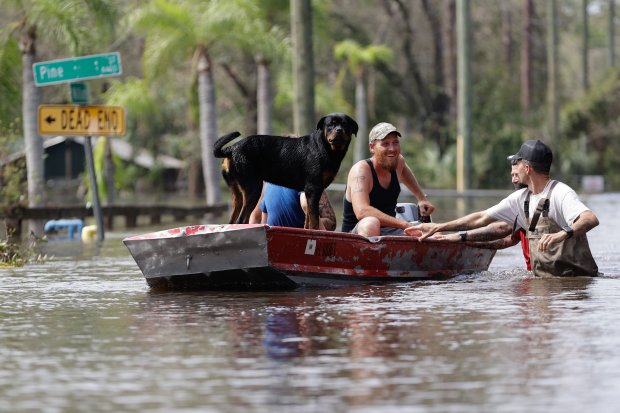 Residents ride in a boat in a neighborhood inundated by historic flooding of the Alafia River caused by Hurricane Milton in 2024. The county could divert funds set aside for natural disasters to the Rays stadium. (Luis Santana/Tampa Bay Times)
“How those ingredients are used, and how much of them, I’m going to leave that for the public officials to comment on,” he said. “But I can tell you there is great appetite and desire from all sides to figure this out.”
Hillsborough sometimes sees projects come in under budget or get scrapped. The county has identified $20 million that could be reallocated to the Rays from such work. About half of the money would come from an accounting system upgrade completed years ago under budget.
Other identified sources that could go to the Rays, however, would limit Hillsborough’s ability to invest elsewhere.
The county’s economic development reserve, which has $24 million, could be suitable for a stadium.
Completely draining the fund would make it unavailable to other projects, like the redevelopment of the Museum of Science & Innovation site. The reserve typically receives about $2 million to $4 million annually, mostly from property taxes. Replenishing it would take years, but a Rays stadium fits its economic development billing.
The county also has a fund it uses to maintain buildings and equipment. Typically, it allocates anywhere from $50,000 to $150,000 per project. Using $10 million of the $18 million it currently holds to support a Rays deal has been presented as an option.
In 2027, the county estimates it will have $35 million that is not yet spoken for and can be put to one-year expenses. Commissioners typically vie to prop up pet projects. Another $10 million for the Rays from this fund, primarily supported by property taxes, is on the table.
Potentially most problematic is the use of two pools that could be pivotal in the future.
Hillsborough receives a share of Florida’s 6% sales tax. This county reserve of $91 million grows by about 2.7% annually. The framework proposes allotting $20 million of it to the Rays.
At DeSantis’ urging, lawmakers may sharply curb local governments’ property tax revenue — likely teeing up a heavier reliance on this reserve.
The threat of storms looms, too. In the wake of hurricanes Helene and Milton, Hillsborough approved the use of $100 million from its disaster reserves. The account, which can be replenished as needed with property tax dollars and federal emergency money, stands at $116 million.
The proposed framework says $20 million from this fund could go to a stadium. Its construction could give Hillsborough another shelter or emergency staging center in the event of a natural disaster, but whether it qualifies for disaster funding is sure to be a topic of debate.
A pivot away from lofty sales tax projections
Early debate about how to make a financial framework work centered on the use of the Community Investment Tax, Hillsborough’s half-cent sales tax that pays for roads, public buildings and upgrades to existing professional stadiums. Before voters narrowly approved extending the tax in 2024, most of the current commissioners said the tax should not go to a new stadium. But the referendum’s language was never formally amended to reflect that belief.
As the question of tax’s eligibility loomed, the Rays pursued $467 million from Hillsborough’s portion of the tax, the Tampa Bay Times reported in March.
Hagan’s memo identified money that exceeded the tax’s projections, reallocated sports complex dollars or unallocated tax funds as potentially viable for the Rays. Publicly, the team and advocates of the deal focused on the potential of the excess capacity.
The tax, however, is not as potent as the team hoped.
As a result, when Hillsborough released a potential funding framework last month, the tax’s contribution was drastically reduced, with the projected excess growth no longer the main component.
The county’s sales tax contribution to the deal is now at $272 million. That breaks down to $181 million pulled from the $545 million in anticipated tax revenue set aside for public facilities, and $91 million from revenue that exceeds forecasts.
To remain in the same stratosphere of the Rays’ $750 million request in county funding, Hillsborough rolled out the general revenue funding options.
Could the funding gap grow?
Fesler and Greg Horwedel, the deputy county administrator, said at the workshop that they were not recommending the use of reserves — at least not yet.
“This is a complex deal,” Horwedel said. “We’re not at the stage yet with staff where we feel comfortable with all the dollar amounts that are being proposed and how those might impact the county budget.”
There is already a $48 million funding gap between the Rays’ request and the $702 million pieced together by the county, as well as a $27 million funding gap on the city of Tampa side of the deal.
There is also a chance the gap grows.
County staff briefings with commissioners, as well as commissioner discussions at the dais, could result in some property tax funds getting yanked from the deal’s final framework.
Staff have searched the couch cushions, but they have not yet blessed the use of the money they’ve found.
Commissioner Joshua Wostal, an outspoken opponent of the deal’s current structure, said he wants negotiations to continue but needs to see changes. He’s proposed a deal built solely around tourism tax dollars.
In a statement to the Times, Commissioner Christine Miller said it is too early to make a judgment.
“As of today, we have no facts — we have bits and pieces of what those facts might be,” she said. “The absurd amount of ‘what-ifs’ directed to policymakers before we have a deal to opine on does no one in our community any good.”
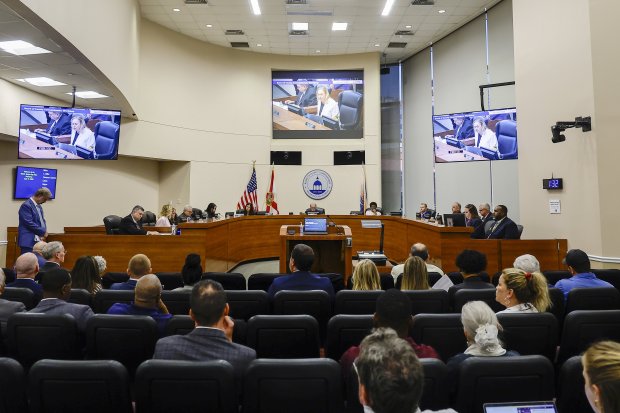 Hillsborough County Administrator Bonnie Wise makes opening remarks during a Hillsborough Board of County Commissioners workshop for the Rays’ stadium proposal on April 16. (Luis Santana/Tampa Bay Times)
Commissioner Harry Cohen declined to comment, also noting the need for more information. Commissioners Gwen Myers and Donna Cameron Cepeda did not respond to a request for comment, and Hillsborough declined to make any county official, including Horwedel and County Adminstrator Bonnie Wise, available for interviews.
Hagan, who said he is on a father-son golf trip in Scotland and unavailable for comment, said in a radio appearance last month that the impact on taxpayers would be “less than zero.”
“Irrespective of where you live in Hillsborough County, no one will feel it,” he said on WDAE-AM.