
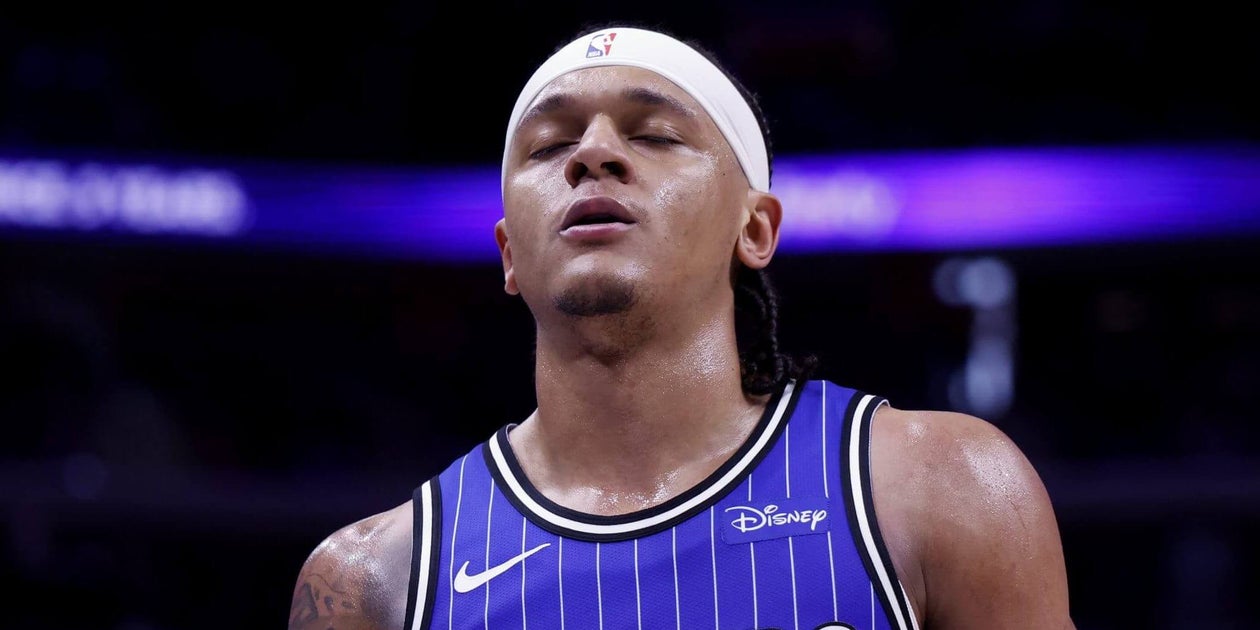
DETROIT — After they hugged each other and congratulated the opponent, Orlando Magic players and their head coach trudged off the Little Caesars Arena court late Sunday afternoon, perhaps for the last time as a unit.
Wendell Carter Jr. was the first of the starters to leave, followed a short while later by Paolo Banchero and Franz Wagner, who wore a walking boot over his lower right leg. Then, Desmond Bane and, later, coach Jamahl Mosley. Jalen Suggs was the last remaining Magic player on the floor and, with his blue pinstriped jersey already off, he buried his face in his jersey as he walked into the tunnel toward the visitors’ locker room.
They had just lost Game 7 to the Detroit Pistons, 116-94.
They had just lost a first-round series for the third consecutive year.
They had just become the 15th team in NBA history to take a 3-1 lead in a best-of-seven series and then lose the series.
“It’s terrible,” Bane said later. “We were a game away from moving on to the next round. After all that we had been through this season with injuries and adversity, we felt like we were right there to kind of write the story, rewrite the story, and we didn’t. So, yeah, it’s a terrible feeling, for sure.
“I don’t want my season to end. I know that all the guys in the locker room weren’t finished either.”
This will be a difficult offseason for the Magic, one marked by at least some changes. League sources have whispered since late October that Mosley’s job could be in jeopardy, but Magic president of basketball operations Jeff Weltman declined to make an in-season coaching change despite several puzzling lopsided defeats.
“These guys laid it all on the line in this game, and that’s all (we’ve) asked them to do, again,” Mosley said Sunday. “And that’s part of being able to coach this group, that they found a way to fight no matter what the circumstances, and that that’s the one thing that I want to say.
“I’m appreciative most of all for these guys.”
Weltman does not appear to be in jeopardy of losing his job. Two league sources said Weltman signed a contract extension during the first half of the season, around the time the team reached the NBA Cup semifinals.
Where should the blame fall?
On injuries? On the construction of the roster? On the coaching?
All three factors led to this.
Banchero, Suggs and Wagner all missed significant time during the regular season because of injuries, none of them more costly than a high-ankle sprain Wagner suffered on Dec. 7 when little-used New York Knicks center Ariel Hukporti fouled him on a drive to the basket.
Magic officials always maintained that they felt optimistic about their team’s chances if all members of their preferred lineup of Suggs, Bane, Wagner, Banchero and Carter were healthy.
Because of injuries, the quintet played together in only 19 regular-season games. During those 182 minutes on the floor, the Magic outscored opponents by 11.6 points per 100 possessions. They also allowed only 105.2 points per 100 possessions. To put that defense into perspective, consider that the Oklahoma City Thunder, the league’s best defensive team by far this season, limited opponents to 106.5 points per 100 possessions during the regular season.
So, when the Magic struggled during the season when Wagner or Banchero or Suggs were out, team officials would often say something along the lines of: “If we can get our lineup healthy and into a rhythm in time for the playoffs, we’ll have a chance.”
Team officials were right about that — until another injury occurred.
The Suggs, Bane, Wagner, Banchero and Carter lineup outscored the Pistons by 14.7 points per 100 possessions during the 61 minutes that Mosley deployed them in the playoff series, and that advantage sparked Orlando to a 3-1 series lead. But Wagner strained his right calf during Game 4 and did not play again in the series. If he had never gotten hurt, the Magic had a strong chance of closing out the series on the road in Game 5 or at home in Game 6.
Wagner’s absence illustrated, once again, how crucial he is to the Magic’s hopes. Banchero is Orlando’s best offensive player. Bane is the best shooter. And Suggs is their best or second-best defender. But Wagner is the team’s best all-around player, someone who is equally effective on both ends.
Mosley had deployed Wagner as the primary defender on Cunningham, and while Cunningham piled up the points during the series’ first four games, he was inefficient, making only 42.4 percent of his shots overall and 28.6 percent of his 3-points and committing 6.8 turnovers per game.
Losing Wagner changed the series in fundamental ways. It made the going easier for Cunningham, and it also amplified the Magic’s inherent roster flaws and weaknesses on offense.
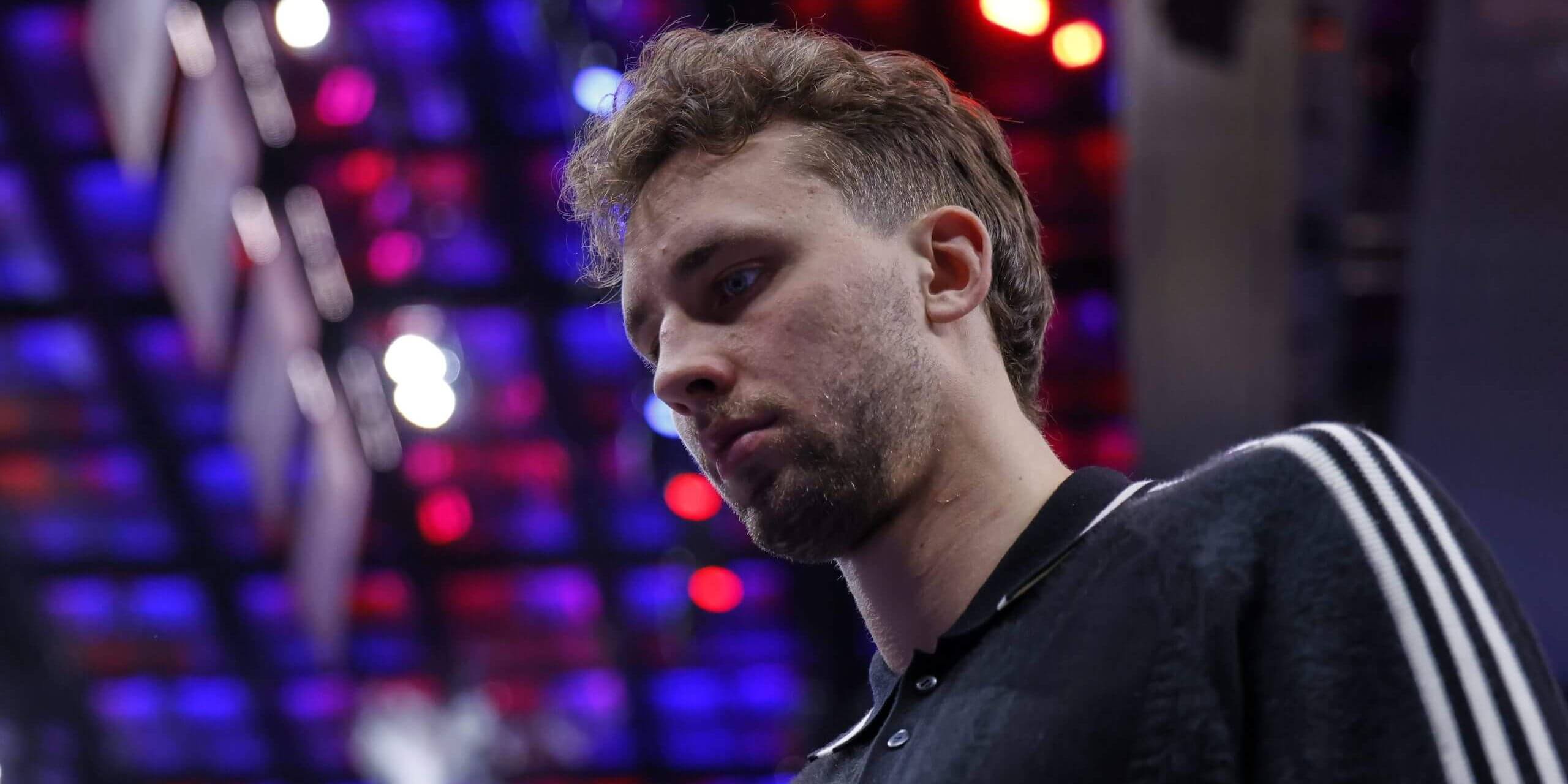
Franz Wagner’s injury in Game 4 resulted in the Magic not having one of their best all-around players for the final three games. Rick Osentoski / Imagn Images
“When one of your best players goes down, it definitely changes a lot, especially a guy like Franz,” Carter said. “Franz’s IQ for the game, his will, his determination — he’s the ultimate competitor and one of the best teammates I’ve ever had. So, when he went down, it was tough, for sure. But we still gave ourself a chance even with him being out. I think we just drank the Kool-Aid. We were just right there.”
Wagner and Banchero are 6-foot-10 wing-forwards, but they have always served as Orlando’s de facto point guards, in primary ballhandling roles similar to the roles of the Boston Celtics’ Jayson Tatum and Jaylen Brown. The Magic love to give either Wagner and Banchero the basketball on the perimeter, set picks to create size, speed or strength mismatches and then have Wagner or Banchero drive to the hoop to either score, draw a foul or pass the basketball to open outside shooters.
When Boston’s offense has been at its best in recent years, Tatum and Brown enjoyed an embarrassment of riches in terms of their teammates, with a long list of capable long-range shooters to pass to: Derrick White, Jrue Holiday, Al Horford, Kristaps Porziņģis, Payton Pritchard and Sam Hauser.
Wagner and Banchero have not had that same advantage that Tatum and Brown have had.
Over the last three years, and especially in the playoffs, the Magic generated plenty of wide-open 3-point shots but struggled to a great degree to convert those opportunities.
The Magic ended this season ranked 11th league-wide in “wide-open” 3-point attempts per game but 28th in accuracy, converting only 36.5 percent of those attempts. The Magic also struggled to make what the NBA defines as “open” 3s, ranking 28th league-wide in accuracy, at 31.7 percent.
It’s no wonder, then, why the Magic’s offense often looks so disorganized, clunky and ineffective. It is all of those things, but if the roster featured more 3-point shooting, the unattractiveness of the tactics and the playing style — with a pair of 6-foot-10 players dribbling and dribbling and dribbling and waiting and waiting and waiting for a teammate to set a pick — would not have been so painfully obvious. The ugliness would have been forgiven.
And the recurring lengthy offensive droughts would have been less common.
Orlando’s Game 6 collapse not only demonstrated the team’s reliance on Wagner, but it also highlighted the team’s shooting and roster-construction flaws.
Needing only one more win to end the series, the Magic dominated in the second quarter and then scored an early third-quarter basket to take a 24-point lead. But the Pistons elevated their defensive pressure, and what followed was the most inept half of offense ever seen in an NBA playoff game. The Magic scored only 19 second-half points, the fewest for any half in playoff history, and made only one of their 20 fourth-quarter shot attempts.
In that second half, Orlando attempted eight wide-open 3-pointers (a sign of good offense) but made only two of those attempts (signs of poor shooting and the pressure of the moment). Orlando also attempted eight open 3-pointers (a sign of good offense) but missed all of them (signs of horrendous shooting and the pressure of the moment).
The Magic’s defense has been celebrated during Mosley’s tenure. Mosley, assistant coach and defensive coordinator Dale Osbourne and assistant defensive coordinator Altavious Carter deserve credit for the X’s-and-O’s schemes they have implemented and the accountability they require. But the front office also should be credited for drafting and trading for players who have the physical abilities and desire to play defense, led by Suggs, Wagner, Carter and Anthony Black.
But just as roster construction contributed to the quality of defense, that same construction contributed to the struggles of the offense. The Magic front office has prioritized positional size and defense but has done so at the expense of shooting skill.
Suggs, Banchero, Wagner and Black ranked as below-average 3-point shooters at their respective positions during the regular season. Jett Howard, the 11th pick in 2023, can shoot well, but he has not earned the coaching staff’s trust on defense.
Bane was supposed to add shooting — and he did exactly that, at the high price of trading a first-round pick in 2026, a first-round pick in 2028, swap rights to a first-round draft pick in 2029 (top two protected) and a first-round pick in 2030 to Memphis, along with Kentavious Caldwell-Pope and Cole Anthony.
But having only one capable 3-point shooter in the starting five leaves a defensive-oriented team at a severe disadvantage during the playoffs against most opponents.
Though superb on defense, the Pistons themselves have only average 3-point firepower, a deficiency that gave the Magic, with their defense and their physicality, an opening to reach the second round.
After Sunday’s loss, Banchero was asked whether the team has what it needs to reach the next level.
“I can’t really answer that,” Banchero said. “I want to say ‘yes,’ but we haven’t been out of the first round. So, if you’re going off the last three years, the answer is ‘no.’ But the nice answer would be ‘yes.’ But honestly speaking, I can’t say that we’re good enough to be in the (NBA) Finals or Eastern finals because the last few years we’ve had the same result.
“So, that’s your answer.”
That inability to reach the second round also exposed their lack of a traditional point guard, someone who could have navigated the Pistons’ ramped-up defensive pressure in Game 2, Game 5 and the second half of Game 6.
Suggs is listed as the team’s point guard, but because of his tendency for turnovers and general lack of floor generalship, the coaches have deployed him more as a 3-and-D player. His defense remains outstanding, but his regression as a 3-point shooter cost the Magic in their matchup against the Pistons. He finished the series 13 of 54 from beyond the arc (24.1 percent), including a 1-of-13 night from 3 in Game 4, a 1-of-6 performance from deep in Game 6 and a 0-of-4 mark from 3 in Game 7.
“Outside of Game 4, where I felt like I pressed a bit at the end, every other game, I felt really confident in everything I was doing,” Suggs said. “I thought I got to the right spots, took the right shots. A lot of them were (off the) back rim. I wasn’t missing much right, left. I should’ve taken a bit better care of the ball in certain stretches and helped us get into some better things.”
During the offseason, the Magic signed point guard Tyus Jones to a one-year free-agent contract using their non-taxpayer midlevel exception, hoping he would help organize their offense, especially in the postseason. But he was one of the season’s biggest disappointments, ineffective on both ends. To avoid starting their tax-repeater clock, the Magic traded him before the deadline and had to attach two second-round picks to do it.
Black could be the long-term answer at point guard, and he made substantial strides as a third-year player. But the presence of Suggs and Jones and the ballhandling roles for Banchero and Wagner have hindered Black’s development as a floor leader.
Adding a primary ballhandler and 3-point shooting should be the Magic’s priorities this offseason. But the Magic’s cap situation and reduced number of draft picks because of the Bane trade will put the front office in a difficult spot as it plots ways to improve the roster.
Banchero’s maximum-salary extension will kick in with the start of the 2026-27 season, and Wagner also has a maximum-salary contract. Next season, Bane and Suggs will earn $39.4 million and $32.4 million, respectively.
Suggs, who has four guaranteed years remaining on his contract at descending salaries, could be a trade candidate as Orlando seeks to address its roster deficiencies and clean up its long-term cap sheet. But despite his rugged defense, his injury history might limit his attractiveness to potential trade suitors.
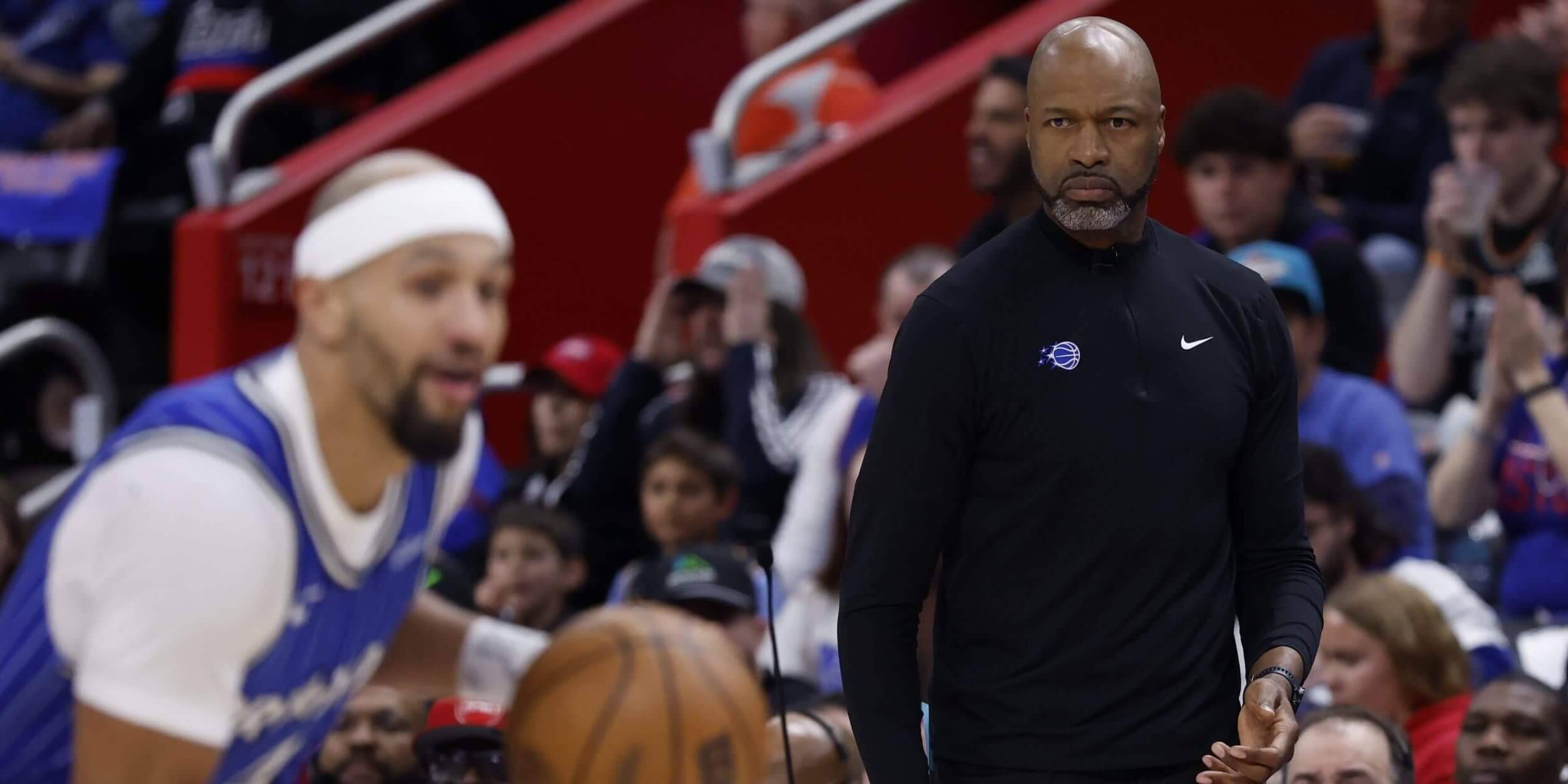
Magic head coach Jamahl Mosley is 189-221 in his five seasons with Orlando, but has had three consecutive 40-plus-win seasons since 2023-24. Rick Osentoski / Imagn Images
Mosley seems likely to be fired after three consecutive first-round exits, even though the team’s lack of 3-point shooting was a central factor in all three defeats, along with Suggs’ absence because of injury in 2025 against the Celtics and Wagner’s absence during the final three playoff games against the Pistons.
Mosley has built a strong defense, but even Banchero has noted that his coach has been slow to respond to opponents’ second-half adjustments. The Magic’s Game 7 defeat in 2024 in Cleveland is one of those examples. This spring’s Game 5 and Game 6 losses are two additional instances.
The Magic continue to have an existential question on their hands: Although team officials regard Banchero and Wagner as stars, will the duo’s 3-point shooting deficiencies relegate the Magic’s offense to mediocrity or worse when they play together?
That question needs to be answered definitively, and that’s one reason why Mosley’s dismissal seems likely. The Magic have tried to play a certain style on offense, and it hasn’t worked well enough. The franchise likely needs to try to see if a new coach — with a different offensive scheme — can coax more out of the Banchero-Wagner pairing, and the offense in general.
The Magic have come close to reaching the second round in two of the last three postseasons. But with Banchero and Wagner a bit closer to their prime years, and with the team’s salary-cap situation on the verge of becoming severely restrictive, close is no longer good enough.
The series against the Pistons was as close as the Magic have gotten to advancing to the second round in 16 years.
Asked what he’ll remember most from the season, Black offered an immediate answer.
“Losing Game 6,” he said.