
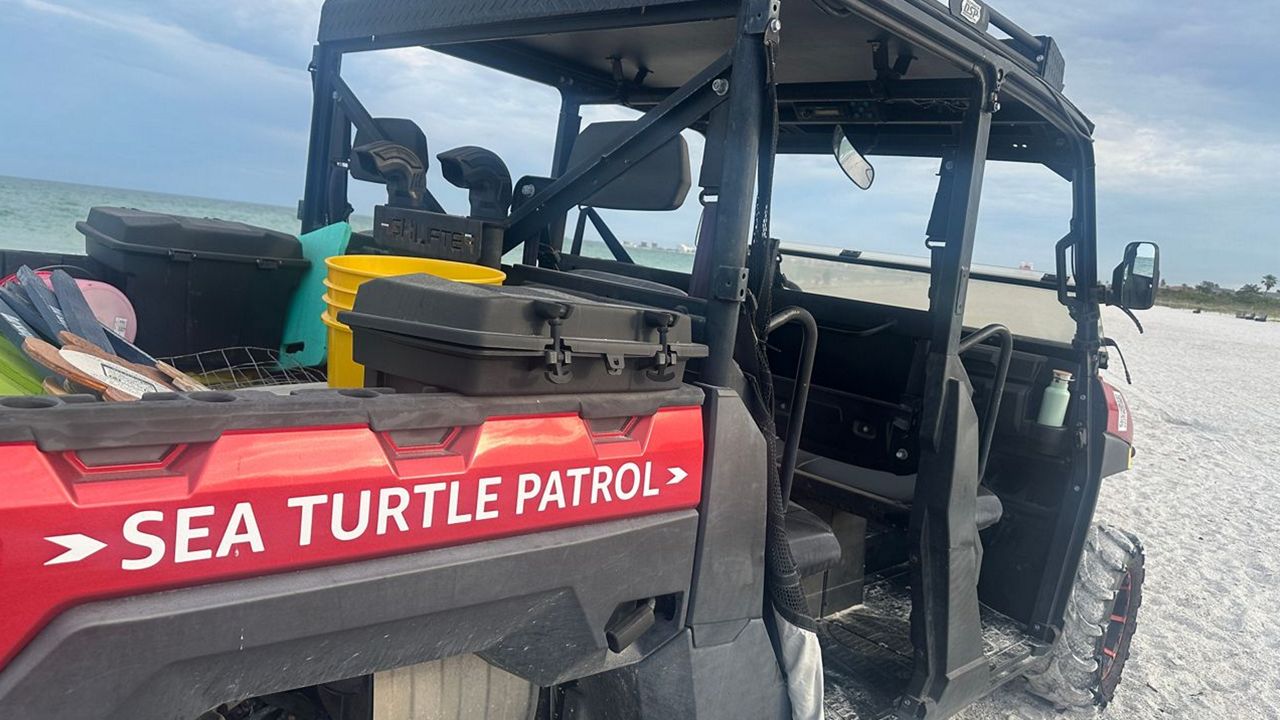
PINELLAS COUNTY, Fla. — Sea turtle nesting season is now underway, but those who track turtle nests on the southern tip of Pinellas County say it’s possible that 2026 will be a quieter nesting year than the last.
Volunteers with Sea Turtle Trackers, the group that monitors nesting activity south of Upham Beach, say their turtles tend to lay nests every other year or so. That leads to busier years with bigger numbers followed by a quiet year. They say 2025 was busy, so they expect this year won’t be record-breaking.
“These mama turtles that are coming up and making the nest, these turtles were actually hatched around this area,” said Jacky Dawson of Sea Turtle Trackers. “So they come back to nest where they were born.”
The team with Clearwater Marine Aquarium patrols the remainder of Pinellas County’s beaches, primarily north of Upham Beach. Clearwater Marine Aquarium reported 405 turtle nests last year, while the Turtle Trackers had 70.
Each morning at sunrise, volunteers and staff patrol the shoreline searching for new nests. When one is found, it is marked off and covered with a protective screen to keep predators such as coyotes and raccoons away. If left undisturbed, the nests hatch roughly two months later.
We’re officially in sea turtle nesting season! Look at these little guys making their way to gulf 🥹
Rules like no white light on the beach at night are in effect. You also can’t leave anything on the sand once dark. In places like Treasure Island, you can get a citation @bn9 pic.twitter.com/X6BJZ7Pulq
— Angie Angers (@angie_angers) May 4, 2026
However, environmental conditions can significantly impact survival rates. Dawson says despite a relatively calm hurricane season last year, heavy mid-summer rainfall damaged some of their nests in southern Pinellas County.
“It inundated the nests. The eggs just didn’t make it,” Dawson said. “They can only tolerate a certain amount of washover or water in the nests, so the eggs just weren’t viable in some of them… and the mama turtles weren’t coming up as high onto the beach as we would like.”
Local officials are also working to improve hatchling survival by enforcing seasonal regulations.
In Treasure Island, code enforcement teams inspect beachfront properties to ensure compliance with lighting and obstruction rules. Properties are required to use low-wavelength lighting and keep blinds closed at night to prevent artificial light from mimicking moonlight, which hatchlings rely on to find the ocean.
“We typically want to shield lighting so it wouldn’t take the presence or shape of the moon that would disorient the hatchlings,” said James Dixon, code compliance supervisor for the city.
Violations can lead to warnings followed by citations if not corrected promptly. Last year, the city issued between 30 and 40 citations.
From now through October 31, beach visitors are required to avoid shining white or yellow lights on the beach at night and to remove all personal items before leaving each day.