
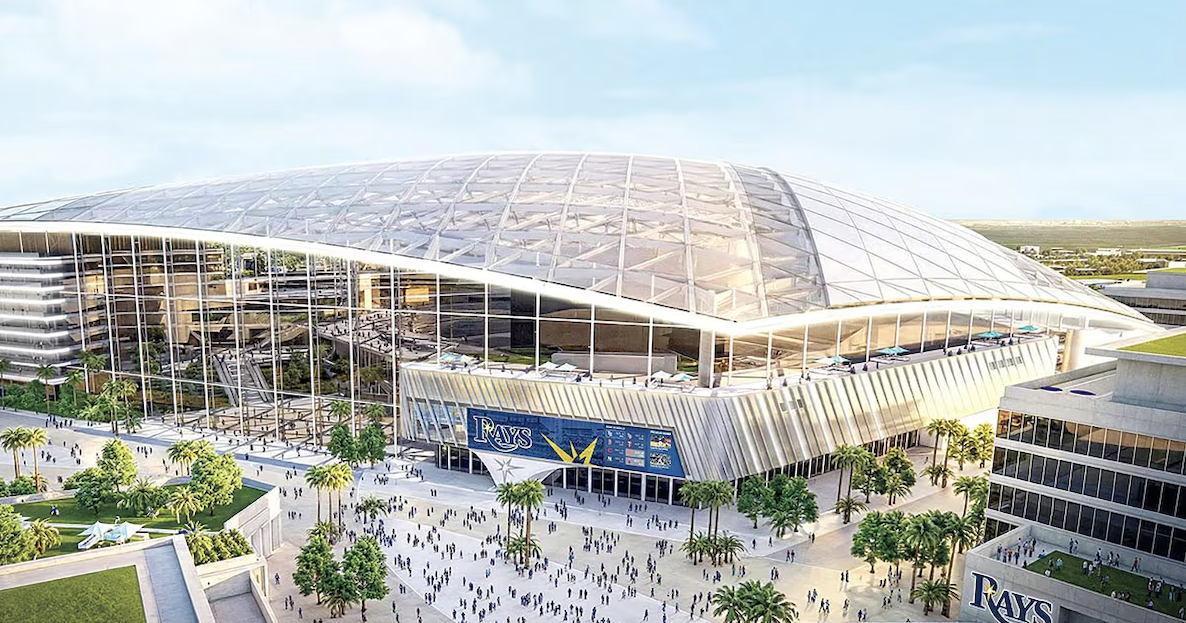
There’s a saying in dealmaking: The closer you are, the further you’re away. That’s a nod to how negotiations can stall over nonnegotiable terms. It’s a concept worth remembering as the Tampa Bay Rays pursue a ballpark deal in Hillsborough County.
The Rays want Hillsborough and the city of Tampa to contribute about $1.1 billion combined toward the cost of a $2.3 billion stadium at the site of Hillsborough College, on Dale Mabry Highway. The team is pushing the local governments for votes in May, though the county asserted last week it is unlikely to meet the Rays’ June 1 timetable to complete the deal.
I don’t see these negotiations as stalled; far from it. County staff is working hard to vet the numbers and has been careful not to prejudice the policy debate facing elected leaders. The Rays, for their part, have not colored negotiations with a threat to relocate outside Tampa Bay. However one feels about the stadium deal, the dialogue between the two sides has been even keel.
Still, I see several sticking points as we near a critical phase. Some are real, some are imagined, so let’s separate the two.
Timing. In back-to-back exchanges last week, the team said it was “focused” on preserving a timeline for a May vote, despite the county’s contention that a deal could take months more to negotiate. The Rays say its schedule is key to opening the stadium by the 2029 season and unlocking state financial assistance in rebuilding Hillsborough College.
Opening a new stadium would help the Rays’ bottom line, but whether that’s 2029 or 2030 shouldn’t matter to Hillsborough. What’s important is to seek a contract that is doable, fair and mutually beneficial. The $150 million anticipated from the state to rebuild the college is small potatoes in the overall scheme. Florida spent three times that much on Alligator Alcatraz; if a deal makes sense, state money will follow. This rush job has created a cloud of suspicion in the public eye. Do the Rays want a vote today or a deal all sides might agree on?
Subsidies. Hillsborough officials have raised several questions about the Rays’ estimated stadium price, all aimed at reducing tax subsidies for a deal. The team wants $750 million from the county and $251 million from the city of Tampa. A county assessment estimated a shortfall of up to $135 million between what the Rays want from local taxpayers and what area governments might provide.
That gap presents both a financial and political problem. Even with a hold-harmless provision ensuring that tax money for police and fire services doesn’t go toward a stadium, elected officials will face enormous pressure to spend tax money on other backlogged priorities. The Rays insisted flatly last week that other funding tools — such as ticket surcharges or special assessments — amounted to “private” revenue sources that would not be considered as “an alternate public funding source.” The team may need to give here — a lot.
Buildout. The initial agreement between Hillsborough and the Rays, called a Memorandum of Understanding, doesn’t list a host of commitments from the team, including the community benefits of any stadium project. Those pledges are essential. But Hillsborough could proceed with a nonbinding MOU, retain its leverage and iron out the details later.
But the county needs some specifics: What is the Rays’ schedule for developing a mixed-use project at the site? What percentage of the residential housing will comprise affordable vs. market-rate rent? How much net property tax revenue will the project generate? How will the Rays guarantee their financial solvency? There’s more, but that’s a start.
Officials also need to consider what such a large outlay of Community Investment Tax dollars toward the stadium might mean to the future of that funding source. Many critics — already soured that CIT funds were used to construct Raymond James Stadium — complain that Hillsborough commissioners reneged on their word by even considering CIT funds for a baseball stadium. Voters first approved the tax in 1996 as a way to fund new schools, police cars, fire stations, the stadium and other big-ticket projects. Voters then passed the tax with 53% of the vote, but passage dropped to under 52% last year, even after commissioners halved the tax’s term to make it more politically palatable. If using CIT for baseball endangers the tax’s renewal on its expiration in 15 years, how will Hillsborough afford costly infrastructure projects?
Let’s not pretend that big obstacles don’t remain. Unreasonable deadlines and vague promises also don’t help in making a big decision. If this deal makes sense, it’ll be obvious soon enough.
John Hill is a columnist for the Tampa Bay Times.