
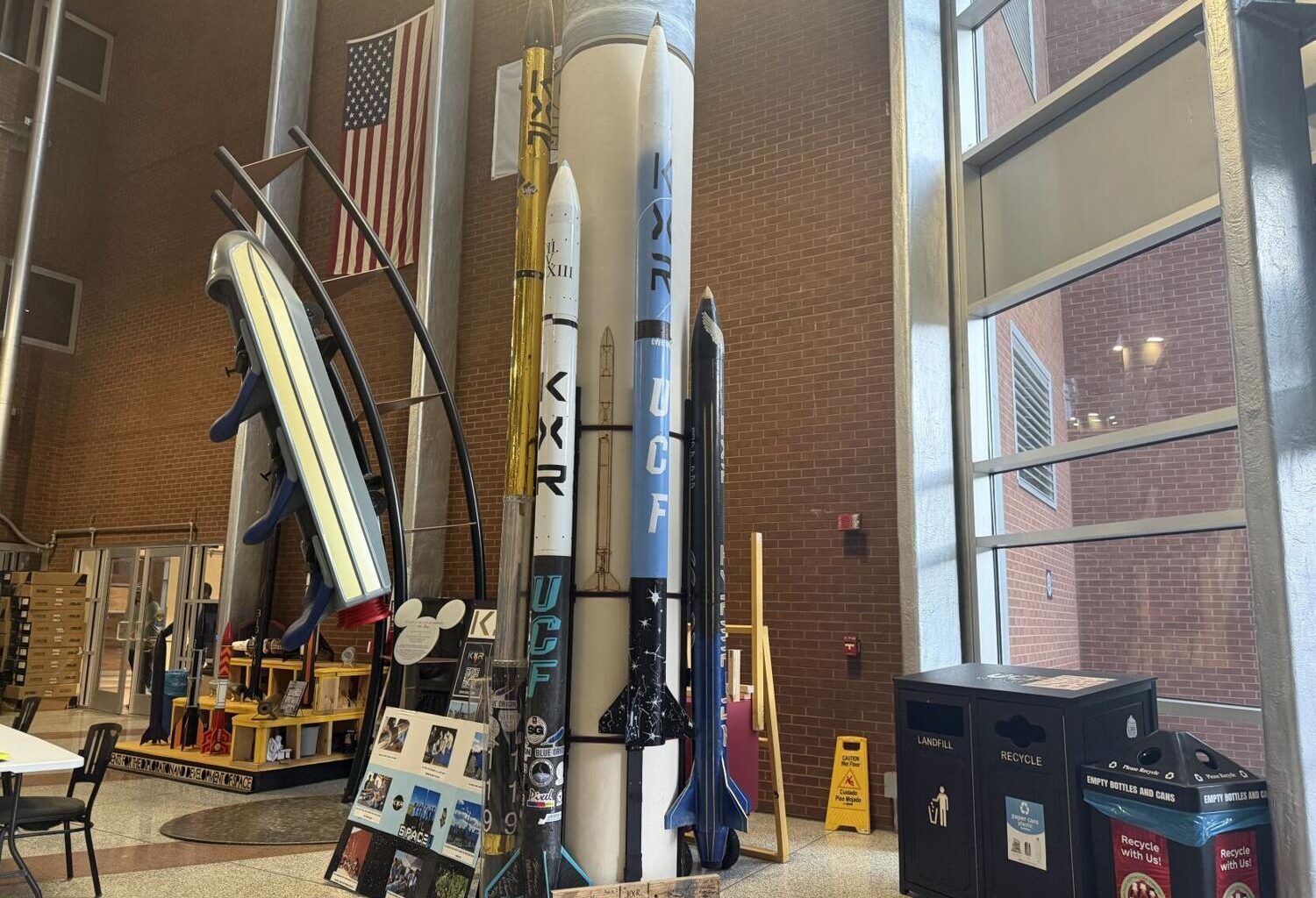

Display of the Knights Experimental Rocketry rockets in the Engineering II building Atrium on April 26. The KXR club is a Registered Student Organisation at UCF. As a rocketry club, they mainly launch competition rockets.
Allison Smith
NASA’s Artemis program has inspired all parts of SpaceU within and outside STEM fields, with UCF launching an online space graduate degree and the integration of space tourism in Rosen College of Hospitality and Tourism courses.
Salma Tujjar, sophomore hospitality major, has accepted a space tourism-focused internship at SpaceX Starbase for the Summer 2026 term. Tujjar said she was excited that there was a position for her in the space industry as a non-STEM major.
“I definitely think Artemis does emphasize that excitement and show people that there are opportunities in that area,” Tujjar said.
Tujjar said she was always interested in space since she was little, but thought she had to grow out of it because the opportunity was never there for her. But once she started going to Rosen College, there was an emphasis on space hospitality.
“It’s so exciting to know that I am going to be a part of something that hasn’t necessarily been widely established yet,” Tujjar said. “I am really excited to learn more.”
Dr. Amy Gregory is the endowed chair in Space Tourism Programming and Initiatives at UCF and Tujjar’s professor. Tujjar said Gregory was the one who introduced her to the space tourism sector and helped her find opportunities.
“At Rosen College, we look at hotels and restaurants,” Gregory said. “So, we look at that in the application of space.”
Gregory compared commercial space travel to cruise ships. She said it used to be enough for people to sit on the decks and look at the ocean, but now they need entertainment. Entertainment will eventually be needed in space as well, Gregory said.
“Then we work very closely with the College of Medicine too, because we look at culinary health, food as medicine,” Gregory said. “How can we fortify foods so that they help people that are living, working or traveling in space? So, I can’t think of a place that it wouldn’t touch in terms of a college, school or discipline.”
Dr. Zaheer Ali, program director in Space Commercialization and Strategy, said the increase in applied science at NASA has increased interest in the space economy. He said that he believes it is going to grow the university.
“The direction of space is going to lead to a surge of people choosing aerospace majors, and associated majors, taking their major and thinking about how they can be a part of the space economy,” Ali said.
Greg Autry, associate provost for space commercialization and strategy, also known as the “Space Czar,” helped design UCF’s Space MBA program, which is being introduced in Spring 2027, according to UCF’s website.
“I think it’s a huge opportunity for students, and I want to be clear that it’s not just science and engineering students,” Autry said. “In addition to engineers and scientists, you’re going to have to have people watching the money.”
Ali said the space MBA program at UCF is a fully accredited MBA with four courses mainly focused on the space industry. The courses intend to teach students about leadership, technology, law, and finance entrepreneurship. These courses will be taught by some of the top people in the space industry, Ali said.
These figures include Michelle Hanlon, as the top space lawyer; Steven Shinn, who used to be deputy chief financial officer at NASA and is now CFO of Aerospace Corporation; Autry, who teaches entrepreneurship; and Ali, who is to teach leadership in technology. Ali said the purpose of the MBA was not to add a couple of electives, but to focus on the culture and tone of the degree in space.
“We launched with a really great cohort of 30 students,” Ali said. “They’re working on projects as part of the degree directly with industry. It’s something very different than anything that exists anywhere else.”
Keagan Bowman, sophomore computer engineering major, is currently the Students for the Exploration of Space secretary and president for the 2026-27 academic year. Bowman said there was more interest from faculty leading up to and after Artemis II in SEDS.
“With the new Space MBA that launched, there has been a massive influx of interest across the school and space industry in general,” Bowman said. “Of course, since we are a club that very much focuses on that, it transfers over on us as well.”
Bowman said that despite having many STEM majors in SEDS, they also find graphic design students and business majors.
“We [UCF] are involved in the space industry in a lot of ways,” Bowman said. “Expanding into the space MBA is a pretty good idea because there is a lot going on in the business side of things. I don’t think everyone realizes that, but there’s something for everyone in the space industry.”
UCF is also partnering with NASA’s Payloads and Research Investigations on the Surface of the Moon (PRISM) program to launch Lunar VISE. The PRISM program was launched in the beginning stages of the Artemis missions as a part of NASA’s initiative to expand the lunar economy and to promote investigation of the lunar surface, according to NASA’s website.
Dr. Kerri Donaldson Hanna, principal investigator of Lunar VISE, said the program’s goal is to study the lunar surface to gain a better understanding of how the moon was formed.
“We’ll land on a volcanic feature on the surface of the moon, and we’ll have 10 Earth days to study that volcanic feature from the surface of the moon,” Donaldson Hanna said. “That’s the big thing on the horizon.”
Dr. Adrienne Dove, deputy PI of Lunar VISE, said that students getting involved with projects like Lunar VISE, especially at the graduate stage, can help set up opportunities to be involved in the industry beyond grad school.
“Just being able to be involved in a mission, whether it’s data analysis from a mission that is already ongoing, sets you up really well to be able to do that sort of thing beyond grad school,” Dove said.
The project has provided students the opportunity to work on a lunar research project that is set to launch in 2028, giving them experience they can carry into the industry, Dove said.
“This is enabling engineers to move forward with their career,” Ali said. “And also educate non-technical people about space sufficiently.”