
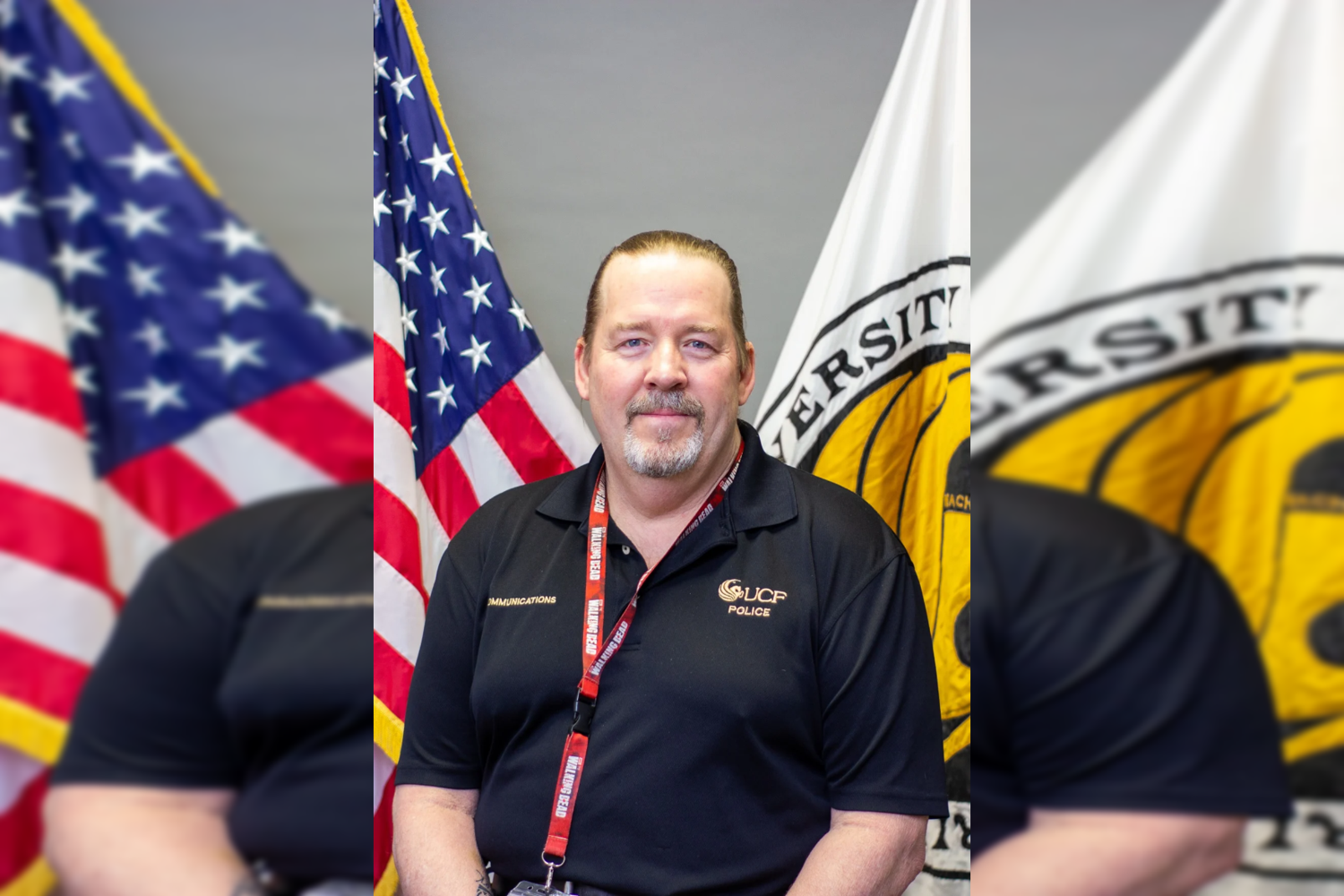

Steven Keith, a dispatcher at the UCF Police Department, has been working overnight shifts for more than a decade, taking calls that range from routine assistance to high-pressure emergencies.
Courtesy of the UCF Police Department
A voice breaks through the quiet of the night shift, panicked, urgent, unpredictable.
On the other end of the line, UCF Police Department dispatcher Steven Keith listens, processes and responds, often within seconds. From reports of students locked out of classrooms to reports of violent crimes in progress, Keith has spent more than a decade fielding calls that few ever hear and even fewer fully understand.
UCFPD responds to several calls for service each year across campus, according to its Annual Security and Fire Safety Report, reflecting the constant demand placed on the university’s dispatch center, where every emergency and non-emergency call begins.
At 70 years old, an age when many may have chosen to retire, Keith continues working overnight shifts as one of UCFPD’s most experienced dispatchers.
He didn’t always envision a career in public safety; the opportunity fell onto him.
“I sort of felt like I, in a way, fell into it, even though I had envisioned myself at one point in life when I was in college, trying to decide what I wanted to do in graduate school,” Keith said in a phone call. “Several of my professors were really involved with their law enforcement program at the University of Alabama.”
Keith earned his degree in psychology and criminal justice at the University of Alabama before going to graduate school and deferring for a year, ultimately never going back.
After his decision, he chose to embark on a different path in life by giving a swing at minor league golf in Florida for 10 years before realizing he may not be totally cut out for it.
Keith then decided it was best to utilize his degree in criminal justice when he saw an advertisement for the Oviedo Police Department as a police dispatcher.
“I decided I wanted to do something with my degree and saw an advertisement for the Oviedo Police Department…as a police dispatcher,” Keith said. “I figured my background, my degree in criminal justice and psychology, might be helpful with it.”
After five years with the department, he was faced with a decision to either stay with the dispatching center that was merging with the Seminole County Sheriff’s Office or find somewhere else to go.
Ultimately, he found himself applying for and landing a dispatching position with UCF.
“I didn’t want to go to work for a big, massive agency where the lack of personality and personal involvement was very different,” Keith said. “UCF was hiring at the time, and I hired on at UCF in 2012.”
Keith’s day-to-day isn’t usual. At around 10:45 p.m., while much of the campus falls asleep or engages in nightly activities, he sits in the center of a high-tech concave surrounded by eight glowing monitors containing 20 different programs that each require their own specific password as he prepares for his eight-hour shift.
As an overnight dispatcher, Keith views his role as bigger than an operator but as a “pilot” of the department as he takes control of the quiet but high-stakes overnight hours.
“We’re basically a pilot of the UCF police department at that point in time,” Keith said. “We’re flying the ship and there are other people that are up and down a chain of command that we respond to.”
With every shift being a mystery as to the kinds of calls they receive, he enforces the idea of staying prepared, as there is a wide range of severity that comes from different calls.
“It’s one of those things where you never know what’s going to happen,” Keith said. “It could be somebody calling that has been assaulted or somebody that has had something stolen from them.”
However, all calls surround one focus and share one factor.
“More than anything else, you get phone calls all the time from people that need assistance,” Keith said.
He knows what job he must do, but understands that many misconceptions come from working with a police department. However, he reassures those who believe those misconceptions that he has one purpose and one purpose only.
“We’re here to help people,” Keith said. “Some people are scared of the police and I understand that.”
He emphasized that, in all reality, that mission is what keeps him going and keeps him in the profession and how this role gives him a sense of purpose and meaning.
“It makes you feel like you’re actually doing something good, which was the thing that has probably kept me invigorated and, at my age, still excited about going to work,” Keith said. “It is probably the only reason I’m still doing it and that I haven’t retired, which I could do right now.”
He also expanded on his role with the police department, considering it more psychological and emotional, and how his role plays into the effectiveness of the department.
Keith even added that the position prides itself on focusing on other people and making a difference in other people’s lives by putting them on the right track.
“We’re the psychologists of the police department,” Keith said. “We deal with a lot of issues that people have and try to help them.”
That sort of impact goes beyond the calls, according to Dispatch Supervisor Tiffany Ortiz.
“Steven consistently goes above and beyond on every call he handles,” Ortiz said in an email. “He ensures each caller feels genuinely heard and supported, while also taking the initiative to review open cases and assist detectives.”
This work does not go unnoticed as he has claimed a few accolades during his time as a dispatcher, highlighting his success in the field and recognition, according to Public Safety Communications Manager Amanda Sellers.
“His contributions have been recognized through being named Dispatcher of the Year in both 2016 and 2022,” Sellers said in an email. “A testament to his consistency, excellence, and commitment to service.”
However, in this line of business, there are always moments that stick out the most, Keith said. Moments, he said, that mold how he handles this line of work and will be ones that are carried with him until he retires.
Keith looked back on the first 911 call that he ever took while with the Oviedo Police Department, where he was on the phone with someone witnessing a home invasion taking place at their neighbor’s residence.
A dispatcher workstation at the UCF Police Department shows the multi-screen setup that Steven Keith, a UCFPD dispatcher, described, where operators monitor calls, communicate with officers and access information in real-time.
Courtesy of UCF
He said that call was one of the scariest feelings he ever had in a dispatch center because of the timing of it in his early days of dispatching.
While the memories can be daunting, Keith emphasized the importance of handling pressure and mentally training your mindset to remain calm when the person on the other end of the line is not.
“They’re not memories that haunt me,” Keith said. “They’re memories of me doing this job and doing the best I can to help people at the job.”
Keith explained the importance of putting personal fears aside and relying on training and experience to handle stress.
He also emphasized the need for multitasking and constant training to manage the demands of the job and discussed the importance of following policies to resolve situations effectively.
“You just draw on your experience, if you have it, but also your training,” Keith said. “One thing that drives me crazy about this job is a mentality that we have to get it right, we can’t afford to get it wrong.”
All in all, Keith embraces the idea of serving a bigger purpose, even if those who don’t see his face or know his name but only hear his voice. It rewards him by reminding him who he is serving, which is the community.
“An actual positive thing about doing this kind of job, is that you can get to the point where you feel like you’re making a real contribution to a community,” Keith said. “Working at UCF gives you that kind of feeling of you’re working for a community that is doing something good in the world.”
Sellers reinforced that this impact is felt across the entirety of the department.
“Well-respected and genuinely appreciated by everyone who has the privilege of working with him,” Sellers said. “Steven truly embodies the values of teamwork and service.”
Even after decades of different paths, from classrooms to golf courses to dispatch consoles, Keith still shows up each night answering calls from people he may never meet, solving problems he may never see resolved, and doing the work few notice but many rely on.