
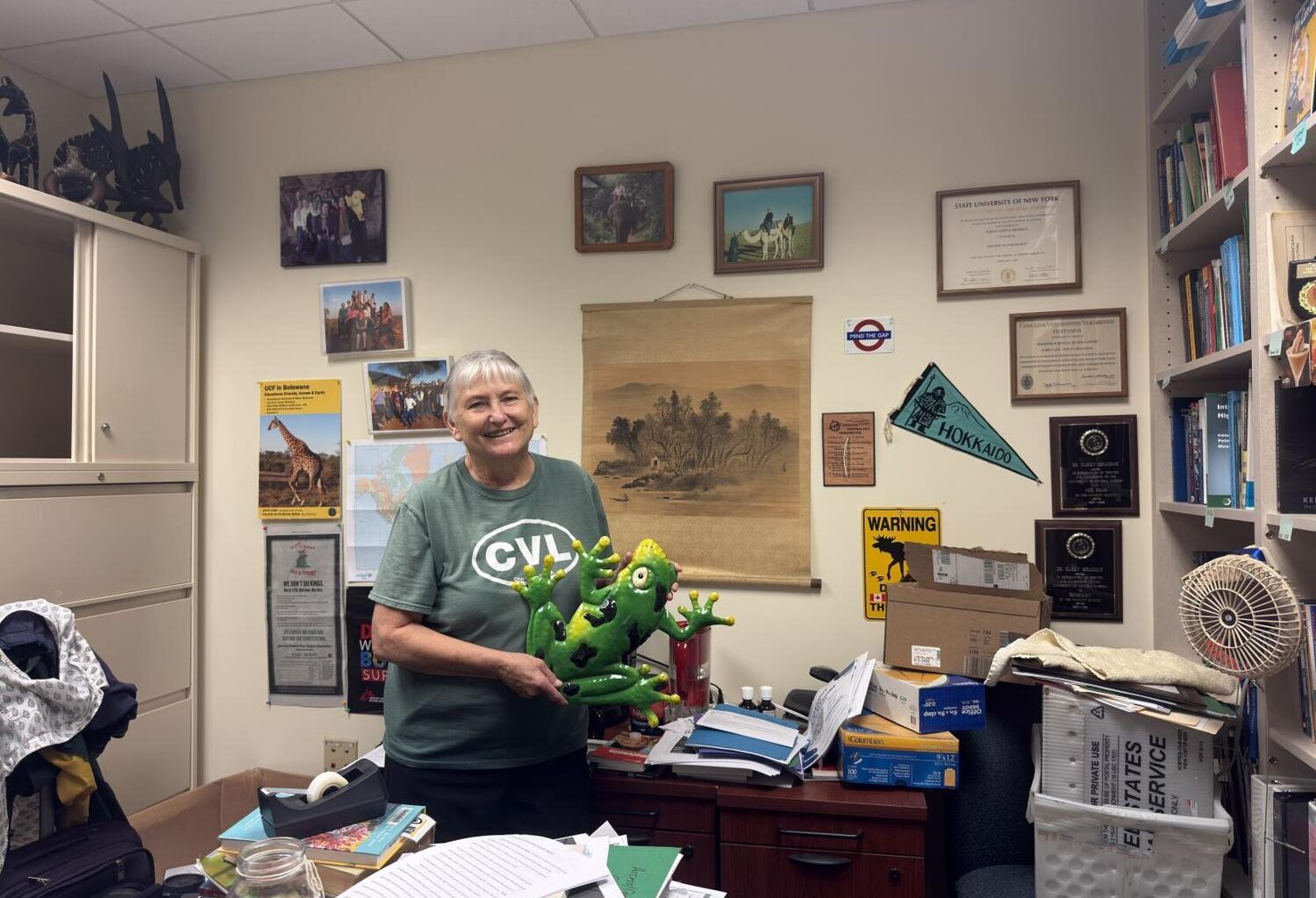

Karen Biraimah, tenured professor of Comparative and International Education and Fulbright Liaison, stood in her office at the College of Community Innovation and Education, in front of her degrees, pictures and memorabilia from her trips.
Natalia Garcia
Dr. Karen Biraimah lived without electricity or running water for a year in Ghana to teach mathematics, starting a long career as an international educator.
Now a UCF professor, she taught geometry and algebra in Ghana as a Peace Corps volunteer for two years. The Peace Corps is a U.S. government agency that deploys volunteers around the world to work in areas of need, such as education, agriculture, and health, according to its official website.
“The Ministry of Education had housing in the town for us, but I went to live in the village,” Biraimah said.
Without refrigeration, she would eat a lot of canned tuna or fresh market meat. For water, the Peace Corps provided a large oil drum to fill during the rainy season. During those years, Biraimah walked a small path through the rainforest, carrying a heavy pile of workbooks to grade. One of those times, two students approached her and asked if she was afraid of the spitting cobra.
She didn’t know what to respond, thinking they were kidding. According to the African Snake Institute, spitting cobras hang from trees, spitting on their victims’ eyes to blind them and attack. Spitting Cobras target much smaller prey than adult humans.
“I really enjoyed that year,” Biraimah said.
Originally, Biraimah studied math and physics in the undergraduate department at Lewis and Clarke College in Portland, Oregon. However, after some international programs at the University, where she studied in Japan and Africa, she switched her studies to international affairs.
“My father was never happy with this, when I switched from physics to international affairs,” Biraimah said. “When I finally got a university job, he relaxed.”
After volunteering for the Peace Corps for two years, she ended up teaching public high school in Detroit in the 1970s. She taught in the math department for about seven years.
During this time, she also taught in Buffalo, New York, and Niagara Falls, where she remembered a boy named Jesse. His mother worked multiple jobs, and she went to every parent-teacher conference. Jesse’s mom was concerned that she couldn’t help her son with math. Biraimah said that as long as Jesse did his work at home, she could take care of the math. Jesse ended up obtaining a four-year scholarship at a New York university.
After serving in the Peace Corps, she taught high school math for about seven years in Detroit, Buffalo, and Niagara Falls.
There, she taught a student named Jesse, whose mother, despite working multiple jobs, stayed deeply involved in his education. With her support, Jesse earned a four-year scholarship to a New York university.
“The kids who got past Algebra 1 saw school as the only way to stay off the street,” Biraimah said. “I’ve never had such a dedicated group of kids in my life.”
Whilst teaching, Biraimah got her master’s degree in African areas studies, followed by a doctoral degree in comparative and international education. Part of her higher education training was observing teachers in suburban schools.
“I saw all the stuff these kids had, and my kids in Detroit had nothing,” Biraimah said. “The protractors were so old that the students could not read the degrees on them.”
Her academic research focused on issues of educational equity based on factors like race, ethnicity, class and gender. After completing her doctoral studies, she landed a faculty position at UCF in 1985, where she became a Fulbright Scholar.
The Fulbright program offers teaching and research positions abroad for interested faculty members and students. Biraimah signed up to teach university students in Malaysia and Kenya. She remembers the tremendous political unrest that affected the University in Kenya. At the time, a bad harvest affected the North, so the students sent their university stipends to their families so they could eat.
“They started throwing these kids out on the street because they haven’t paid, and this caused huge violence on campus,” Biraimah said. “You could hear gunshots and students screaming and running down their street with their suitcases.”
Biraimah lived on campus along with other faculty members who sheltered many students in campus housing during the riots.
“My husband said, ‘We need to sit at the other end of the wall, because the front end is on the street and the bullets are going to come through the wall,’” Biraimah said.
Her next Fulbright location was the University of Namibia, where she had a lovely year teaching and won the Senior Fulbright Scholar Award in 2015. Biraimah won three other Fulbright Scholar awards for her work in Malaysia in 1993, Kenya in 2008, and South Africa in 2024.
Constance Goodman, associate lecturer in the College of Community, Innovation and Education, said Karen was a mentor, a supervisor, and a leader. Explaining that she truly helped advance the Fulbright Scholars program for UCF. Currently, Biraimah serves as the Fulbright Campus Liaison and is a program coordinator for the university.
Carol Kranz, a UCF alumna in education, told UCF Today, “The actual dissertation process led by Karen Biraimah was pivotal in developing me as a scholar and researcher in the field of African education.”
After 42 years at the university, she is hoping to land a faculty role in Botswana, Africa.
“I have worked my whole life; the idea of not working is like going to hell,” Biraimah responded. “I can’t sit around the house all day, I’d go crazy.”