
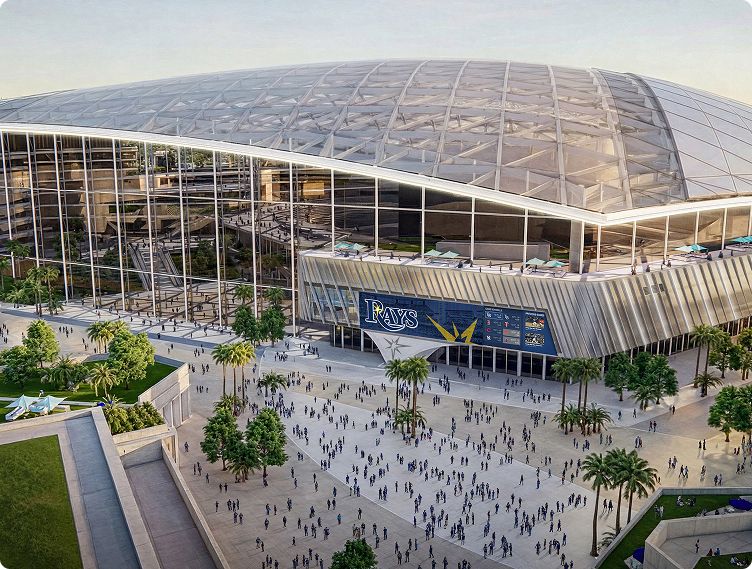
Negotiations over a proposed Tampa Bay Rays ballpark may be entering their final weeks, as Rays CEO Ken Babby and Hillsborough College President Ken Atwater are mounting an aggressive public push urging Tampa leaders to approve a deal before time runs out.
Speaking during a Tampa City Council workshop on the proposed $2.3 billion ballpark and entertainment district at Hillsborough College’s Dale Mabry campus, Babby said the project is a “generational opportunity” to build not only a new home for the Rays, but also a major mixed-use district and a transformed Hillsborough College Dale Mabry campus — improvements he argued would not otherwise happen without the partnership.
But behind the optimism was an unmistakable sense of urgency.
During Tuesday’s workshop, Babby emphasized repeatedly that the June timeline to finalize a memorandum of understanding is rapidly approaching. The Rays have set that deadline to meet a target of opening a new ballpark by the 2029 MLB season, which coincides with the end of the team’s lease at Tropicana Field in St. Petersburg.
Babby also implied that the franchise could relocate outside the Tampa Bay area if an agreement is not reached by the end of the month.

“We are still actively negotiating a memorandum of understanding (MOU) with the city and the county,” Babby said. “It’s not the Rays timeline. If simply put, I would say this is the community’s timeline. It’s Tampa’s timeline,” Babby said during the workshop.
“The State of Florida will enter Legislative Session in the next couple of weeks to make decisions on Hillsborough College’s campus, on the transportation infrastructure. They are looking to us — the city, the county, the Rays — to see if we can put this project over the finish line. So we aspire tonight to continue our work on reaching that MOU in the month of May.”
Tuesday’s workshop marked one of the most direct public lobbying efforts yet by the Rays organization as negotiations continue behind closed doors between the team, the city of Tampa and Hillsborough County over a proposal that could exceed $1 billion in public funding.
“Our ownership group is committed, ready, willing and able to contribute more than $1.1 billion toward the cost of this new ballpark, 100% of the overruns, all of the operational maintenance, 100% of the development cost and risk, plus what the state is preparing to put into the college and, of course, into infrastructure,” Babby said.
Babby repeatedly stressed that the proposal extends far beyond baseball. He said it’s a broader economic and workforce initiative centered around a “work, live, learn, play” district, anchored not only by the ballpark, but also a redeveloped Hillsborough College campus.

The Rays proposal calls for a mixed-use district modeled after The Battery in Atlanta — the entertainment district surrounding the Atlanta Braves’ Truist Park — while promising retail, hospitality, housing, workforce development programs and entertainment venues. Babby highlighted projections estimating more than $55 billion in economic impact, nearly 12,000 jobs and 10 million annual visitors.
“We embarked on buying a baseball team, and we ended up getting the opportunity to work alongside a college to do something far bigger than talk about baseball,” Babby said. “We got to talk about the opportunity tonight to change a city, to make an investment in ourselves, to do something otherwise not possible.”
Babby also highlighted Tampa’s strong financial standing, including the city’s high bond rating, arguing the proposal represents a major long-term investment opportunity.
“I had the great pleasure this morning of attending the State of the City, and I heard our Mayor (Jane Castor) say that the city of Tampa has the second-highest bond rating of any city in the United States,” Babby said.
“That’s an incredible position that comes after making wonderful decisions, not just by the body of the elected officials in this room, but those who were your predecessors. They also made bold decisions, made bold investments that required a great deal of scrutiny, but they always maintained not to impede on public safety. That is the work and commitment we’re making.”
Atwater used his remarks to reinforce to Council members that a public commitment to the project would also benefit Hillsborough College’s Dale Mabry campus, which he said faces significant infrastructure needs. Atwater said the campus has between $75 million and $80 million worth of repair needs, including aging roofs and elevators that date back to the 1970s.
Atwater also argued the project would create direct workforce pipelines for students in hospitality, culinary arts, IT, cybersecurity and AI programs through internships, apprenticeships and future employment opportunities tied to the development.
“I would urge you to support the Tampa Ray ballpark,” Atwater said. “In doing so, you will be supporting education, opportunity, economic development and more importantly the future of our region. I respectfully urge for your support for this project. At HC we say, ‘This is a game changer.’”
Despite the optimism from the Rays and Hillsborough College, city officials and Council members repeatedly highlighted unresolved financial concerns hanging over the proposal.
Tampa Chief of Staff John Bennett said the city is approaching negotiations with “do no harm” guardrails designed to protect public services, infrastructure and obligations already tied to Raymond James Stadium, Benchmark International Arena and Steinbrenner Field.
Tampa Chief Financial Officer Dennis Rogero also acknowledged that the financing structure itself remains complicated, particularly because the Rays are seeking significant upfront funding through bonds backed by future Community Investment Tax (CIT) revenues.
Rogero said the city will not start collecting CIT revenues until the end of this year, and that it’s going to take the city about 15 years to collect an estimated $783 million from the tax.
“They can’t wait over a 15-year time period to get that funding,” Rogero said. “So we’ll need an infusion of significant funding on the front end — as opposed to waiting over a 15-year period of time — and that can be accomplished by bonding this revenue source.”
Asked who would ultimately pay the interest on those bonds by Council members, Rogero responded plainly: “That is still a subject of negotiation.”
Rogero also acknowledged that the city is navigating uncertainty surrounding future tax revenues after lawmakers eliminated the state sales tax on commercial leases and as Tallahassee continues debating potential changes to property taxes. He said the loss of commercial lease taxes is expected to reduce future CIT collections by “millions of dollars a year,” and that potential state action on property taxes leaves the city vulnerable.
Council members also raised concerns about transparency, long-term debt obligations and whether the surrounding entertainment district would actually be fully built out. Council member Bill Carlson said the Council has not been directly involved in negotiations, nor in which concessions the Rays have made during them, if any.
“The pie chart continues to grow and grow and grow even more toward the private side,” Babby said in response to Carlson’s questioning.
“Every time we change it, my wife asks me, ‘Does it just keep getting bigger and bigger and bigger?’ This has to be a fair process, there has been a lot of back-and-forth. We’ve given up a lot to make this work. We continue to give up a lot to make this work. And by the time a memorandum of understanding reaches this body for a vote, you can rest assured — and I believe your staff will agree, you can barely hear my voice speak — we’re exhausted from this process.”
Council member Charlie Miranda offered one of the evening’s most skeptical assessments, repeatedly warning that Tampa already faces substantial infrastructure needs and debt obligations.
Miranda echoed many key points shared by some city and county officials who have expressed concern about the proposal. He questioned the rush for upfront funding, noting that the ownership group recently purchased the team for $1.7 billion while still partnering with former team owner Stu Sternberg as minority owner.
Miranda offered sobering words, saying the money seems to be a problem — either for the team or for the public. He also argued that baseball doesn’t sell in the south, noting gameday attendance struggles in Miami and St. Petersburg as evidence.
“The City of Tampa has a AAA bond rating, right behind the heels of Minneapolis, Minnesota — that’s No. 1, we’re No. 2 in the whole country. That’s wonderful to have. But let me also tell you that the city of Tampa is in debt for $2.8 billion right now in the bonding area. … That’s what we owe.”
Miranda added that the city still needs thousands of miles of roads repaved, and noted that it costs roughly $500,000 to build a mile of road.
He roasted the Rays over what he perceives as a lack of available upfront capital after the new ownership group purchased the team, and questioned the financial position the transaction has left the group in.
“How are roads today? Nowhere near anything but poor, and you’re asking me for money?” Miranda said.
“When you buy a team for $1.7 billion, you should have the assets to do other things with it. I don’t know if that’s a true figure or not, I haven’t seen. You know, when we go to the bank you’ve got to turn in a financial statement of where your money is coming from. When you have a sports team, which is a business, you don’t do that or I have never seen one. We need the Rays to really talk about transparency. Let me see your sales. Let me see what you did last year at the Yankee Stadium. Let me see your sale of $1.7 billion, and why the person who sells the team becomes a minority owner. That doesn’t make sense.”
Miranda also warned that most of the public benefit from the project would come from the surrounding entertainment district itself, but that there is still no guarantee that the district would be built out as promised.
“We’re not building a stadium here. We’re building something more than a stadium, and it’s not called a business. That’s the hotels and other things, but there’s no guarantee that’s going to be built that I know of,” he said.
Still, Babby urged city leaders and the broader public to view the proposal as a once-in-a-generation investment opportunity rather than simply a stadium subsidy debate. Whether local officials can actually commit before the clock runs out remains a looming question hanging over the negotiations.
But the financial hang-up is not with the city alone. At least some Hillsborough County Commissioners have also expressed consternation over the deal, which would require the county and the city to bond huge amounts of public dollars upfront to make the project work. Hillsborough County Administrator Bonnie Wise previously said “several significant issues remain unresolved” as officials continue vetting financing structures, ballpark ownership arrangements and long-term taxpayer exposure.
Hillsborough staff have also acknowledged the proposal still faces a funding gap at the county level despite identifying potential revenue sources tied to Community Investment Tax dollars, Tourist Development Tax revenue, reserves and other financing mechanisms. The county is tight on cash, the city is tight on cash, and the Rays are still keeping their financials close to their chest, according to curious local lawmakers.
Whether Tampa and Hillsborough County can actually come to an agreement with the team before the clock runs out remains the looming question hanging over negotiations.
“The money is the thing that’s probably the problem, not the Rays,” Miranda said. “It’s the money, whether the lack of there or the lack of here.”