
TAMPA, Fla. — Florida is preparing for the arrival of air taxis, and researchers at the University of South Florida are helping to make sure cities in Tampa Bay and beyond are ready.
“It’s really exciting. It’s a totally new thing, and it’s very interesting,” said Yantong Dou, a USF PhD candidate.
Smart Urban Mobility Lab leader Dr. Yu April Zhang said setting up an air taxi system is more complicated than ground transportation.
“The challenging part is it’s a little bit different from adding a bus route or looking into alternate vehicle technologies that will run on existing roadway networks, which is infrastructure systems already there,” Zhang said. “For advanced air mobility, the technology is new and how to accommodate this advanced aircraft is also new.”
That’s what Zhang and her team at the lab are studying. Zhang said the Federal Aviation Administration could certify aircraft like eVTOLs — or electric vertical takeoff and landing vehicles — in the next year. She said they’re often called “air taxis” and may be a future option to avoid traffic on short trips.
“It basically compliments the modes we already have on the ground and in the air, and provides more frequent short distance air mobility to urban areas by avoiding the congestion on the ground,” said Zhang, who is also the Advanced Air Mobility program director for USF’s Center for Urban Transportation Research.
“It will not serve as a main transportation would, but it will lift some of the ground transportation,” said Mohammed Almasabi, a transportation engineering PhD candidate. “It will serve some purposes, like mostly what I think will be commuting.”
Zhang said the team has developed a tool to simulate future AAM operations that can be applied anywhere, including in Tampa Bay. Dou said the system allows researchers to simulate a variety of real-world situations.
“You can set the different vertiport locations and also the obstacle locations by yourself,” Dou said while demonstrating how to use the simulator website.
Zhang said the idea is to give policymakers the ability to better understand how air taxis would work before any aircraft take to the skies.
“The simulation platform provides a very powerful tool for the stakeholders to make decisions on some policies, regulations, and operational decisions,” Zhang said.
Civil Engineering PhD Candidate Mahdi Monemi Nodehi said his work involves analyzing how much AAM demand there will be in the future, and possible locations for vertiports. He said by 2045, as many as 50,000 passengers could travel by AAM every day.
“This also depends on the type of service,” he said. “The service that we have defined for advanced air mobility is like a public transportation system.”
Zhang said AAM could save commuters and travelers time and money in the future. According to Monemi Nodehi, it wouldn’t take a huge percentage of travelers transitioning from the ground to the air for drivers to see a difference in commute times.
“When we analyze the system, you might say in the region, maybe only 2% of the passengers shift to advanced air mobility, but that impact is significant,” said Monemi Nodehi.
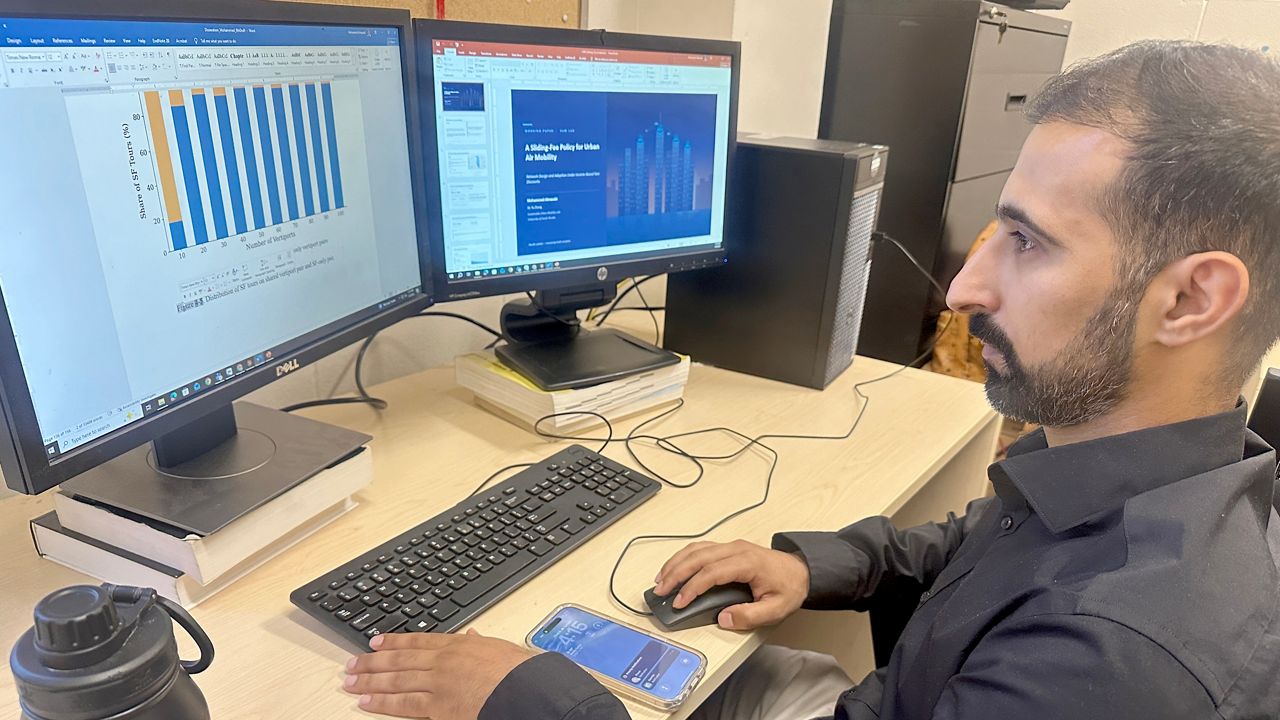
Researchers are also looking at what it would mean to introduce a pricing system based on income. Almasabi said AAM is expected to be a premium service for higher income customers, which could create an equity issue when it comes to access.
“How can we design the new AAM network in a way that people from different income levels can benefit?” Almasabi said.
He told Spectrum News that researchers studied implementing a sliding scale for pricing based on income and compared that to a fixed pricing system.
“The revenue stayed higher when we applied a sliding fee policy than the baseline, because we increased the adoption of people who will be using it,” Almasabi said.
While it’s unclear when the aircraft could make their official debut, Zhang said it’s important to be ready when they do.
“We could have infrastructure systems ready,” she said. “We could have the corridor in the air space ready. We could have the accessibility to the vertiports with the different transportation modes ready.”
When it comes to air taxis, the state of Florida is also preparing — Gov. Ron DeSantis signed a bill last month that authorizes the Florida Department of Transportation to fund a portion of vertiport project costs.