
SANTA ROSA COUNTY, Fla. — Before Northwest Florida was known for beaches and tourism, it ran on timber.
Arcadia Mill in Santa Rosa County was a hub of the industry.
Today, the entrance to the Arcadia Mill archaeological site looks a lot like a neighborhood park.
In fact, it is. Many people go there to hike the trails or picnic among the trees, enjoying the quiet sense of calm.
But just beyond the historic marker, there’s a hidden world — one that helped shape Northwest Florida.
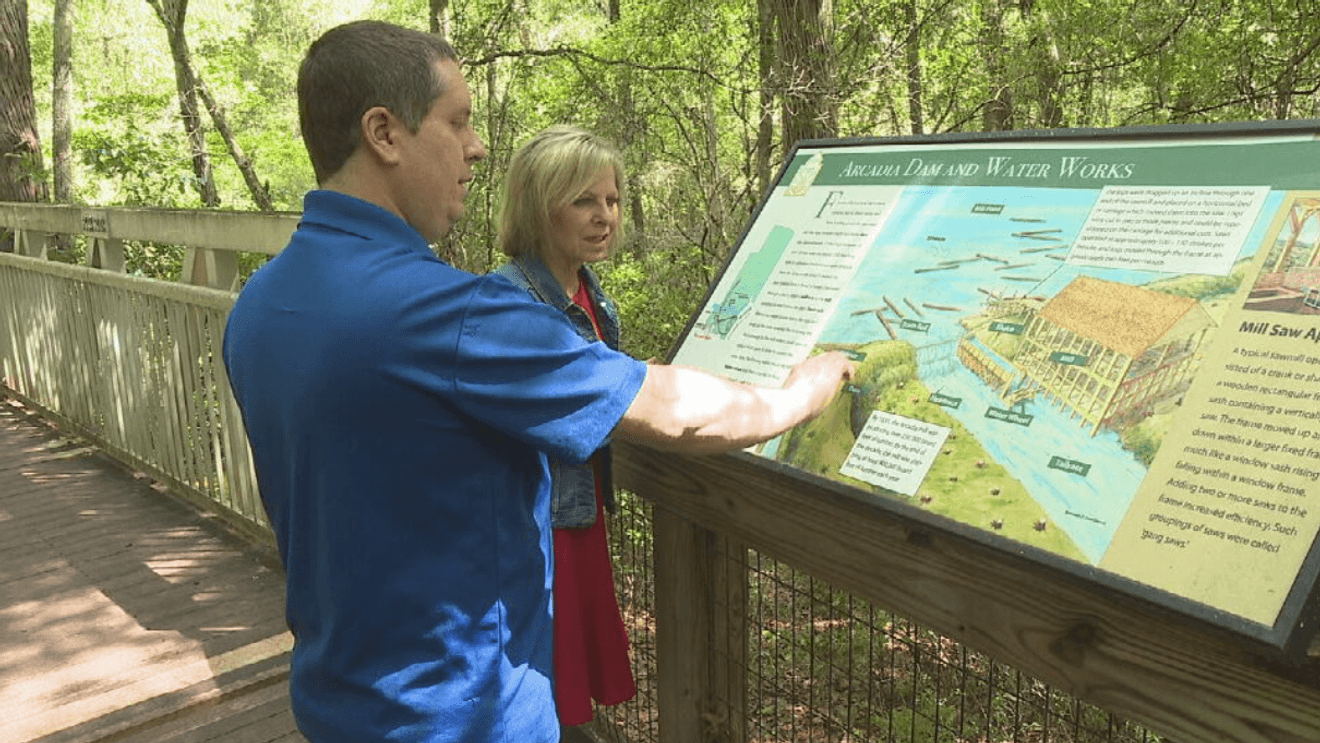
“This is area A of the excavation, this is the Sawmill Bridge,” said Alli Frank with the University of West Florida Historic Trust.
Beneath a century of forest growth lies the footprint of an industry that once powered the region.
“Arcadia Mill was the first and really the largest industrial complex in Northwest Florida,” said Phillip Mayhair with the UWF Historic Trust.
In the early 1800s, the area’s vast longleaf pine forests drew developers looking to capitalize on an abundant natural resource.
A water-powered sawmill was built along Pond Creek — strategically placed to use the current not only for power, but for transportation.
“You would see these mills located on creeks or rivers because that was powering the mill, but it was also the way of transporting the logs,” Mayhair explained. “They would dig ditches across the countryside, float the logs to the mill, and eventually send them down to Pensacola for export.”
Today, visitors can still see pieces of that system.
Inside the visitor center are tools and artifacts uncovered during archaeological digs. Outside, remnants of log flumes crisscross the landscape, along with traces of a dam that once created a 60-acre mill pond.
In its peak years, dozens of workers — including enslaved laborers — cut, moved, and processed timber here, turning it into one of the region’s most valuable commodities.
“Those industries are really what created our communities that are still here today,” Mayhair said. “Milton was a mill town.”
Not far from the mill site, framed by towering live oaks, sits the homesite of the mill owners. A marker shows where the original structure stood before it burned in the 1930s.
“You’re literally walking through antebellum history,” Frank said. “You’re walking through the archaeological features here.”
For Frank, the site is more than a place to study — it’s personal.
“I grew up in this neighborhood, playing around the archaeological site,” she said. “My friends and I would come after school and just run up and down the bridge.”
Her childhood fascination grew to a passion, and then a career.
Now when she sees visitors here enjoying nature, she knows she can help them see into the past, just like she does.
“History is all around you,” she said. “You might not recognize it, but it’s still there.”