
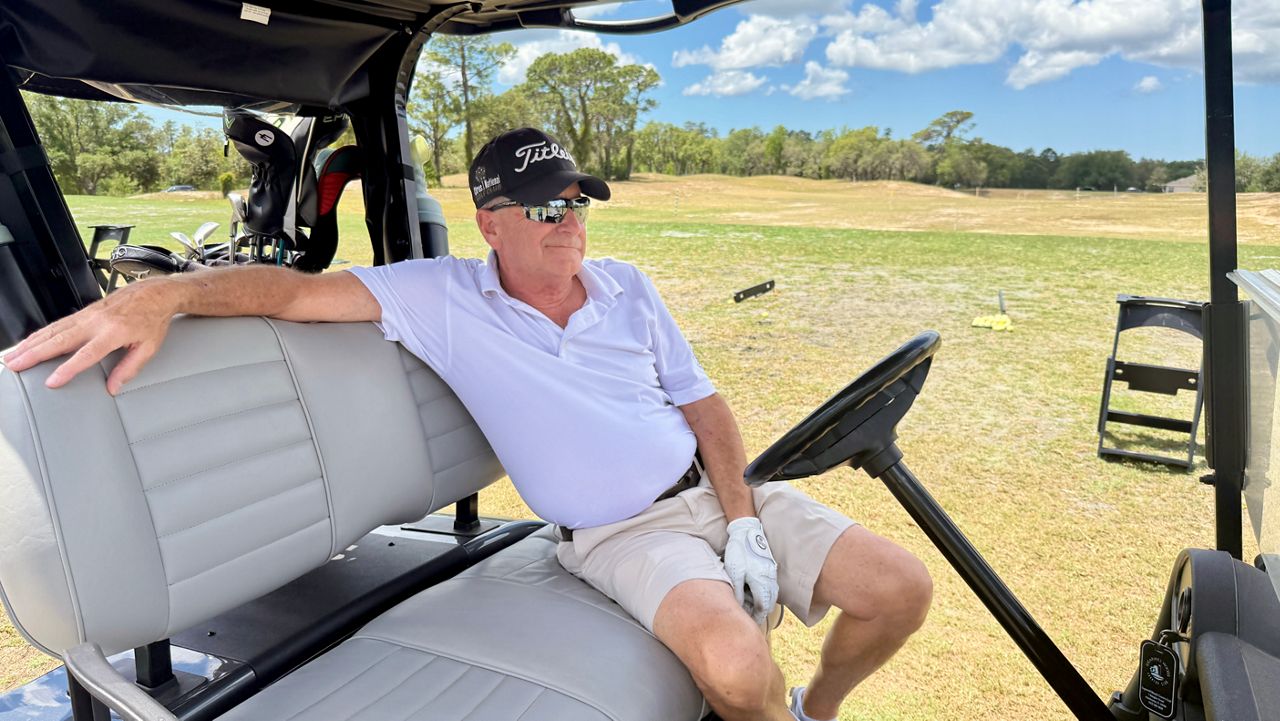
LARGO, Fla. — Jackson Cairns feels blessed with the life he lives after a health scare with an abdominal aortic aneurysm.
“You could say I’m living the perfect life you know? Retired, I work part time at the golf course. Get to play every day if I want,” he said.
He works at Citrus National Golf Club in Homasassa.
“I get the course ready, the driving range ready, and putting greens,” said Cairns.
He also gets to play all the golf he wants, and in April he was doing just that with friends when his back started to hurt. It got so bad he took himself to the emergency room where they gave him a CT scan.
“Thank God they did because, you know, that’s come find out it was the AAA (abdominal aortic aneurysm),” said Cairns. “The aneurysm, she said, was the size of a grapefruit.”
“It’s literally five times bigger than what his aorta should be,” said Dr. Jesse Klein, an interventional cardiologist at HCA Florida Largo Hospital.
Cairns’ diagnosis was so severe he was transferred from HCA Florida Oak Hill Hospital to HCA Florida Largo Hospital under the care of Klein, an interventional cardiologist.
He had AAA, which stands for abdominal aortic aneurysm.
“It is serious,” said Klein. “It’s the 13th leading cause of death. And it is a true silent killer because it usually is unrecognized until the patient becomes symptomatic.”
Symptoms include deep pain in the stomach or side, back pain, and/or throbbing or pulsing near the belly button.
Because Cairns was given a CT scan, it was clear his aneurysm was huge. It was 10 centimeters.
“With that being that big, you really had close to a 50% chance of death in the next year, even if he was asymptomatic at the time,” said Klein.
Instead of open-heart surgery, which Klein says is well known to be one of the most dangerous surgeries, he opted for a vascular surgery called E-VAR (endovascular aneurysm repair).
Going through the femoral artery, a sleeve goes up and realigns the aorta. That prevents blood flow to the aneurysm. Klein says all studies point to this being highly favorable to survival at the 30-day mark post surgery compared to open-heart.
“It was very successful,” said Klein. “And that led him to be discharged from the hospital a day or two later. Where, as you know, he’s back on the golf course a week later enjoying what he does.”
“I thank God He loves me,” said Cairns, laughing as he swung at a ball on the driving range.
A week after the vascular surgery, Cairns was back hitting golf balls. Now a month later, he can play a full 18 if he wants.
“I think God said to me, He says, ‘You’re not under a 10 handicap yet, so we got to keep you alive a longer.’ So I’m glad He gave me another chance here,” said Cairns.
AAA is not uncommon and affects older people, 65 and up, at a higher rate. It also is more prevalent in men.
People who smoke are at higher risk of AAA and Klein said screening for this is important.
Anyone who is a Medicare patient over 65 can get a free screening if they have a family history of aneurysm or have been a smoker.