
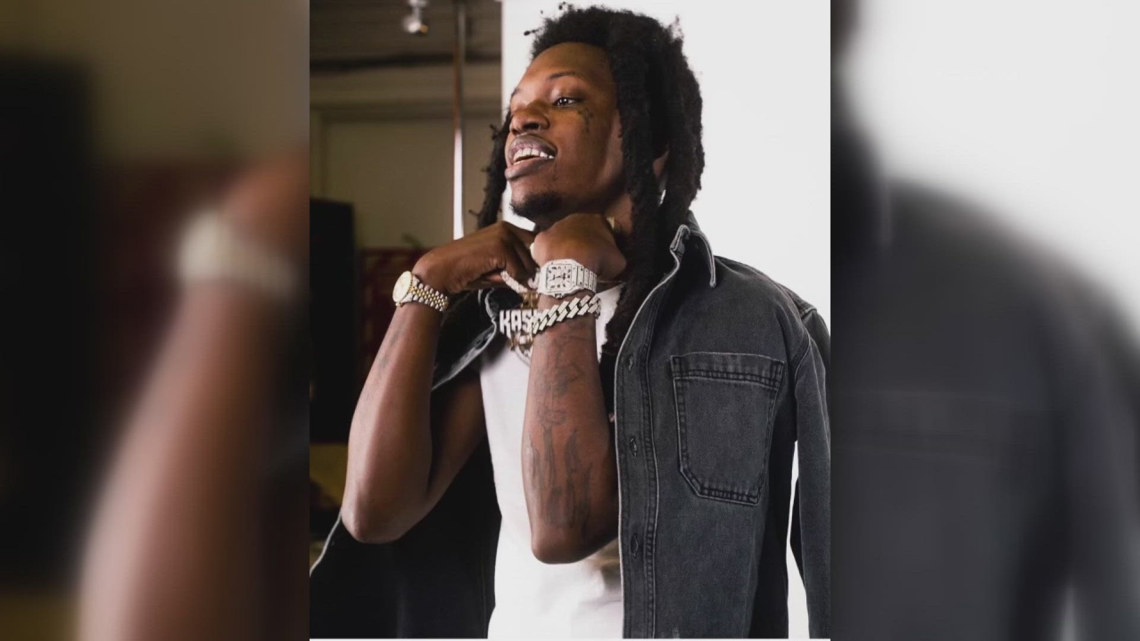
The verdict is in for four men accused of killing the Jacksonville rapper in Tampa in June 2024.
TAMPA, Fla. — A verdict has been reached in the murder trial of four men accused of killing Jacksonville rapper Foolio in 2024.
A Tampa jury is set to deliver the verdict to Judge Michelle Sisco.
Foolio, whose real name was Charles Jones, was celebrating his 26th birthday in Tampa on June 23, 2024, when investigators said he was ambushed and killed outside a Holiday Inn hotel. Three others were wounded in the shooting.
Prosecutors said the rapper’s murder is part of an “ongoing gang war” in Jacksonville.
Isaiah Chance, Sean Gathright, Davion Murphy and Rashad Murphy are each charged with first-degree premeditated murder.
Closing arguments wrapped up in the trial on Friday.
In the state’s closing arguments, Assistant State Attorney Michelle Doherty rehashed evidence presented throughout the trial, including cellphone records and cell site data, that provided a timeline of the defendants’ movements before and after Jones’s murder. She said the records and data show the four defendants traveling from Jacksonville to Tampa the day before Jones was killed, and that cell towers pinned Chance’s and Gathright’s phones at the murder scene. Doherty said texts and calls were also made between defendants leading up to Jones’ death.
The state also rehashed video and ballistic evidence collected over the course of the investigation. They brought up how surveillance footage spotted Chance at a nightclub at the same time as Jones hours before his murder, and how the brand of ammunition found in Gathright’s vehicle when he was arrested matches the brand of a shell casing found at the scene.
The state revisited surveillance footage shown earlier in the trial, including video prosecutors said captured Chance at a nightclub at the same time as Jones just hours before the shooting.
Defense attorneys argued the state’s case relies heavily on circumstantial evidence and does not directly prove who carried out the shooting.
Rashad Murphy’s attorney, Brian Gonzalez, told jurors that Murphy’s cellphone data does not show him traveling from Jacksonville to Tampa the day before Jones was killed and said the phone was not located in Tampa during times relevant to the murder.
Gonzalez also addressed statements Murphy made to investigators after his arrest that prosecutors said were false.
“When someone is fearful for a wrongful implication, they sometimes make poor judgments and that’s exactly what Rashad Murphy did,” Gonzalez told jurors. “It’s common to attempt to remove yourself from the closeness of a bad situation, but don’t automatically presume that that means and equates one to one that he’s lied about committing a murder.”
Following the defense’s closing arguments and the state’s rebuttal, a tense moment occurred in court when Davion Murphy was heard arguing with Judge Michelle Sisco, who ordered him out of court after warning him multiple times to stop talking.
“This doesn’t help your situation,” Sisco said to Murphy as he was being escorted out.