
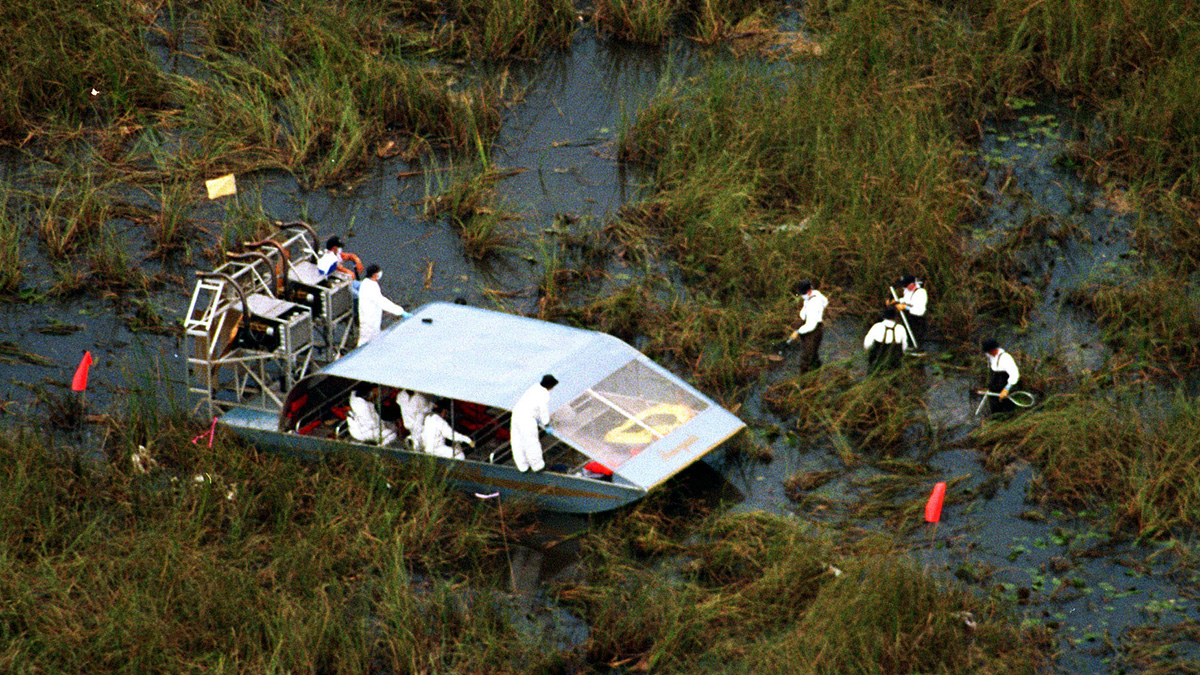
Monday marks exactly 30 years since ValuJet Flight 592 plunged into the Florida Everglades, killing all 110 people on board shortly after taking off from Miami.
The tragedy lefts its mark on South Florida and the aviation industry, leading to major changes in air safety regulations.
The Crash
It was the afternoon of May 11, 1996, the day before Mother’s Day, when the Douglas DC-9-32 crashed about 10 minutes after taking off from Miami International Airport.
The plane – carrying two pilots, three flight attendants, and 105 passengers – was on its way to Atlanta when it went down about 10 miles west of the Miccosukee Casino and 17 miles northwest of MIA.
There were no survivors.
Getty ImagesGetty Images
Search And Rescue Workers Reach Into The Muck As They Search For Evidence In The Crash Of Valujet Flight #592. 5/14/96 (Photo By Miami Herald/Getty Images)
According to a National Transportation Safety Board report, the captain, Candalyn “Candi” Kubeck, reported an electrical problem on the plane not long after takeoff.
“We’re losing everything,” Kubeck told the departure controller, according to the report. “We need to go back to Miami.”
Seconds later, shouts of “fire, fire, fire, fire” could be heard in the background of the radio transmission, and the plane’s cockpit voice recorder captured a man’s voice saying “we’re on fire, we’re on fire.”
The flight’s first officer was heard saying there was smoke in the cabin and the plane began turning back but it was too late.
National Transportation Safety BoardNational Transportation Safety Board
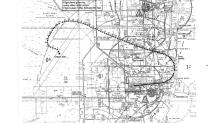
ValuJet Flight 592’s flight path
Witnesses who were fishing on a boat in the Everglades reported seeing the plane nosedive and hit the ground “in a nearly vertical attitude.”
“The witnesses described a great explosion, vibration, and a huge cloud of water and smoke,” the NTSB report said. “One of them observed, ‘the landing gear was up, all the airplane’s parts appeared to be intact, and that aside from the engine smoke, no signs of fire were visible.”
The report said a witness who was sightseeing in a private airplane at the time “remarked that the airplane seemed to have disappeared upon crashing into the Everglades.”
The Investigation
First responders scoured the crash site but it quickly became clear that no one survived the impact, so crews began collecting what was left of the wreckage.
A lengthy investigation was launched and the NTSB determined the plane crashed after improperly packaged oxygen canisters ignited a fire in the cargo bay.
NBC 6NBC 6
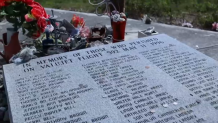
Memorial of the 110 victims of the 1996 ValuJet crash
The NTSB report said a ValuJet maintenance subcontractor needed to clear their facility of what they thought were “expended” oxygen generators, the devices that are installed above every passenger seat that in case of an emergency produce oxygen for the masks that drop from the overhead baggage racks. The process involves a chemical reaction, which produces searing heat.
The workers, employed by Sabretech, boxed up the oxygen generators, did not place safety caps on them but certified that they were properly capped and were empty, investigators found.
Those generators were placed in several cardboard boxes in the cargo bay that rested on top of airplane tires. At least one of the oxygen generators ignited, which in turn caused the boxes and tires to burn.
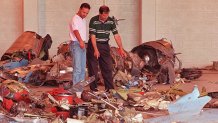
Getty ImagesGetty Images
MIAMI, FL – MAY 26: National Transportation Safety Board (NTSB) investigators point 26 May to debris gathered from the crash site of Valujet Flight 592 that crashed 11 May some 20 miles northwest of the Miami International Airport after the pilot reported smoke in the cockpit. Investigators told journalists at a press conference that 40% of the plane had been recovered from the crash site in the Florida Everglades swamps. AFP PHOTO Chris BERNACCHI (Photo credit should read CHRIS BERNACCHI/AFP via Getty Images)
“The Safety Board concludes that although the installation of safety caps would not likely have prevented the oxygen generators from being transported on board flight 592, it is very likely that had safety caps been installed, the generators would not have activated and the accident would not have occurred,” the NTSB report said.
The fire broke into the cabin, filling the DC-9 with smoke and flames, and the heat eventually burned through the airplane’s control cables, likely leaving the pilots unable to control the stricken jet.
“The Safety Board concludes that the loss of control was most likely the result of flight control failure from the extreme heat and structural collapse; however, the Safety Board cannot rule out the possibility that the flightcrew was incapacitated by smoke or heat in the cockpit during the last 7 seconds of the flight,” the NTSB report said.
The Manhunt
The investigation into the crash resulted in the indictment of SabreTech and three of its employees. Two of the employees were taken into custody but the third fled before trial.
That third employee, Mauro Ociel Valenzuela-Reyes, remains a fugitive. In 2018, more than two decades after the crash, the FBI announced a $10,000 reward for his capture.
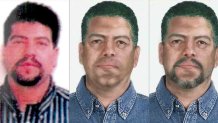
FBIFBI
Age-progressed images of Mauro Ociel Valenzuela-Reyes from the FBI
Valenzuela-Reyes has connections to Atlanta, Georgia, where his ex-wife and kids have resided, and Santiago, Chile, where he has family and may be residing under a false identity, FBI officials said.
Valenzuela-Reyes, who would be 57 now, faces charges including conspiracy to make false statements to the Federal Aviation Administration and the Department of Transportation, false statements to the Federal Aviation Administration and the Department of Transportation, causing the transportation of hazardous material, disobedience and resistance to lawful order and command of the United States District Court for the Southern District of Florida, and failure to appear for trial.
Safety Changes
In the wake of the crash, multiple changes were made regarding flight safety.
The FAA tightened oversight of maintenance companies and imposed strict regulations on what items could be shipped in airline cargo holds. In addition, the FAA quadrupled the inspectors who check out cargo shipments on passenger jets.
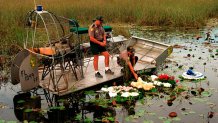
Getty ImagesGetty Images
In The Everglades, West Of Miami — 5/15/96 — Metro-Dade Fire Rescue — Florida Game And Fish Commission Officers Lay A Teddy Bear And Wreaths From Family Members On The Water Above The Scattered Remains Of Valujet Flight 592. Family Members Of Crash Victims Were Taken Near The Site Wednesday Evening, But Did Not Go Out Into The Water Where The Plane Crashed. (Photo By Pool/Getty Images)
Other changes were implemented to keep the cargo clear of anything that can catch fire and devices were installed in the cargo area allowing pilots to see if something is overheating or if a fire actually breaks out. There is also now a fire suppression system to put out any fires.
Crash Legacy
After the crash, a memorial to the victims was erected in the Everglades off Tamiami Trail. The memorial includes 110 descending concrete columns, one for each victim of the crash.
The columns are in the shape of an arrow that points toward the crash site.
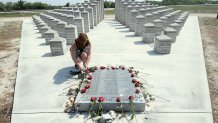
Getty ImagesGetty Images
Robin Steinbrenner takes a moment to pay her respects Wednesday, May 11, 2011 at the memorial in Miami-Dade County, Florida, to those who died in the ValuJet Flight 592 crash. Robin’s father Fred Steinbrenner was on that flight that crashed into the Everglades 15 years ago. (Peter Andrew Bosch/Miami Herald/Tribune News Service via Getty Images)
ValuJet never recovered from the disaster and merged with another low-cost airline. The Miami-based SabreTech went out of business.
The ValuJet disaster is the deadliest plane crash in Florida to-date.