
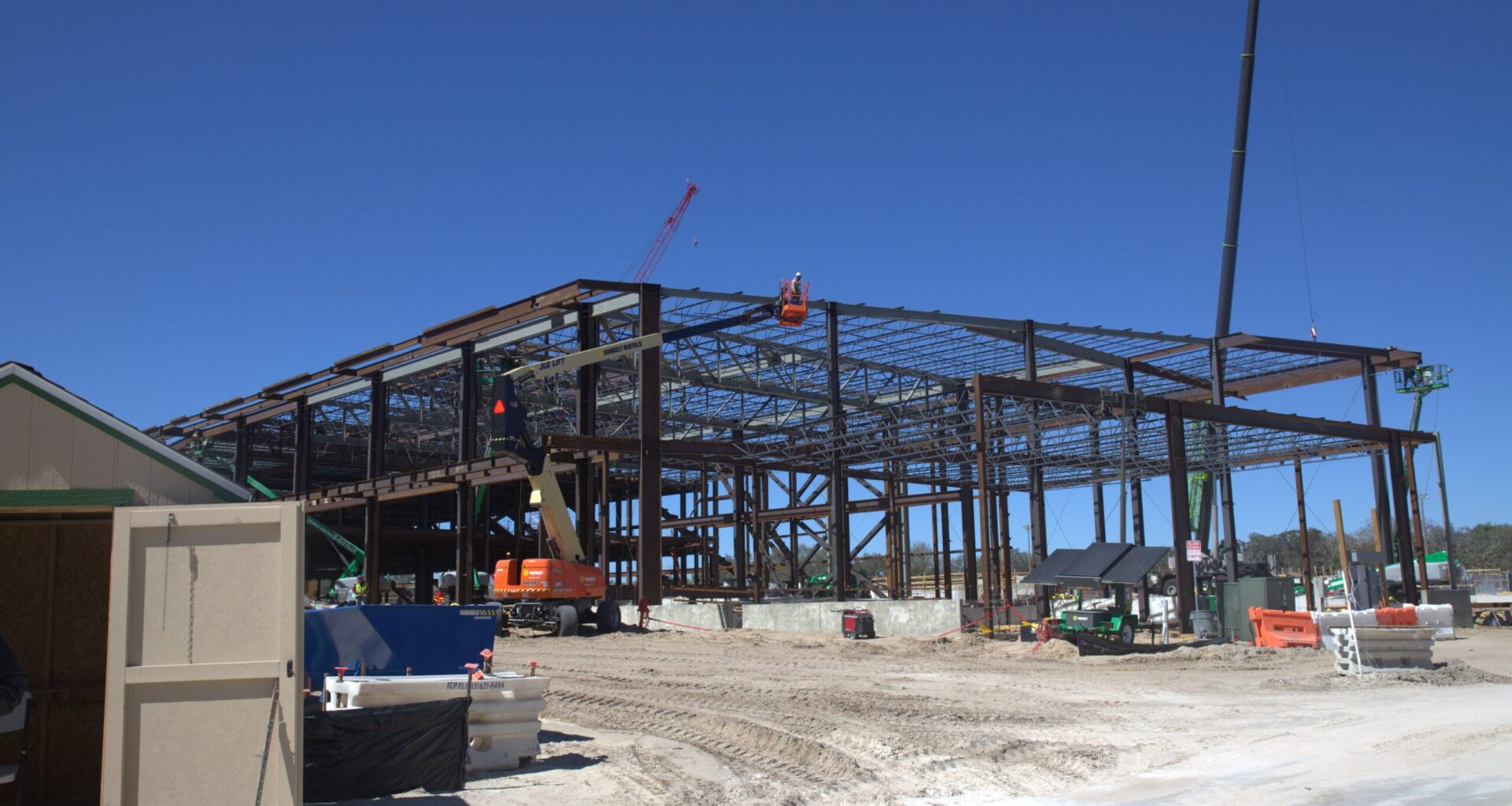
 USF’s on-campus stadium broke ground in November 2024, and is set to open by fall 2027. It’s being built at Sycamore Fields, where two sinkhole formations were reported just weeks before groundbreaking. ORACLE PHOTO / MITHIL VYAS
USF’s on-campus stadium is one of the most ambitious developments in university history. But, concerns over unstable ground have followed the development from the start.
USF Emergency Management reported the formation of two potential sinkholes at Sycamore Fields in October 2024, weeks before USF broke ground on the same site for its planned $407 million stadium project.
One formation was reported to be three feet wide and two feet long, while the other was reported to be three feet wide and one foot long, according to the Florida Department of Environmental Protection’s Subsidence Incident Reports map.
The sinkholes did not cause any structural damage, but led to practice delays for USF intramural teams, according to The Oracle.
Still, the discovery of the sinkhole formations and surrounding unstable soil prompted developers to pump thousands of cubic yards of grout into the earth to fortify the stadium’s construction.
Related: USF students autograph piece of on-campus stadium: ‘Extremely excited’
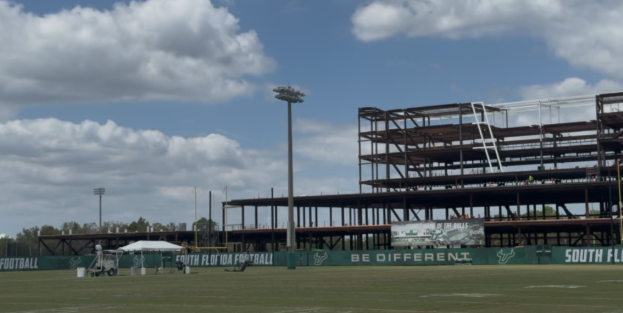 The on-campus stadium and related infrastructure were given a $407 million expenditure in April 2025. The stadium itself is set to cost $348.5 million. ORACLE PHOTO / NOAH VINSKY
Months after the findings, engineering consultants hired by USF identified additional concerns beneath the site.
USF tapped engineering consultant Tierra, Inc. in February 2025 to perform a geotechnical engineering services report of the stadium site. After drilling 96 borings into the soil around the site, it found 11 that were “indicative of potential karst/sinkhole activity.”
“The encountered conditions indicate the highly weathered nature of the Limestone formation and the potential for future soil raveling as the result of sinkhole/karst activity,” the report said, dated Feb. 26, 2025.
The engineering firm recommended subsurface compaction grouting for the 11 borings, a construction technique that stabilizes sinkholes or loose soil through injecting stiff grout into the ground.
Tierra, Inc. and contractor Keller North America performed the compaction grouting, installing 159 grout points throughout the stadium site, according to the compaction grout monitoring report.
Each point was injected with 1.1 to 120.8 cubic yards of grout – resulting in 4,225.2 cubic yards of grout injected, according to the report.
The compaction grouting was completed between July and October 2025, a few months after former Vice President for Athletics Micheal Kelly said in April 2025 stadium construction would begin “in earnest” that month.
University spokesperson Althea Johnson said it’s “best practice” for USF to address the soil conditions before construction began.
“Independent engineers identified subsurface soil conditions in limited areas that are indicative of karst geology, which is a naturally occurring condition across much of Central Florida,” Johnson said.
Despite USFEM reporting two potential sinkholes at Sycamore Fields in 2024, Johnson said the findings do not mean that sinkholes were already present, or actively forming, on the site.
She did not answer questions about USF’s initial response to the potential sinkholes.
USF approved $407 million last April for the stadium development and supporting infrastructure, including new wastewater and stormwater facilities and a lift main.
Although Johnson did not respond to questions whether the grouting will cause additional project costs, USF approved an owner’s contingency fund of $10.5 million to account for any unexpected costs.
Despite the formations, geology and engineering experts say the stadium is in little danger of sinking into the ground, and additional structural fortification is a common occurrence given Florida’s penchant for sinkhole formation.
Related: USF football’s operations center will feature barbershop, golf simulator
Ryan Shamet, an assistant professor of civil engineering at the University of North Florida, said the amount of grout used is “a lot,” but necessary precautions aren’t unusual given the size of the project.
“This is a long term investment, so before they construct it, they’re just covering their bases and trying to improve the ground to a pretty high degree,” Shamet said.
USF’s on-campus stadium is set to open by fall 2027, and will boast a capacity of 35,000 spectators. It will be home to USF’s football and women’s lacrosse teams.
Plans for an on-campus stadium stem back nearly a decade, but were renewed in 2021 when former Board of Trustees Chair Will Weatherford promised the construction of the stadium during the groundbreaking of USF’s indoor practice facility.
Four potential sites were considered for the stadium. Kelly proposed a fifth in December 2021 – Sycamore Fields.
By March 2022, the BOT recommended the intramural fields as the site for the stadium.
The Florida Board of Governors approved USF taking a $200 million debt issuance for the stadium in September 2023. After a few delays, USF broke ground on the stadium at Sycamore Fields in November 2024.
Construction activity, however, remained limited for several months afterward as engineers continued evaluating soil conditions beneath the site.
Related: USF approves $407 million price tag for stadium, related infrastructure
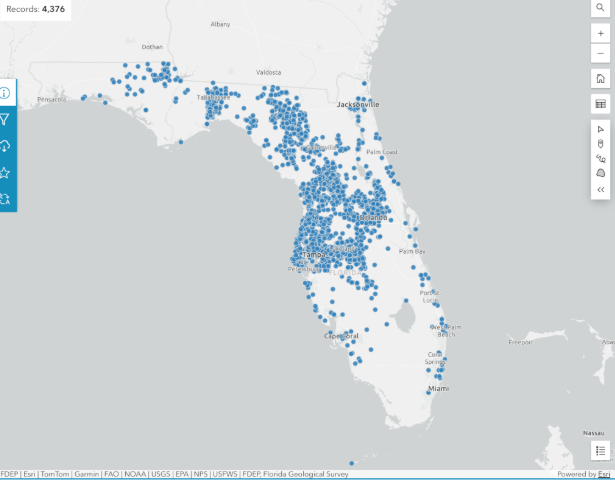 A view of the Florida Department of Environmental Protection’s Subsidence Incident Reports Map. Each blue dot represents a reported sinkhole formation. PHOTO COURTESY OF FDEP
Florida is especially prone to sinkhole formation, Patricia Spellman, an assistant professor at the USF School of Geosciences, said.
Spellman said sinkholes form within karst landscapes, a layer of limestone underneath the ground surface that is extremely soluble and sensitive to water.
Rain easily washes away these limestone formations, which gives way to sinkholes and other features common in karst geology like springs and caves, Spellman said.
“Limestone is very vulnerable, it’s easily weathered, so it dissolves readily when rainwater hits it, basically any acidic waters,” Spellman said.
USF lies within what is commonly known as Florida’s “Sinkhole Alley,” which encompasses Hillsborough, Pasco and Hernando Counties.
Karst features are common in this area of the state. 66% of all sinkhole damages reported to the Florida Office of Insurance Regulation occur in these three counties, according to the City of Tampa.
USF is also an active hotbed for sinkhole formations. There are 20 formations reported within the boundary of USF’s Tampa campus, according to the Subsidence Incident Reports map.
A truck was caught in an eight-foot sinkhole that opened on Magnolia Drive in 2019, according to The Oracle. The driver was uninjured and the truck was successfully removed.
Sinkholes also opened on Magnolia Drive in 2022 and 2025, according to the Subsidence Incident Reports map.
A 10-foot wide sinkhole opened in the roadway along the former Sycamore Fields in 2015, according to The Oracle.
Spellman said cover subsidence sinkholes, which are formations in the ground that open up after subsurface limestone is washed away by things like heavy rain, are the most common in Florida.
Predicting sinkhole formation, Spellman said, is a difficult science.
“There are probably likely areas that are more prone to open up and more prone to have sinkholes, but there’s really no way of knowing that,” she said.