
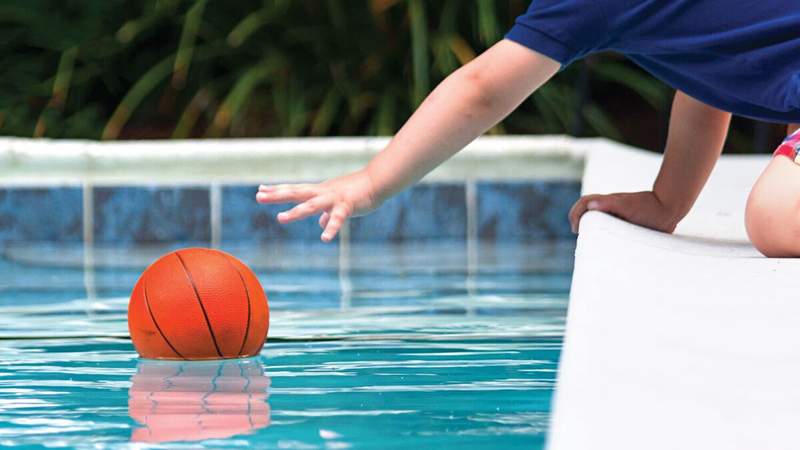
Earlier this month, a 4-year-old girl slipped into a pool at a Bradenton party and drowned. She was underwater for nine minutes, according to a police report. There were adults everywhere.
Nobody noticed because drowning doesn’t look the way it does in the movies.
There’s no screaming, no splashing, no waving arms. Children drown quietly. They can’t call for help because they are gasping for air. A child can be literally within feet of someone who thinks she’s playing.
Bradenton police charged Rosette Pierrecius with child neglect. According to the affidavit, she had drunk six Corona beers at the party. The surveillance video shows her walking around the pool deck on her phone, not watching her daughter. But there was a room full of adults there, too, and not one of them noticed either.
At the National Drowning Prevention Alliance, where I’m a Teen Ambassador, we know that 88% of child drownings occur with at least one adult present and 23% happen during a family pool gathering, and yet children still drown.
As a 16-year-old water safety advocate, I visit preschool and elementary school classrooms to teach basic water safety. In those classrooms, I hear the same thing over and over: Nobody in my family knows how to swim. This is especially true in low-income and African-American communities, where 64% of African-American children have little to no ability to swim, a gap that can be traced in part to segregation-era laws. That legacy is still felt: African-American children ages 10 to 14 drown in swimming pools at rates 7.6 times higher than white children.
Rosette Pierrecius has been charged with serious neglect. I’m not here to defend her. But the charge against her doesn’t address the harder question: Why didn’t anyone at that party know what drowning looks like? And why didn’t anyone ever teach that little girl the most basic water safety rule: If you can’t swim, stay out of the water unless an adult is with you.
The answer is nobody taught them. Not the mother. Not the adults at that party. And most importantly, not the child.
Florida leads the nation in child drownings, with 119 last year. Drowning is the No. 1 cause of death for children ages 1 to 4, and the second leading cause of accidental death for children ages 5 to 14. To its credit, Florida has taken steps to address this. Gov. Ron DeSantis recently signed a law expanding the state’s swim lesson voucher program and requiring hospitals to give new parents water safety information.
The voucher program targets children. The hospital pamphlet targets mothers. But neither guarantees anything. Vouchers require a caregiver who knows about the program, can navigate a form, and can get their child to the lesson. And a pamphlet handed to an overwhelmed new mother at the hospital is not the most effective way to deliver a life-saving message, even if there is a captive audience. Instead, the American Academy of Pediatrics recommends pediatricians discuss water safety at every well-child visit. That’s a more consistent way to make sure the message gets delivered.
The only way to guarantee every child gets the message is to put it in the classroom. Louisiana has already figured that out, passing a law mandating classroom-based water safety education in public schools. All that’s required is a teacher, a lesson plan, and 20 minutes. We can never forget that children don’t understand that they can drown. To them, water looks interesting and safe.
We are very good at assigning blame. We are not as good at preventing the next drowning. Until we start teaching children the basics of water safety, we will keep arresting mothers and burying children.
Kate Casciato is a high school junior, Teen Ambassador for the National Drowning Prevention Alliance, and founder of Own Your Float, a student initiative that teaches water safety in preschool and elementary schools. She is a competitive swimmer and teaches swim lessons to low-income children on weekends.