
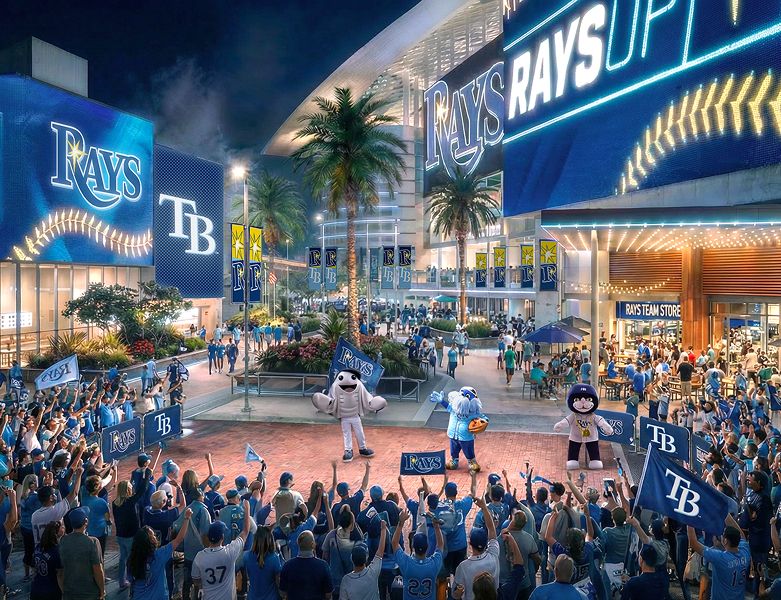
The Tampa Bay Rays have agreed to preliminary terms for a new ballpark at Hillsborough College’s Dale Mabry Campus in Tampa.
That clears the way for local governments to take up a nonbinding memorandum of understanding (MOU) before the team’s June 1 deadline.
Hillsborough County is slated to approve the MOU by the end of the month, with the county pledging $796 million and the city offering $180 million toward the project, sources inside Hillsborough County government told Florida Politics.
Together, those local commitments would total $976 million, which is less than the estimated $1.1 billion in public funding the Rays had sought from the two governments for the stadium. The gap leaves unresolved how the team would close the financing plan for the stadium.
The MOU is nonbinding, so there could still be room for further negotiations as well.

Gov. Ron DeSantis has said the state could support transportation improvements, campus work and other public-facing infrastructure tied to reimagining the Hillsborough College campus. But he drew a firm line against direct state money for the stadium itself.
The MOU would mark the first major local breakthrough for the Rays since new ownership began pushing for a new ballpark and entertainment district in Tampa to replace the team’s home in Tropicana Field in St. Petersburg. Rays President Ken Babby recently told local officials the team needs a deal framework in place by June 1 to preserve its goal of opening a new ballpark by the 2029 season after the team’s lease in St. Pete expires.
Babby has described the proposal as a “generational opportunity” for Tampa while saying Rays ownership is prepared to put more than $1.1 billion toward the ballpark, cover cost overruns, and take on development risk tied to the surrounding district.
But the public cost has remained the central point of tension in recent weeks.
Tampa and Hillsborough officials have been weighing whether to back the deal with future community investment tax revenues, tourist development tax dollars, other financing mechanisms and possible reserve funds.

Several local officials have voiced support for keeping the Rays in Tampa Bay, but have also questioned whether the public risk is too high as the city and county face their own infrastructure, transportation and debt pressures.
The local offer would still represent a massive public commitment, and could alleviate some concerns about public funding at the state level.
Senate Appropriations Chair Ed Hooper recently warned that the Legislature should be cautious about committing state dollars while Tampa, Hillsborough County and the Rays were still working through the local deal.
Hooper said there appeared to be “heartburn” at the local level and suggested the state should wait until those issues were resolved before getting involved.
The Senate had previously backed a $50 million request from Hillsborough College, though the House did not include the money in its budget plan. Sources familiar with the process have told Florida Politics the funding remains in play through the Public Education Capital Outlay process, even after it was left out of earlier budget conference documents.
DeSantis, meanwhile, has continued to say he supports the Tampa site and believes the MLB wants the Rays to remain in Florida. But he has also warned that other markets such as Orlando would be ready to pursue the franchise if Tampa Bay cannot close the deal.
Once officially approved, the MOU does not finalize the Rays stadium deal but it shows that Hillsborough County intends to play ball.
Future agreements would have to answer the larger questions still hanging over the project, including exactly how much public money is ultimately committed, how much of it is bonded and how much comes from other sources like the county’s reserves.