
Dear St. Petersburg City Council members,
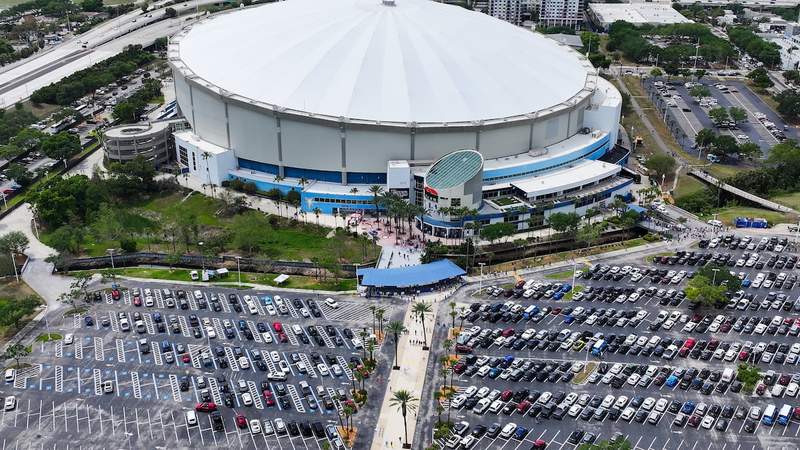
Recently, the council voted to pause selecting, negotiating or advancing a developer for the Tropicana Field site. As I understand it, council’s approach is to develop a comprehensive planning framework to be done by “independent, professionally qualified planners and guided by city residents, city-based businesses and employees, and organizations that represent city residents.” This approach, which I believe is correct, puts the citizens’ representatives in control of the process — not a single developer.
In June last year, I attended a gathering hosted by the Tampa Bay Times and The Foundation for a Healthy St. Petersburg to discuss the future use of the Trop site. There were many attendees and a group of panelists, selected for their unique perspectives on the subject. During the discussion, most of the panelists agreed that parkland should be a significant component of the development.
To me, the most compelling panelist was Mozell Davis, a longtime, highly respected educator and a former resident of the Gas Plant area, where the Trop site is presently located. Much of the discussion over recent years has been how best to honor the promises the city made when businesses, churches and residents were relocated many decades ago to redevelop the area.
When asked what should be on the site, Ms. Davis replied “something that attracts families, groups of people . . . [a] great place to raise your children.” When asked what it shouldn’t be, she replied “lots of concrete, tall buildings, no parks, no sidewalks, things that don’t welcome walkers.”
Ms. Davis later went on to say that “we certainly need to respect and accept and know what happened . . . in particular, if the Woodson Museum is constructed as an excellent facility and it shows the correct history . . . and all of that somehow is archived and presented as a part of the history of St. Petersburg . . . then I think that would be acceptable to those descendants [of Gas Plant residents].” Earlier in the panel discussion, Ms. Davis commented that we “should look back but don’t stay back.”
Looking back, moving forward
In deciding how to move forward by both balancing the desire to honor those who came before and developing this site in a manner that benefits the entire community, the council’s approach described above is the obvious way to proceed with the development of these 86 acres of city-owned downtown property.
The future of this site should not be turned over to a single developer, whose approach will be biased toward results that make the development team more money. There is nothing wrong with making money. But it is the city’s land, and a profit-making built-in bias weighs heavily against committing large portions of the site to city priorities such as parkland and other public amenities that do not translate directly into profits for the developers.
The city should first decide what parkland and other public amenities will be contained on the site. Set aside that land, then identify the remaining parcels that are subject to development by private developers and allow them to bid for the parcels. In addition to giving the public amenities top priority, this process allows for a larger group of developers to be part of the process after land for the public amenities is set aside.
Ms. Mozell’s desire, which I think reflects the desires of many in our city, should be central for the approach to this site: A place that has parkland, is not dominated by concrete and tall buildings, that attracts families, groups of people, and is welcoming to our children. Many in our community feel that downtown is not a place they can be part of, because they cannot afford the activities that take place there. A significant portion of this site should be available for enjoyment by all citizens in our city, regardless of means.
 St. Pete Commons
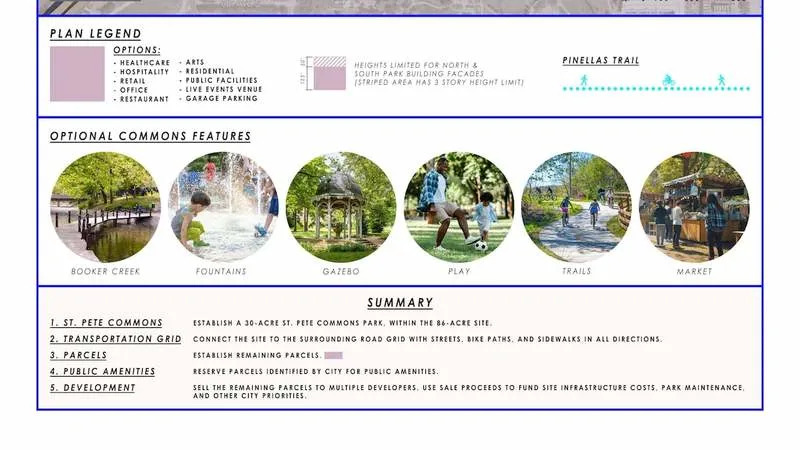
With this approach in mind, the core of my suggested approach is the creation of a 30-acre public park that I call St. Pete Commons, because of its similarity to the amazing Boston Common, a 50-acre park known throughout the world. I did not respond to the city’s request for proposals because I am not seeking to become an owner or developer of the site; rather, I suggest that the city would be better served by taking control of its own future and driving the direction of the redevelopment, not adopting any single developer’s plan for the future of this site. Here is an approach:
Establish a St. Pete Commons park as the site’s central feature. As a starting point, I recommend that the city’s site plan include, as its centerpiece, a 30-acre park, as identified on the attached site plan. A significant park is consistent with public input, as reflected in the speakers at the forum discussed above.
It is our green space that makes St. Pete special. That is important to remember.
The vision of a city focused on parkland and quality of life was established by our founders when they fought to create and preserve our waterfront park system, beginning in the early 1900’s. That effort has been embraced, nurtured and expanded by those who followed over the next 125 years.
One hundred years from now, few will remember or comment on the clusters of concrete buildings that have been suggested to the city in various developer proposals. But one hundred years from now — even in two hundred years — people will be thankful for the creation of a large green space for our residents to enjoy and our families to cherish.
People in our community are crying out for a counterbalance to the high-rise, high-density growth of our downtown. I support density development in the urban core — it is far better than invading rural green fields for urban sprawl. But the development of density in our downtown should be balanced with the growth of open green space and pedestrian scale. Our city’s founders realized that. It is time for us to add to what they created.
Create park amenities. I recently sat down with Mozell Davis at her home. She told me that the park should be welcoming to families, a place that is nice, that tells our residents you can come here and you don’t have to spend a lot of money. Features like picnic pavilions, playgrounds, flowering trees and decorations at Christmastime. Think of the 50-acre Boston Common, a magnificent public park amenity. Water features, outdoor concerts in the park, wading pools, open green space, bandstands, monuments, carousels, gardens, coffee stands, fountains, and more. St. Pete Commons would be about three times the size of St. Pete’s Vinoy Park and five times the size of North Straub Park. The process of identifying park features should be community driven.
Reconnect the site to the surrounding transportation grid. As shown on the attached site plan, the road grid should be reestablished within the site. This connects the site by vehicle, pedestrian and bicycle transportation north, south, east and west. When fully developed, the site will be seen as a seamless part of the downtown core, with the prominent feature being the St. Pete Commons park.
Establish development Sites. Assuming the site is 86 acres, carving out 30 acres for St. Pete Commons would leave 56 acres. A certain amount of that land — perhaps 10 acres — will be needed for roads, sidewalks and other public infrastructure. That leaves 46 acres of developable land — the approximate equivalent of 23 downtown blocks. That is a lot of developable land.
City Council has a once-in-100-years opportunity before it. The process of developing this site should be driven by our city leaders and informed by our residents’ desires and the historic priorities that have shaped the magnificent city we have inherited.
Rick Baker was the mayor of St. Petersburg from 2001 to 2010.