
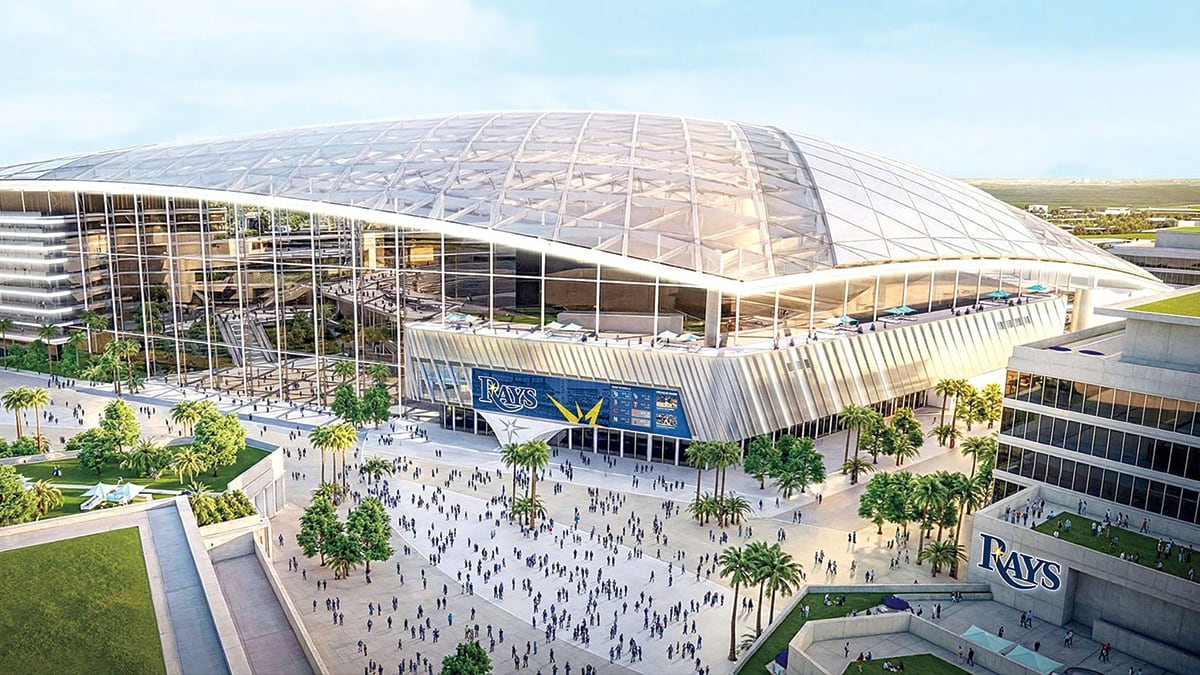
After years of dead ends, false starts and a hurricane that ripped the roof off Tropicana Field, the Tampa Bay Rays finally have a path to a forever home. Hillsborough County and the city of Tampa should take it.
The nonbinding memorandum of understanding (MOU) heading to local governments this month commits up to $976 million in public funding toward a $2.3 billion ballpark and mixed-use district on the Dale Mabry campus of Hillsborough College. The county would put up $796 million. The city and its Community Redevelopment Agency (CRA) would add $180 million combined. The Rays would carry the rest — at least $1.32 billion under the MOU’s math — plus every dollar of cost overruns.
That last point matters. Rays CEO Ken Babby has said Rays ownership is prepared to put more than $1.1 billion into the project and absorb the risk of going over budget. The MOU holds him to it. The team’s contribution “shall not be less than the Public Contribution Amount,” and beyond what the public puts in, the Rays Stadium Entity “will be solely responsible” for the project, “including cost overruns.” That is real risk transfer.
Look at how the public side breaks down. The county’s $796 million includes $360 million in community investment tax (CIT) revenue; $263 million in tourist development tax (TDT) bonds backed by the bed tax on hotel stays; a $40 million TDT reserve payment; $103 million from other county sources; and $30 million in federal disaster recovery funds for stormwater work. The city contributes $80 million in CIT revenue, and the CRA would issue up to $100 million in tax-increment bonds backed by new property tax revenue generated by the surrounding development itself.
The bonds are structured to be nonrecourse to general funds and the governments’ taxing authority. They are secured by specific revenue streams — bed taxes paid largely by tourists, and new property tax growth that does not yet exist. The CRA bonds are taxable and privately placed, meaning sophisticated institutional investors are putting their own capital at risk on the development’s success.

There is more protection built in. Use of the Live Local Act is prohibited in the mixed-use project, preserving full local land-use control. The Rays must demonstrate financial capacity before any public money is released. The bonds must clear judicial validation before construction begins. The Owner Guaranty and Non-Relocation Agreements still to be negotiated will lock the team in for the 35-year initial use term, with five three-year extensions available.
Yes, there are open questions. Commissioner Joshua Wostal is right that bonding future community investment tax revenue creates exposure if collections fall short. He is right that catastrophic reserves should be protected — Hurricane Milton’s bill is still coming due. He is right to demand clawback guarantees if the surrounding entertainment district fails to materialize.
As Wostal told Florida Politics, if the three-phase development does not happen, the property tax revenue the deal counts on will not be there either. The project agreements need to specify exactly what the Rays owe taxpayers in that scenario. A promise to develop is not a guarantee to repay.
Other provisions need sharpening, too. The dispute resolution language is essentially one sentence — for a $2 billion deal, that is not enough. The “Quality Standard” the ballpark must meet is referenced throughout the document but never defined. These are not fatal flaws, but they are the kind of ambiguity that breeds expensive litigation later. Nail them down now, in writing, before anything binding gets signed.
The community benefits framework also needs teeth. The MOU sketches five pillars — workforce development, youth programming, community access, neighborhood enhancements and direct investment — but assigns no dollar figures and calls the commitment voluntary. Drew Park and its neighbors deserve specifics, not slogans.

But the MOU itself is not the deal. It is the framework that lets serious negotiation begin. Council Chair Alan Clendenin put it plainly: the document is “on the squishy side,” a letter of intent meant to get the parties to an endpoint. There is room to tighten guarantees, sharpen community benefits, and lock down protections for public safety funding before anything binding gets signed.
Babby’s pledge to protect “all public funding currently allocated for police, fire, emergency management or response functions, or other previously committed public safety or service priorities” is the right one. The final agreements need to make it ironclad. Wostal’s questions about CIT bonding and reserve exposure deserve real answers, not talking points. The accounting needs to be transparent, the guarantees enforceable, the audit rights robust.
The alternative to engagement is not a better deal. It is no deal. Gov. Ron DeSantis has warned that Orlando is ready to pounce. Senate Appropriations Chair Ed Hooper wants the locals to figure this out first. The 2029 opening depends on moving now — bond validation, redevelopment plan amendments, CIT list revisions and the college land transfer all take time, and they have to proceed in sequence.
A region that has watched the Rays threaten to leave for two decades does not get many chances like this. The MOU is not perfect. It is a starting point with real protections and real risks, and the path from here runs through hard, public, line-by-line negotiation. That work should begin now. Tampa Bay should take this shot. Major League Baseball is watching.
___
Ed. note: This story was drafted with assistance from AI. Editorial judgment, sourcing, and final review were performed by Peter Schorsch and the Florida Politics editorial team.