
A circuit judge in Tallahassee is reviewing evidence, attorney arguments and case law to decide whether or not to grant an injunction requested by voting-rights groups to stop the state’s new congressional map from being used this election year. “They (voters) are so tired of seeing the partisan favoritism over and over again. That’s why these amendments are in the state constitution,” argued Chris Shenton, an attorney representing one of the plaintiffs, Common Cause. It’s suing along with Equal Ground and others in hopes of preventing what they call an illegal and unconstitutional power grab by Gov. Ron DeSantis and Republican leadership, in an attempt to secure four more Florida seats in Congress this year. That could leave Democrats with just four out of 28 seats statewide. The map was drawn by a policy staffer in DeSantis’s office. During a virtual hearing Friday morning, plaintiff attorneys argued the 2010 Fair Districts Amendments make it illegal for one party to draw partisan lines benefiting that political party. They also pointed out that the governor’s senior analyst, Jason Poreda, admitted during the House Select Committee on Redistricting hearing on April 28 that he drew the lines using partisan data. That prompted immediate protest and the filing of three lawsuits after the governor signed the redistricting bill into law. The complaints all seek to throw out the governor’s map. At one point during Friday’s hearing, Equal Ground’s attorney pointed to the boldly Republican-tinted map released before lawmakers ever saw the real one as a blatant sign of the governor’s intent to give Republicans more congressional seats. Christina Ford added, “The governor’s release of this map as a color-coded victory lap for the Republican party, right before the legislative session, makes this an open-and-shut case.” Republican leaders argue drawing maps that don’t seek solely to hand majority minority districts to Democrats is fair and if the result is more Republican representation, that’s a more clear picture of Florida representation in Congress, with Mo Jazil — attorney for Secretary of State Cord Byrd — saying, “The plaintiffs are the ones that have to show that the 2022 map complies with both state and federal law.” Jazil continued to try and shoot holes in the argument by the plaintiffs that the districts drawn four years ago should remain in place. He argued they can’t now support a map that they previously sued to overturn on constitutional grounds, adding, “If we’re talking about the 2022 map, the map that is no longer in place, the map that the Legislature replaced, and the plaintiffs are putting it forward as the alternative, the plaintiffs bear the burden, to show that it is a viable alternative.” The judge hearing this case, Joshua Hawkes, was appointed to the circuit court by Gov. DeSantis and has asked all lawsuits to be consolidated. The hearing was adjourned with no real timetable for the judge to make a decision.
TALLAHASSEE, Fla. —
A circuit judge in Tallahassee is reviewing evidence, attorney arguments and case law to decide whether or not to grant an injunction requested by voting-rights groups to stop the state’s new congressional map from being used this election year.
“They (voters) are so tired of seeing the partisan favoritism over and over again. That’s why these amendments are in the state constitution,” argued Chris Shenton, an attorney representing one of the plaintiffs, Common Cause.
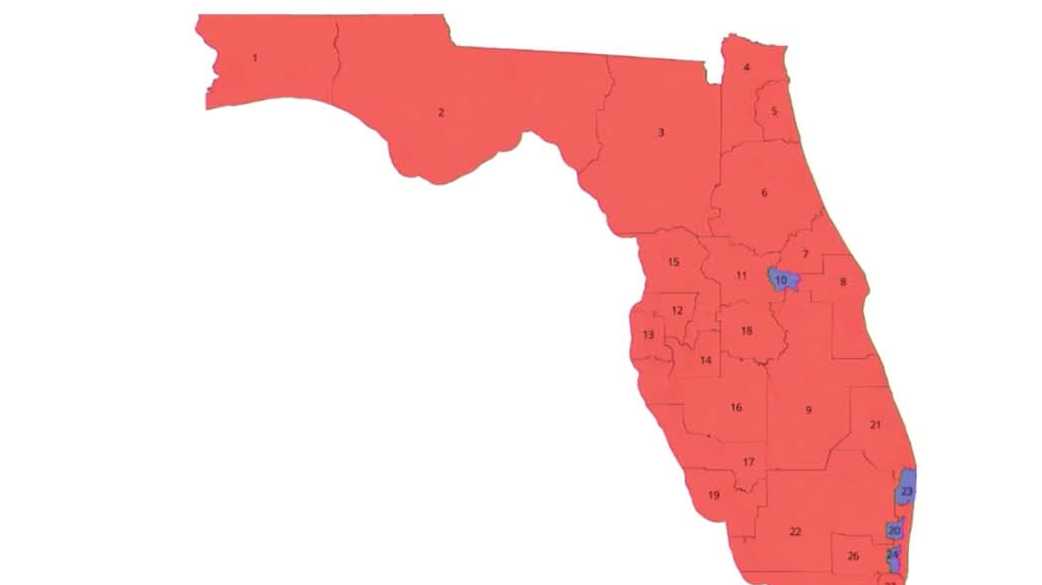
It’s suing along with Equal Ground and others in hopes of preventing what they call an illegal and unconstitutional power grab by Gov. Ron DeSantis and Republican leadership, in an attempt to secure four more Florida seats in Congress this year. That could leave Democrats with just four out of 28 seats statewide. The map was drawn by a policy staffer in DeSantis’s office.
During a virtual hearing Friday morning, plaintiff attorneys argued the 2010 Fair Districts Amendments make it illegal for one party to draw partisan lines benefiting that political party. They also pointed out that the governor’s senior analyst, Jason Poreda, admitted during the House Select Committee on Redistricting hearing on April 28 that he drew the lines using partisan data.
That prompted immediate protest and the filing of three lawsuits after the governor signed the redistricting bill into law. The complaints all seek to throw out the governor’s map.
At one point during Friday’s hearing, Equal Ground’s attorney pointed to the boldly Republican-tinted map released before lawmakers ever saw the real one as a blatant sign of the governor’s intent to give Republicans more congressional seats. Christina Ford added, “The governor’s release of this map as a color-coded victory lap for the Republican party, right before the legislative session, makes this an open-and-shut case.”
Republican leaders argue drawing maps that don’t seek solely to hand majority minority districts to Democrats is fair and if the result is more Republican representation, that’s a more clear picture of Florida representation in Congress, with Mo Jazil — attorney for Secretary of State Cord Byrd — saying, “The plaintiffs are the ones that have to show that the 2022 map complies with both state and federal law.”
Jazil continued to try and shoot holes in the argument by the plaintiffs that the districts drawn four years ago should remain in place. He argued they can’t now support a map that they previously sued to overturn on constitutional grounds, adding, “If we’re talking about the 2022 map, the map that is no longer in place, the map that the Legislature replaced, and the plaintiffs are putting it forward as the alternative, the plaintiffs bear the burden, to show that it is a viable alternative.”
The judge hearing this case, Joshua Hawkes, was appointed to the circuit court by Gov. DeSantis and has asked all lawsuits to be consolidated. The hearing was adjourned with no real timetable for the judge to make a decision.