
Florida wildlife officials Wednesday banned import of sloths until July 10 as they revamp the state’s exotic animal permit rules, after 55 sloths died at Sloth World since December 2024.
The Florida Fish and Wildlife Conservation Commission announced the temporary ban on Wednesday, effective immediately. The ban expires July 10.
“It appears that this group of sloths contracted an intestinal infection that resulted in severe and in many cases fatal effects,” FWC Director Roger A. Young told FWC commissioners Wednesday, adding that it was one facility and was “not a widespread issue.”
Sloth World, now bankrupt, had planned to open along International Drive in Orlando.
But FWC began looking into the facility in August of last year, after learning of about 30 sloth deaths. The animals had been imported from Guyana and Peru.
Brevard Zoo mourns the recent passing of sloths Sammy and Dustin
1 of 9
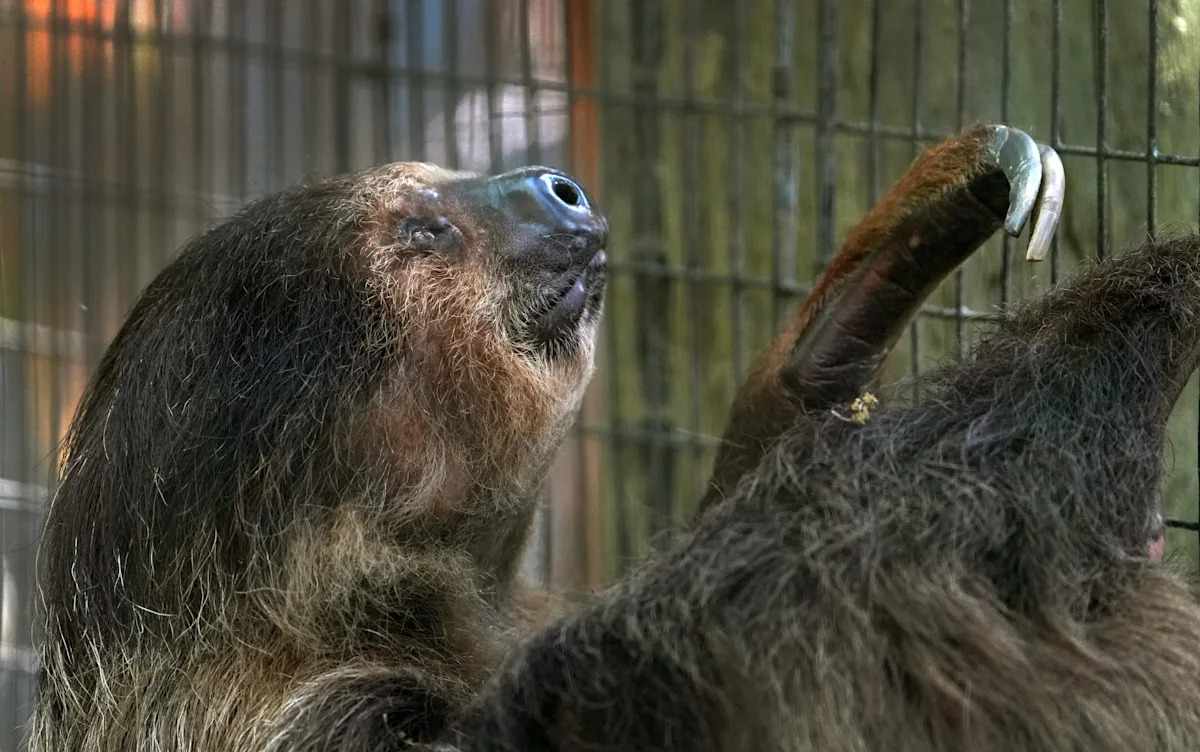
Dustin the two-toed sloth in the Rainforest Revealed exhibit during spring break 2026 at the Brevard Zoo in Viera. He recently passed away at age 23.
The sloths had been housed in an unprepared warehouse with no heat, windows, or running water, according to an Aug. 7, 2025 incident report obtained by Inside Climate News. Based on that FWC report, at least 31 sloths died between December 2024 and February 2025 at a facility associated with Sloth World.
Inside Climate News’ report also cites necropsy reports and internal company emails it reviewed that indicate viruses, including a “novel two-toed sloth gammaherpesvirus,” were spreading through the warehouse.
Pete Bandre, former owner of Incredible Pets in Melbourne, was the licensee listed on the wildlife incident report and Ben Agresta was his business partner in the endeavor. According to the FWC report, Bandre told the inspector that 21 of the sloths sloths died due to a “cold stun” and that they were installing climate controlling devices, including space heaters, A/C units, a humidifier, ceiling fands and atmosphere sensors.
Bandre hung up when reached by phone Thursday after a FLORIDA TODAY reporter identified himself and explained the reason for the call. A subsequent voicemail to Bandre, asking for comment, wasn’t returned as of Thursday afternoon.
According to the FWC report, multiple space heaters were bought but had to be powered with an extension cord from a different building. The space heaters tripped the fuse and shut down, the report says, “and it appears that at least for one night, the sloths were in the cold building without heat. There was no one present overnight to correct this.”
Conservationists take action to change Florida’s sloth rules
Wednesday’s announcement of the import ban came just days after Dr. Rebecca Cliffe, executive director of The Sloth Conservation Foundation, and Sam Trull, executive director of The Sloth Institute, spent several days meeting with Florida officials and local authorities to discuss stronger sloth protections. Both traveled from Costa Rica, where their nonprofit groups are based, to address the issue.
“Imported wild sloths have been dying for years, in virtual silence,” Trull said Wednesday in a prepared statement. “But today’s decision from the FWC shows that it doesn’t have to be this way. There are measures that can be taken, should be taken and will be taken to better protect wild animals, like sloths.”
Florida’s attorney general James Uthmeier, said in a recent post on X that prosecutors from his office were helping in an “ongoing criminal investigation” into the sloth deaths and the circumstances behind the animals seizure in the wild.
The Central Florida Zoo and Botanical Gardens in Sanford took in 13 surviving sloths.
FWC forms task force to tighten exotic animal import rules
FWC recently formed a task force to overhaul exotic animal permit rules, after state Rep. Anna Eskamani (D-Orlando) met with agency officials, The Sloth Institute, and the Sloth Conservation Foundation.
“Wild sloths — animals that belonged in the rainforest — were brought into Florida and exploited for profit until the business that exploited them collapsed,” Eskamani said in a May 11 prepared statement. “That cannot be the end of this story. Accountability requires action.”
Sloths difficult to care for
Deaths and health problems are happening primarily in sloths that originally come from the pet trade and from those born at zoos, because their diets in their native habitat may be difficult to replicate, leading to nutritional imbalances. This issue is still being explored.
Analysis by The Sloth Institute of wildlife import data shows 1,141 of 1,146 sloths imported into the United States between 2011 and 2021, were taken from the wild, with 97% coming from Guyana, most entering in Miami.
In April, two beloved sloths — Dustin and Sammy — died at Brevard Zoo. The two Linne’s two-toed sloths, 23-year-old Dustin and 20-year-old Sammy, were both well beyond their species’ median lifespan. That’s about 21 years for males and 14 years for females, according to the Association of Zoos and Aquariums (AZA).
Sloths in human care often experience nutritional issues, vitamin and mineral imbalances and premature deaths, zoo officials said.
“Sloths have a delicate and very complex gastrointestinal system,” Rachel Turner, the zoo’s director of veterinary programs, said in the Facebook post at the time.
“Sloth diets in their native habitat may be difficult to replicate, leading to these imbalances. This issue is still being explored,” Turner added in the post. “We still don’t have a lot of good answers for why it’s happening, even in animals receiving excellent care.”
Contact Waymer at (321) 261-5903 or jwaymer@floridatoday.com.
This article originally appeared on Florida Today: Florida bans sloth imports after 55 deaths