
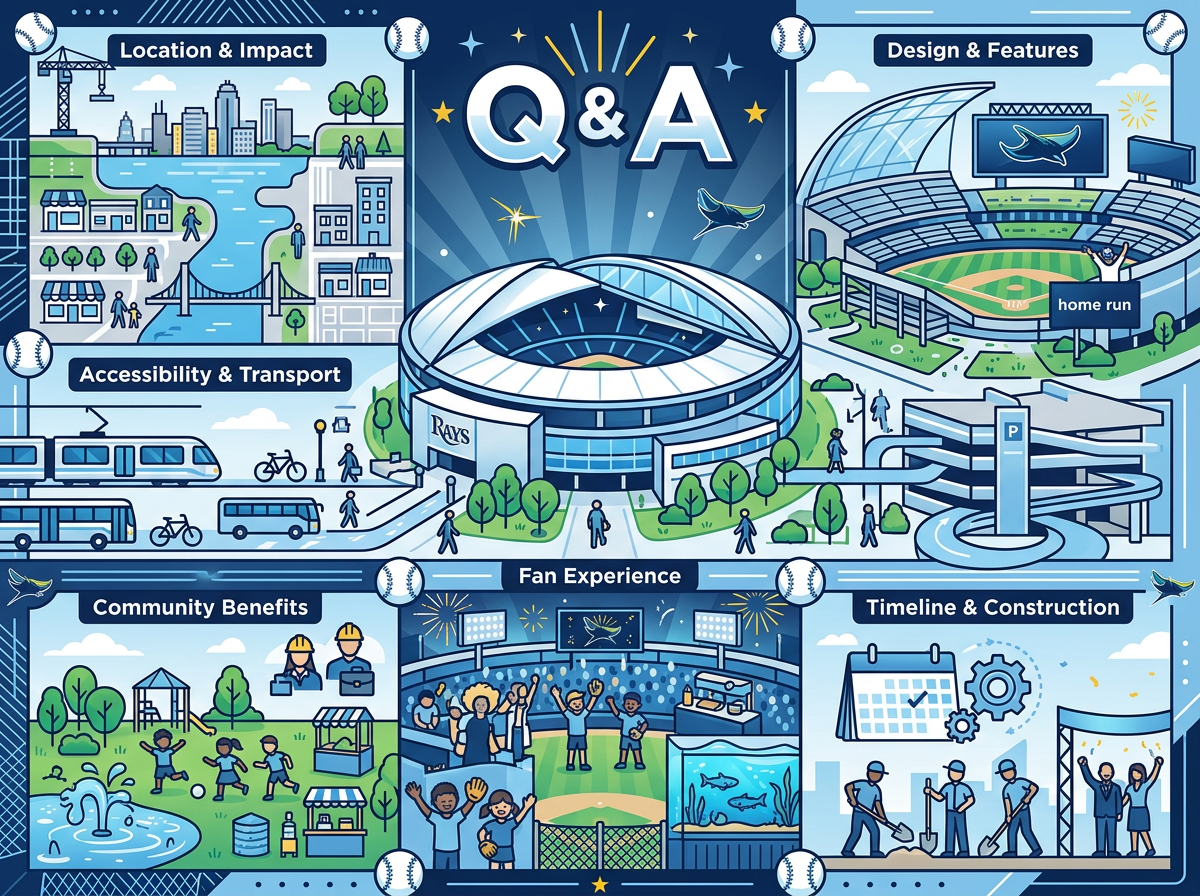
The Tampa Bay Rays, Hillsborough County, and the City of Tampa have a deal — or at least the framework for one.
Last week, the three parties released a Memorandum of Understanding outlining a $2.3 billion enclosed ballpark and surrounding mixed-use district anchored on the Dale Mabry Campus of Hillsborough College. The non-binding MOU caps the public contribution at $976 million, with the Rays committing more than $1.2 billion plus any cost overruns — what the team is calling the largest private investment by a sports franchise in Florida history.
The Hillsborough County Commission is set to take up the agreement May 20, with the Tampa City Council following May 21. Behind those votes is a June 1 deadline the Rays have set to keep alive their goal of opening a new ballpark by 2029, when the team’s lease at Tropicana Field expires.
I spoke with Rays CEO Ken Babby to talk through the MOU — the public funding structure, the carve-outs protecting police and fire dollars, the Hillsborough College piece, and why he sees this as a regional play that reaches well beyond baseball.
Q: The MOU is now public. What should people take away from it?

Babby: The most important takeaway is that this is a roadmap for a transformational project that secures the Rays’ future in Tampa Bay and creates long-term benefits for the entire region.
This is about much more than a ballpark. It is about building a world-class civic asset, revitalizing a Hillsborough College campus, creating thousands of jobs, generating $55.5 billion in economic impact and delivering a privately financed mixed-use district where people can live, work, learn and play.
The MOU reflects months of serious, good-faith work with our public partners, Hillsborough College leadership, Major League Baseball and community stakeholders. It is non-binding, and there is still work ahead on the final agreements, but this is an important step forward.
Q: Let’s get right to the question on the taxpayer’s mind. Will this project require new taxes?
Babby: No. There will be no new taxes to fund this project.

The public investment is structured through existing revenue sources and project-generated revenues, including Tourist Development Tax funds, Community Investment Tax contributions, Drew Park CRA tax increment revenues generated by the new mixed-use development, and federal CDBG-DR reimbursement funds for eligible stormwater infrastructure.
That distinction matters. We have been very intentional about structuring this in a responsible way that does not create a new tax burden for residents.
Q: One concern we have heard is that public money could be taken away from police, fire, emergency services or infrastructure. Can you address that directly?
Babby: Under no circumstances will public funding allocated for police, fire, emergency management services or other committed public safety priorities be impacted by this project.
That has been a core principle from day one. This framework was built around a “Do No Harm” approach. The Community Investment Tax portion is structured so that existing public safety and infrastructure commitments remain protected.
We understand why people ask the question. And demand assurances. That is why it is explicitly laid out in the MOU that no current funding earmarked for police, fire, or any public safety or emergency functions, or infrastructure needs, will be affected. The detail is in the MOU, but be assured this was as important to us as it is, and should be, to our fellow neighbors and citizens. Public safety is one of the most important responsibilities of local government, and that’s exactly why we have been deliberate about ensuring those commitments are not affected.
Q: Some critics will still ask whether public investment in a ballpark is worth it. Why is this a good deal for Tampa Bay?
Babby: It is a fair deal because of the scale of private investment, the long-term economic return and the protections built into the framework.
The Rays are committing at least $1.235 billion in private investment, plus responsibility for cost overruns for a ballpark that the County will own. That represents the largest private investment by a sports team in Florida history.
The project is also expected to generate major economic benefits, including jobs, new tax revenue, tourism activity and long-term growth. It creates a brand-new county-owned civic asset, modernizes Hillsborough College, revitalizes Drew Park, and secures the Rays in Tampa Bay for decades.
This is not just a ballpark. It is a regional economic development project.
Q: Why should someone in Plant City or another part of Hillsborough County outside of Tampa care about this?
Babby: Because the benefits of this project are countywide.
This is about jobs, small businesses, workforce development, tax revenue and community investment across Hillsborough County. The Community Benefits Agreement will be the largest community investment partnership in City and County history, with funding for local hiring, workforce development, youth programs, and community investments throughout the county.
The community will also have the opportunity to weigh in on how those funds are invested, so this reflects real local priorities.
Whether you live in West Tampa or Valrico, this project will help grow the tax base, create opportunities and strengthen the region’s competitiveness.
Q: The Hillsborough College partnership has become a major talking point. Why is that piece so important to you?
Babby: Because this is where the project becomes transformational.
The opportunity to modernize Hillsborough College’s Dale Mabry campus while directly connecting students to workforce training, internships, career pathways, and world-class employers is incredibly exciting.
We’re not just talking about new buildings. We’re talking about creating an ecosystem where education, sports, hospitality, entertainment, business, and innovation intersect in a way that directly benefits students.
That matters for Tampa Bay’s future workforce and it matters for keeping talented young people in this region after graduation.
To me, that’s one of the most meaningful aspects of the entire proposal.
— Ed. note: This story was drafted with assistance from AI. Editorial judgment, sourcing, and final review were performed by Peter Schorsch and the Florida Politics editorial team.