
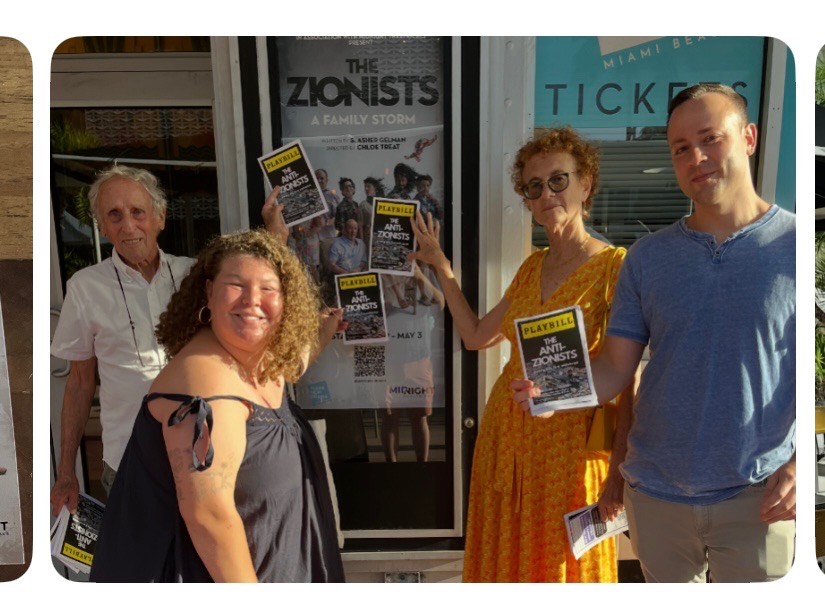
I recently went to see “The Zionists: A Family Storm”, a play at the Colony Theatre in Miami Beach that ran through May 10. The play showed how polarizing opinions since Oct. 7, 2023, divide Jewish families. In a family of eight, one queer son and his partner represented my beliefs, that Israel is committing a genocide and should be held to the same standard of war crimes that every other country in the world is accountable to.
 Hayley Margolis is a Miami based educator and organizer with Jewish Voice for Peace South Florida. (Margolis/Courtesy)
The first half of the play gave me hope. The character who was empathetic to Palestinian suffering was given a platform to speak eloquently. He used his voice to uplift important facts that Zionists forget: that over 50,000 Palestinian children have been killed since October 2023, or that Israel has an apartheid legal structure that treats Palestinians as second class citizens, including a death penalty law that only applies to Palestinians. My hope wavered when this character’s family let every talking point roll off their impenetrable Zionist armor with no effort to empathize.
I lost all hope in the second act of the play, when the character who supported Palestinian justice was slowly stripped of credibility and respect from his family. This play did not facilitate dialogue or put forth multi-faceted Jewish perspectives, but, rather, reinforced six different reasons why Israel is a miracle, and how the necessity of its existence overpowers any critiques of how it weaponizes military power to inflict harm.
After watching the play, I joined my fellow Jewish Voice for Peace (JVP) members outside the theatre to pass out flyers as the audience exited. My friend had produced a compassionate and creative playbill pamphlet that introduced anti-Zionist ideas without the inaccessible academic language that often limits conversation. Unfortunately, the play that was supposed to open the audience to alternative viewpoints hardened and reinforced firmly rooted Zionists, and the response to our passing out flyers was angry and hateful. While we offered the flyers to those walking out, many of the people were disgusted and yelled how dare we use the opportunity of this play to share our perspective. Flyers were ripped up, and one JVP member was pushed in her face as she offered a flyer.
The experience was distressing for me. I left the performance with my heart racing. The play’s thesis implied that beliefs rooted in a concern for the well-being of all people cause harmful rifts in families, and even implied social justice activism is selfish and negatively impacts family members. The play’s prioritization of emotional dynamics in Jewish families further dehumanizes the over 900 Palestinian families that have been erased from the registry because every single living member has been killed. Why is discomfort amongst Jewish families so intolerable that we refuse to feel the pain Palestinian families experience? When we value Jewish families as more worthy of safety and protection than Palestinian ones, we disconnect from our shared humanity.
“The Zionists: A Family Storm” implied that opposing opinions on Israel and Palestine are irreconcilable unless we choose to prioritize Jewish family bonds over political disagreement. This trivializes the suffering of Palestinians, and ostracizes anti-Zionist Jews advocating for justice and liberation. The audience of “The Zionists: A Family Storm” expressed as much hatred toward dialogue with anti-Zionist Jews as they do towards the Palestinians they dehumanize.
I wish “The Zionists: A Family Storm” had modeled active listening, and the ability for rigid ideologies to melt into understanding and flexibility. If Jews want safety and peace, we have to reckon with the history and reality of the harm of Zionism. The next generation of Jews is taking the time to learn about the Nakba, understand settler colonialism, and question decades of propaganda reinforced by both family and religious institutions. Belittling us will not convince us to accept injustice and occupation. Unlearning Zionism is not easy. It requires shifting an entire paradigm and worldview, challenging core beliefs about ourselves and our identities, and being willing to endure difficult conversations. But the end result is a deeper understanding of Jewish values and a vision for Jewish safety that is not dependent on oppressing another people.
Hayley Margolis is a Miami based educator and organizer with Jewish Voice for Peace South Florida.