
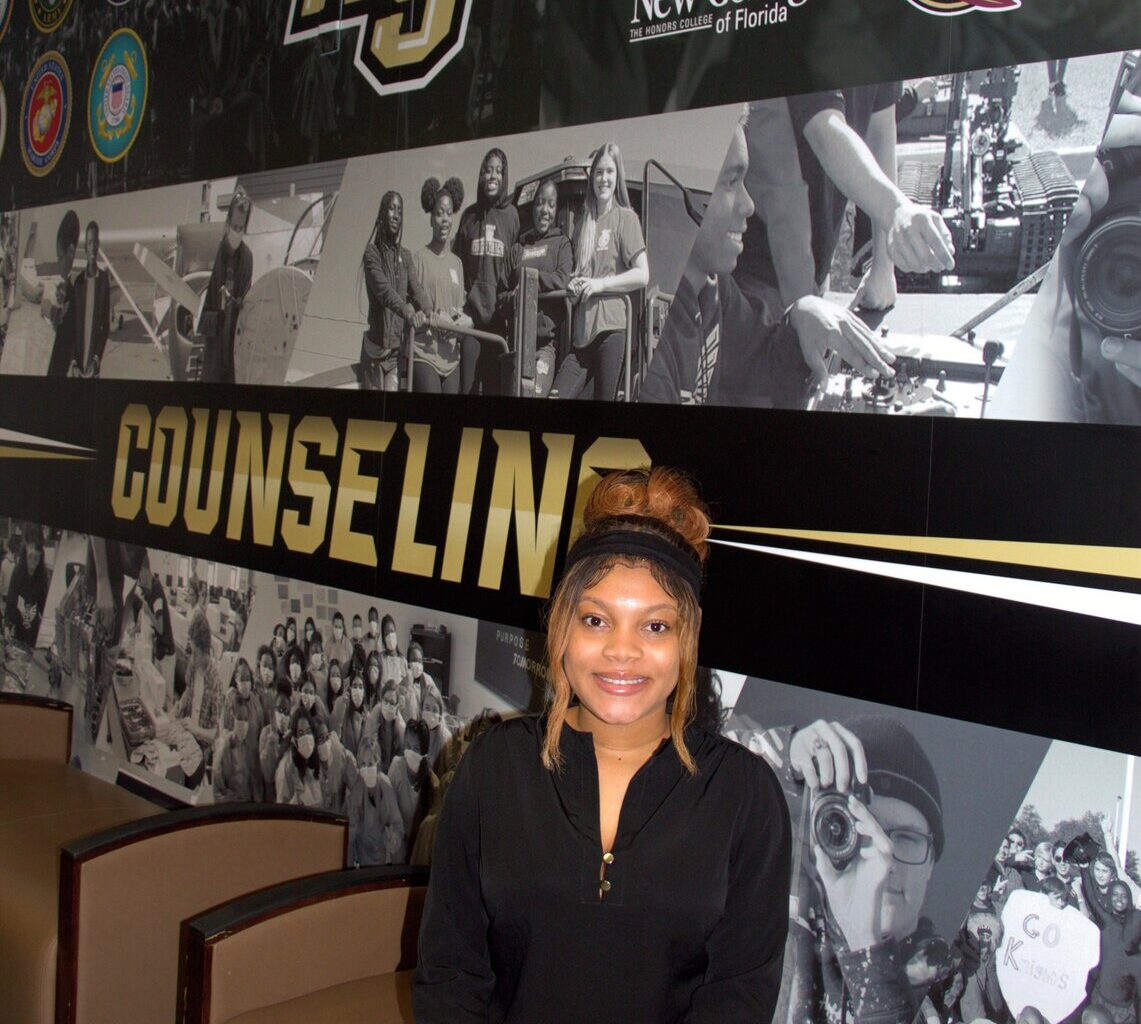
OAKLEAF – When Marie Abigaila Perez walked through the front doors of Oakleaf High for the first time, she was fluent in Creole, and she didn’t understand English or American culture.
She faced uncertainty, a language barrier and a sense of isolation that came with being a child in a new country. She knew it would be hard, but she also knew returning to Haiti for her final two years of high school wasn’t an option.
Failure at Oakleaf could have meant going back to an area dominated by gangs, where murder, drugs, kidnapping, human trafficking and corruption are part of the everyday life.
Her parents were so concerned, they used the Processes for Cubans, Haitians, Nicaraguans and Venezuelans parole program that allowed as many as 30,000 a month to fly to the United States if they have a sponsor to escape dangerous criminal condition.
Marie’s aunt and uncle, Miennka and Marckly Marcelin, live in Clay County and were happy to be her sponsors. But once she got here, she had to do the rest. Marie had one advantage: “She had a lot of drive and determination,” said Reading Teacher Dunia Jean-Baptiste.
Make that two advantages. Jean-Baptiste also came from Haiti and could translate Creole.
“My teachers here helped me so much,” Marie said. “I worked so hard. I was very motivated. I knew it was not going to be easy. My parents said it was going to be hard, but I couldn’t give up. I knew I was smart. I knew I was going to make it.”
Jean-Baptiste said the Haitian language is a dialect derived from French and different African cultures. She said it’s very “phonic,” and during translation, it uses different parts of the brain.
“She was so nervous at first,” Jean-Baptiste said. “When she needed to answer a question, we came up with a plan. I told her to first think of an answer in Creole, then translate it over to English. Sometimes it’s hard for her to come up with the words in English, so think about it in Creole first.
“Not everybody’s path is the same, especially when you have to navigate two worlds.”
Marie is an A-B student who will move her focus to becoming a registered nurse after she graduates.
“It took a lot of work, but there never was a time when I thought I couldn’t do this,” Marie said. “I had help, but I always knew everything was possible. It’s part of me to keep going.”
Which was learned in Haiti to simply stay alive.