
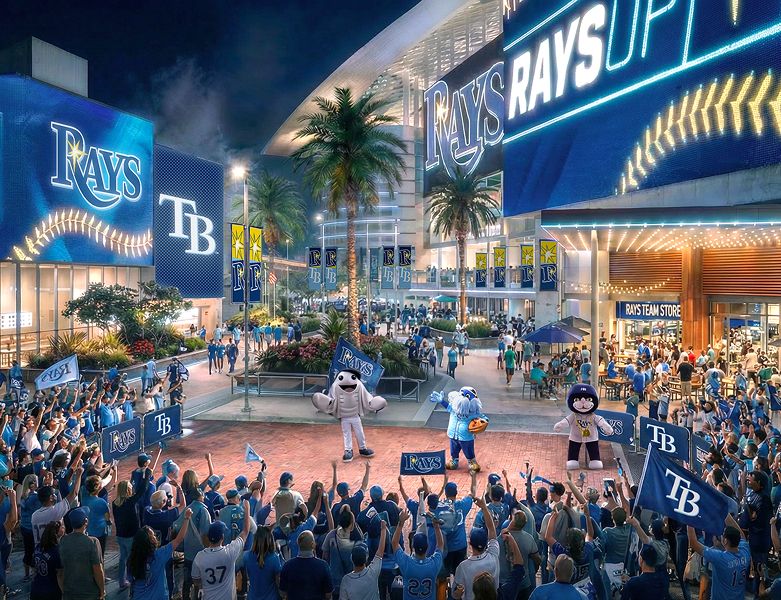
After extensive public testimony and detailed questioning, the Tampa City Council narrowly voted 4-3 to move forward a nonbinding memorandum of understanding (MOU) with the Tampa Bay Rays to build a new ballpark and mixed-use district in the city.
The vote comes just one day after Hillsborough County Commission also voted in favor of the MOU. With both votes, the stage is now set for both the city and the county to continue negotiations with the Rays on the $2.3 billion proposed project at the Hillsborough College Dale Mabry campus.
With its vote, the Tampa City Council gave its preliminary OK to move forward with ironing out details of the deal, which currently prescribes $80 million from community investment tax (CIT) funding and up to $100 million from the city’s Community Redevelopment Agency (CRA) funds.
But while the Tampa City Council’s vote means the project lives on, its road ahead still faces an uncertain future.
City Council Member Bill Carlson, who is also running for Mayor, seemed like he would be a “no” vote on the MOU. But after hearing from Rays CEO Ken Babby about the team’s plan to continue addressing concerns, and its need to move forward with the MOU in order to draw down state dollars, Carlson cast the swing vote allowing the MOU to clear.

But Carlson cautioned that he would be a “no” in the future unless serious concessions were made. Had he voted “no” on Thursday, the deal would have been dead.
Council members Lynn Hurtak, Guido Maniscalco and Charlie Miranda all voted against the MOU.
Concern centered on the use of public dollars to — as detractors described it — subsidize a private entity, while potentially neglecting other projects for which CIT dollars could have been used.
“How do I face the taxpayers and the voters?” Maniscalco wondered out loud about the potential that things like new sidewalks and road improvements may be deferred as about half of the city’s CIT dollars go toward the Rays ballpark.
Under the MOU, $20 million from the CIT would go toward the Rays project over four years, leaving an estimated $14.7 million for other projects in Fiscal Year 2027, $22.8 million in 2028, $24.1 million in 2029, and $25.5 million in 2030.

After that, the full CIT value would revert to its other allocations, including capital investment for parks and mobility projects, public safety vehicles and facilities, and other public facilities. Those totals assume an annual growth of CIT revenues of 3%, which the city’s CFO, Dennis Rogero, acknowledged could fluctuate if there’s an economic downturn.
Hurtak, also a mayoral candidate, mused in her remarks that voters may not vote to reauthorize the CIT. The CIT is a half-penny sales tax levied for capital improvement projects. It was first approved in 1996 for a period of 30 years and was set to expire this November. Voters in 2024 reauthorized the tax until 2041, but the vote was narrow, with less than 52% of voters favoring it.
“I really believe that if the voters of Tampa aren’t allowed to have a say on this deal, which reallocates CIT funds, I really believe that we’re going to hear from them loud and clear during the March elections, and the next time we need to ask voters to renew the CIT to pay for public safety, parks and roads, I don’t think we’ll get it,” she said.
Carlson agreed.
“We also know that there’s no appetite in the public to raise taxes again,” he said.
In addition to funding capital costs, the CIT can also be used for capital equipment, as well as construction, renovation, replacement or expansion projects on existing facilities or assets. The CIT specifically references fire rescue and police vehicles as examples of possible CIT expenditures.
While more than half the City Council raised major concerns about the MOU as it’s currently written, three were more enthusiastic.
Board Chair Alan Clendenin said the city’s investment could lead to as much as $8 billion in economic activity.
“Show me the table in Vegas and I’m flying out tomorrow,” he joked of the return on investment by comparing it to a wager.
Luis Viera, who is leaving office later this year as he seeks a seat in the Senate, made a biblical analogy.
“It’s the 10 suggestions, not the 10 commandments,” he said, adding a less parochial reference that with the MOU, “we’re not getting married, we’re dating.”
“Maybe we’ll move in,” he quipped.
Viera’s point was in reference to the fact that the MOU is nonbinding, and that additional approvals will be needed from both the city and county as the deal progresses.
But Maniscalco fired back, instead saying that when you get engaged, you’re making a commitment — and this is akin to putting a ring on it.
At issue is a $976 million ask from the city and county. The county’s portion of public funding represents the lion’s share, at $796 million. Hillsborough Commissioners approved the MOU on Wednesday on a 5-2 vote. The overall project is expected to cost $2.3 billion.
From the city’s portion, the $100 million from the CRA would be used to pay off bonds issued for stadium construction, while the $80 million discussed Thursday from CIT funds would be used for project infrastructure, including roads, sewer and water.
Babby, the Rays’ CEO, was on hand to answer questions and spoke during public comment. He pointed to concessions the Rays have already given throughout negotiations, including walking back a previous deadline of June 1 to finalize all agreements with local governments and changes to the CIT investment. That includes not using the county and city CIT funds for bonding.
“That was a big concession for us,” he said. “We’ve given and we’ve given and we’ve given and we still have work to do to reach definitive agreements, which will involve even additional compromise on both sides. I would urge you to let us continue the conversation.”
Babby ended his remarks with a statement that sounded more like a warning.
“Don’t send the Rays out of Tampa.”
While much work is still ahead on the Rays stadium and development project, Thursday’s vote may have checked at least one box.
The Rays have been lobbying lawmakers for $150 million in state funding for Hillsborough College to improve its Dale Mabry campus facilities. The Senate during the Regular Session approved $50 million, with an expectation that funding could increase to $150 million, but the House was holding out. Senate budget chief Ed Hooper had said the Legislature should hold off on any funding until the Rays reach a deal with local government over its portion.
Now that has happened, all eyes will be on Tallahassee as legislative leaders continue fine-tuning the budget and reconciling differences. That means the local government approval timing is fortuitous. Because the Legislature didn’t finalize the state budget during its prescribed 60-day Session earlier this year, there is still time to sneak the Hillsborough College funding into the upcoming fiscal year’s budget.