
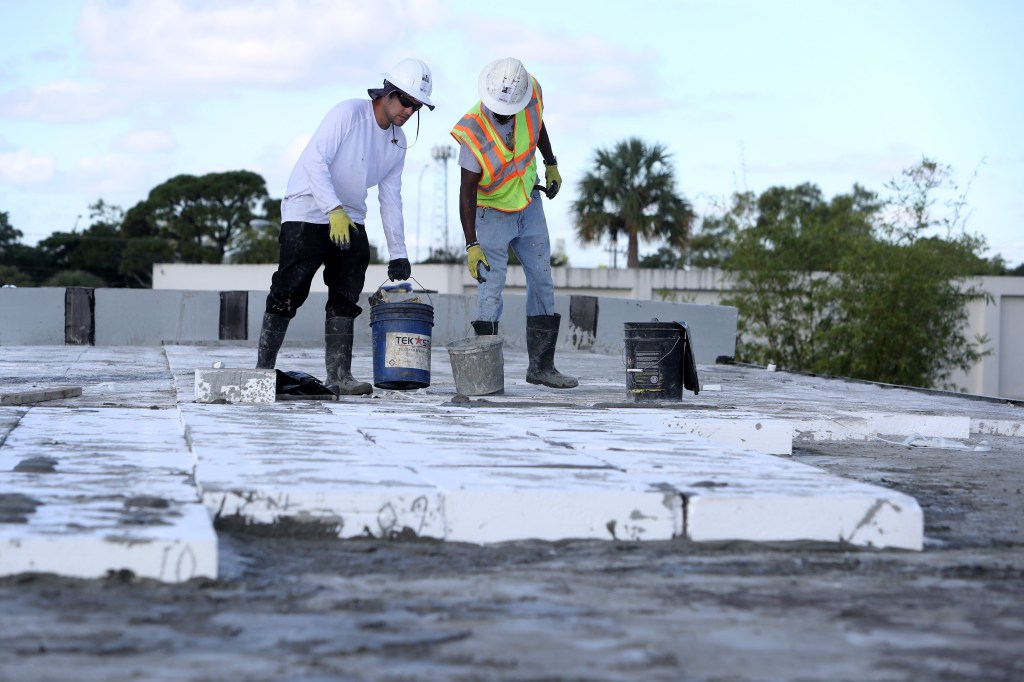
The “SMART Bond” program, a school renovation effort that became a symbol of waste and mismanagement for the Broward School District, is coming to an end — at least by name.
The School Board agreed in 2023 to set an end date of Oct. 31, 2025, for the program that was initially funded by an $800 million bond approved by voters in 2014.
SMART — which stands for Safety, Music/arts, Athletics, Renovations and Technology — was supposed to be over in 2021, and School Board members hoped in 2023 that a firm deadline would help speed up construction.
It didn’t work. There are still more than 100 projects, or a third of all work, that are not complete, according to recent district reports. Most of those projects are under construction and will be finished, officials say, but the name SMART program is being retired. The district is also ending its Bond Oversight Committee, which it created in 2015 to monitor the progress of the bond.
District officials say it’s been years since they even used bond money to fund the projects, which are costing a total of about $1.6 billion.
“The resolution wasn’t to get rid of the projects. It was not to call them SMART projects anymore because the SMART money is gone,” School Board Chairwoman Debbi Hixon said at a recent board meeting.
While most School Board members see the bond program as a debacle, some are discussing doing it again, possibly as early as 2028.
Bureau Veritas, a Maryland firm specializing in building inspections, has been assessing the condition of all district schools for the past year. It’s part of the district’s “Redefining Broward Schools” effort to decide whether to close or consolidate schools.
But the data also will help the district present a case to the public in the future for the need for another bond, officials say. The total capital improvement needs are estimated at $10 billion, district officials say, which is more than 12 times the amount of money voters approved in 2014.
“I’m hoping over the next three years that our performance improves, and we win back the confidence of our county,” School Board member Allen Zeman told the South Florida Sun Sentinel.
Zeman, while critical of how the SMART bond was executed, said he thinks voters would give the district another chance if it can provide a list of schools that need fixing and how the district plans to avoid mistakes of the past. At the Oct. 21 meeting, he said that if the district asked for the full $10 billion in needs, the cost to the average homeowner would be $750 a year, which he thinks would be a good investment.
That figure created sticker shock among board members at the meeting.
“We need to do a great job as a district and as a board and rebuild some of that trust,” Board member Adam Cervera said. “But to come up here and talk about $10 billion dollars in bond money, that’s not going to happen. So we need to start looking at other ways to get these schools some of the TLC that they need. I’m certainly not suggesting that we send our kids to dilapidated schools, but we’ve got to be realistic here.”
Board member Rebecca Thompson said she’s also reluctant to ask voters to approve a bond any time soon. She noted that in March, 65% of Pembroke Pines voters rejected a tax increase for parks, road improvements and a police headquarters.
“Pembroke Pines just went out for a bond for $230 million, which is a fraction of what we would ask for, and it failed, and not close. It miserably failed,” she said. “I just think we need to be really cognizant of the economy that we are living in and that families can’t afford a dollar or two more.”
Cynthia Dominique, a Margate parent who chairs Broward’s District Advisory Council, told the Sun Sentinel she is also skeptical a bond would pass in the foreseeable future.
“The parents I speak to are just disappointed with the debacle the SMART bond was or is,” she said.
She said many parents believe the district has ignored the condition of decaying schools for years and has expressed more interest in closing them than investing in them. The SMART bond program included few replacements of dilapidated buildings, instead focusing on upgrading the roofs and air conditioners of aging schools. Many of those projects were stalled for years.
The SMART bond program was marred by a needs assessment that underestimated the costs and the full scope of work required, high turnover of district management and delays due to friction between district staff and contractors.
The district has frequently accused contractors of performing subpar work and taking too long to fix problems. Contractors have accused the district of conducting overly rigid inspections, changing the scope of projects while in progress and failing to pay them adequately or on time. The district has been sued by at least 10 contractors who alleged breach of contract, while the district filed suit against at least two. Several suits were settled, but most are still active.
The SMART program was the focus of a statewide grand jury report, completed in 2021 and released in 2022, that concluded school administrators had mismanaged the program and misled the public for years. The grand jury recommended that Gov. Ron DeSantis remove School Board members who jurors argued had failed to hold the then-superintendent accountable for the missteps of the bond. DeSantis removed four board members and replaced them in August 2022.
“While the SMART Bond, approved by voters in 2014, had its challenges, there’s no doubt that students have benefited — and continue to benefit — from new and renovated buildings, upgraded HVAC systems, classroom technology, playgrounds, band equipment and enhanced safety measures,” district spokeswoman Keyla Concepcion told the Sun Sentinel.
Zeman, who was elected in November 2022, has been highly critical of the SMART bond and has been looking to move past it since he joined the board. In the spring of 2023, he proposed setting the Oct. 31, 2025, deadline to end the program. This was based on the date that AECOM, a company the district hired in 2020 to take over the bond, had set to reach substantial completion of all projects.
“We represent Broward County, and Broward County’s done with the SMART Bond,” Zeman said at a workshop in April 2023. “They want it over now. The fact that I’m proposing to wait 31 months to get this all stuff closed out means that I’m behind the values of the county I represent already, so I’m non-negotiable on October 2025.”
The School Board voted unanimously to approve the resolution in May 2023. But progress continued to stall. When the board hired Howard Hepburn as superintendent in April 2024, one of the goals they gave him was to get the SMART bond projects completed quickly.
In an interview in December 2025, Hepburn told the Sun Sentinel that he expected all but 25 of the 172 projects that were under construction at the time to be complete. That would have been a 91% completion rate for all projects in the bond program. He said the remaining would be finished in 2026.
“We’re an administration of high expectations,” Hepburn told the Sun Sentinel at the time. “We know the impact of what we do every day, how it impacts our students and impacts our learning environments. We’re trying to close out 10 to 12 projects per month, minimum.”
Instead, the district has averaged about five a month in 2025, according to recent construction reports. A September report lists 115 schools still under construction, with only a few slated to be done by Oct. 31 and some not expected to be complete until 2028. Seven have yet to start construction, and some of those are on hold, as the district looks to close some schools due to low enrollment.
“As the SMART program ends, the number of projects that remain is higher than projected last year, but the current administration remains steadfast on its resolve to see each one to completion,” Concepcion said. “Projects have been completed and closed out at a much faster pace, reflecting our commitment to delivering high-quality learning environments for our students and community.”
Board member Lori Alhadeff supported the resolution in 2023 to set the end date for the program, but now that it’s here, she’s had second thoughts.
“That was a while ago, and I was optimistic to think that we were going to be completing those projects, but it hasn’t been done,” she said at the Oct. 21 meeting. “We can’t falsely say it has been done when it hasn’t been done. That’s not right.”
Hepburn told the School Board the end of the SMART program doesn’t mean the end of the projects promised to voters.
“The projects continue. The resolution is about sunsetting the term SMART bond projects and moving to calling them capital projects because that’s actually what they are,” Hepburn said.
Zeman told the Sun Sentinel it’s appropriate to end the program now, even if many projects aren’t complete.
“We should be honest with the public about what we could deliver for that $800 million. Keep spending the other money you get, the capital dollars we get from the government,” he said. “But to call what we’re doing now SMART bonds, that to me would be the height of dishonesty. Because we already spent their SMART bond money.”