
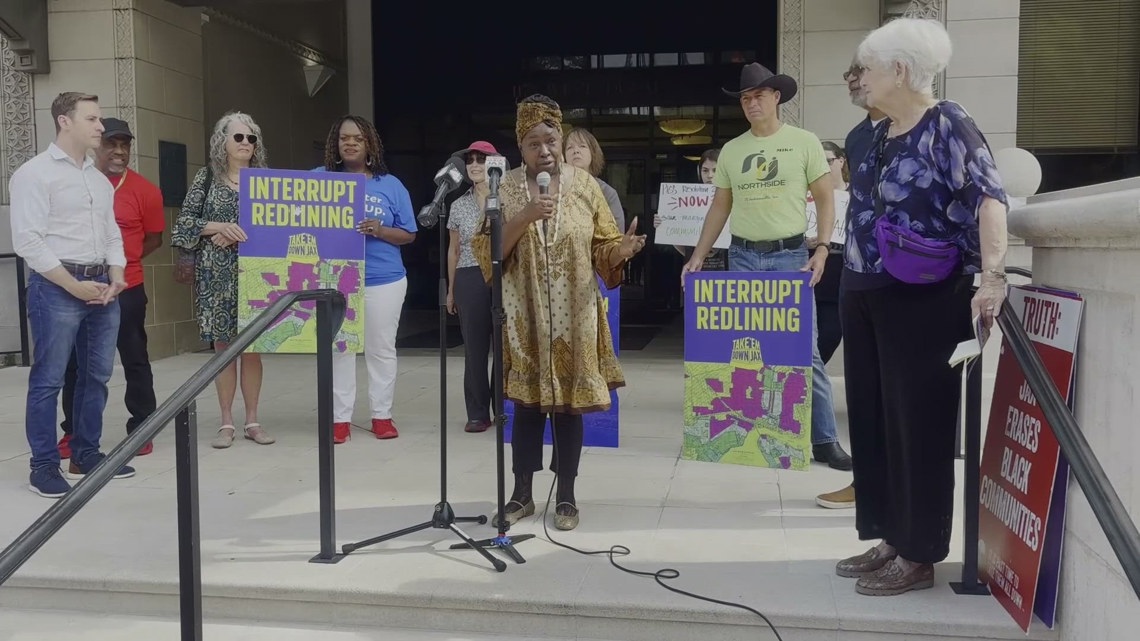
Residents gathered on the steps of Jacksonville City Hall, urging leaders to keep a proposed new jail out of historically discriminated neighborhoods.
JACKSONVILLE, Fla. — Community members and activists are renewing calls to keep Jacksonville’s proposed new jail out of historically underserved neighborhoods, arguing communities already impacted by decades of disinvestment should not bear another burden.
The latest push comes after Jacksonville City Councilman Jimmy Peluso introduced a resolution on Monday asking the city to formally recommend that a new jail not be built in historically redlined communities. The proposal was voted down unanimously by the City Council’s Rules Committee.

This story continues below.
On Friday, community members gathered on the steps of City Hall, urging leaders to reconsider before selecting a location for a new correctional facility. Activists said neighborhoods such as Durkeeville and Brentwood, both historically impacted by discriminatory housing practices, are already dealing with longstanding economic and social inequities.
“We believe that we need to continue to fight redlining,” Peluso said.
Redlining, according to Merriam-Webster dictionary, refers to the illegal discriminatory practice of denying loans, insurance, or financial services to residents in specific neighborhoods, often based on race. Research from the National Institutes of Health has linked redlining policies from the 1930s to lasting structural inequities still felt in many communities today.
The city is currently studying possible locations for a replacement jail to take the place of Jacksonville’s aging downtown facility. While city officials have indicated they do not expect the project to be built in historically redlined areas, critics say that reassurance falls short.
“The mayor’s office says they don’t expect anything to be built in these areas,” Peluso said. “There’s still a possibility something could be built in one of these redlined communities.”
For many residents, the concern is about both economics and community identity.
“Do not put the jail in an area that is already experiencing exploitation and oppression,” one community member said during the gathering.
Another resident expressed concern over property values, saying, “It’s going to cause our community values to go down.”
For activist Lydia Bell, the issue is deeply personal. Bell has also spoken out against the placement of a medical examiner’s office and morgue near homes in Brentwood, arguing industrial and institutional facilities are too often concentrated near historically Black neighborhoods.
“That’s not an image at all. That’s a crisis,” Bell said. “Because we don’t need a jail — it does not uplift our community.”
Community activist LaShonda Holloway said the symbolism of placing a jail in struggling neighborhoods sends the wrong message to young people.
“A jail says to a young person that this community is for containment,” Holloway said.
Peluso’s resolution is scheduled to go before the full Jacksonville City Council on Tuesday, where residents hope elected leaders will revisit the issue and consider stronger protections for historically marginalized neighborhoods.