
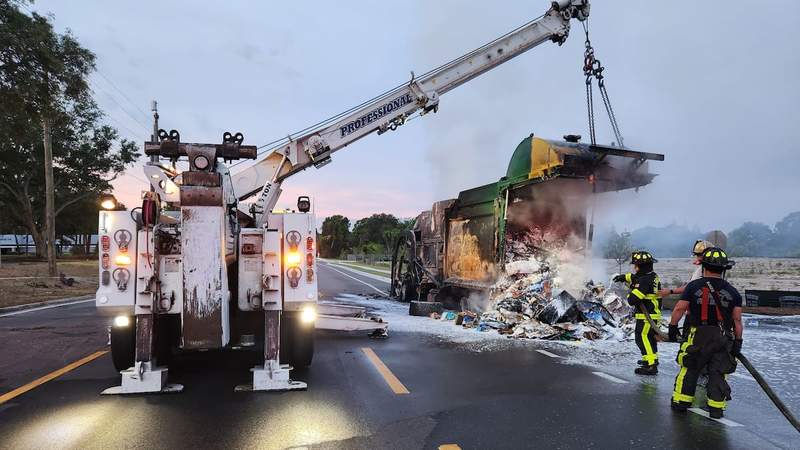
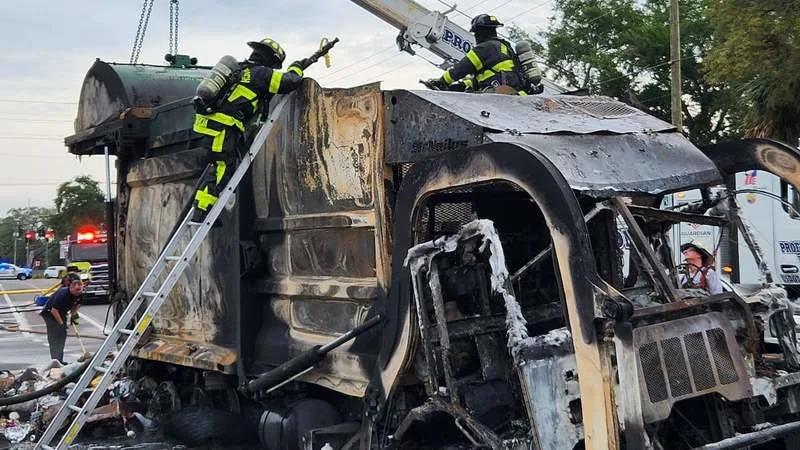
Hillsborough County’s solid waste department began tracking an uptick in garbage fires in 2023, when seven trucks erupted in flames and burned to a crisp.
The next year, that number climbed to 10 fires. And last year, 13 trucks went up in thick, chemical smoke.
In almost every case fire marshals have investigated, one tiny culprit was to blame: rechargeable batteries. They’re found in phones and laptops, lawnmowers and cars, disposable vapes and toothbrushes — even birthday cards that sing.
When drivers suspect they’recarrying a “hot load,” they have to move quickly to find an unpopulated spot where they can dump the smoldering heap. Sometimes it’s a parking lot. Other times, it’s the side of the highway. In a best-case scenario, the trash is dumped before flames consume the truck.
Hillsborough does not own a fleet of garbage collection trucks and instead contracts out to three companies, according to the county. Trucks can cost businesses up to $500,000 each.
Across Florida, 80% of garbage truck fires are started by rechargeable batteries, said Keyna Cory, a lobbyist for the National Waste and Recycling Association’s state chapter. Cory said the total number of garbage truck fires across the state is unknown, but she said one company alone had more than 170 last year.
Blazes have grown more common, county staff and industry representatives say. The problem? People throwbatteries into the garbage rather than properly recycling them.
At least one county government passed an ordinance that aimed to prevent fires by requiring stores that sell rechargeable batteries to create recycling programs.The efforts would encourage customers to return dead or old batteries rather than throw them away.
But lawmakers briefly moved during budget negotiations earlier this month to block local governments from creating their own rules.
“It came out of left field,” Cory said. “(Lawmakers) know that they’ve got a responsibility to get these batteries safely handled and to work with us on that.”
 What are lithium-ion batteries?
Rechargeable batteries are ubiquitous nowadays.
Lithium-ion batteries were created with a transition toward sustainable energy in mind. They’ve helped make electric vehicles run longer and allowed better storage of energyfrom solar power.
But there’s a dark side, experts say.
People want constant upgrades to their electronics, like buying a new iPhone each year. That creates tens of millions of tons of e-waste annually.
But these batteries are volatile. They can get too hot and catch fire when punctured or exposed to water.
Studies show recycling e-waste and lithium-ion batteries, in particular, can be a greener option than sending them to a landfill. Yet people throw away these batteries at five times the rate they recycle them, according to research sponsored by the United Nations.
Recycling batteries allows manufacturers to recoup metals like lithium, nickel, cobalt, copper, manganese and aluminum. This process emits less than half the greenhouse gases released from traditional mining practices, according to a Stanford University study published last year.
Diverting these batteries from landfills should also result in fewer fires. It’s why local governments wanted to do something to make them easier to recycle.
How to prevent garbage truck fires
When truck fires approached their peak in October, Hillsborough County staff launched a regionwidemessaging campaign to educate residents on proper battery disposal.
Billboards, TV ads and digital flyers telling residents where to take their batteries also gave instructions for how to do so safely.
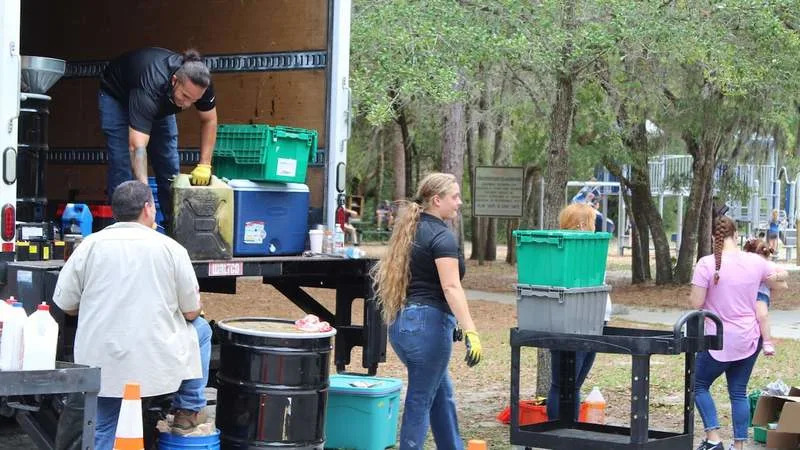
It usually takes six months for the county to fill eight55-gallon drums with thebatteries dropped off by residents at its five collection sites. Since the campaign started, though, Hillsborough has filled 15 drums, said Daniel Gallagher, who manages the county’s sustainability and disposal program.
“People are bringing us a lot of batteries,” he said.
Gallagher said it only takes one small lithium-ion battery to cause a fire that can destroy a collection truck.
“Sometimes these fires spread really fast. The lithium-ion battery fires superheat to like 2,000 degrees Fahrenheit,” he said. “They produce their own oxygen. You can’t submerge them in water. It has to be put out with foam.”
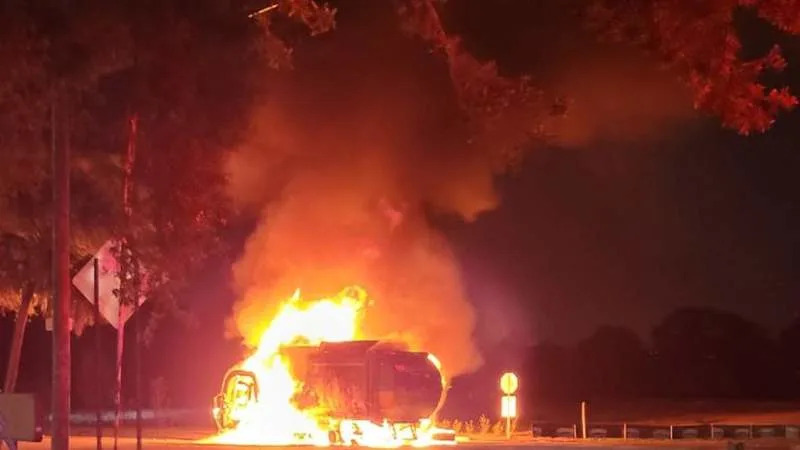
Drivers, who are trained to handle small fires, are on the front lines.
“Could you imagine being a driver? I mean, it must be pretty traumatic,” Gallagher said. “These drivers are just members of the community, too. They work, live and play here, too. They’re your neighbor. They want to get home with their families. They’re trying to do a job, and we really want to make their job as safe as possible.”
It’s unclear whether any drivers have been injured in fires. The companies contracted by Hillsborough County declined to answer a reporter’s questions about collection truck fires or make drivers available forinterviews.
The global lithium-ion battery market was valued at more than $150 billion last year, in part due tocheaper manufacturing costs, according to the International Energy Agency. But batteries only have a lifespan of about five years.
“We’re going to be hit with a lot of batteries very soon, and we really need to educate residents on how to properly dispose these batteries, because they do not belong in your trash or recycling bin,” Gallagher said.
Hillsborough has had five truck fires so far this year, with just one blaze attributed to residential pickup, which usually means it started from a battery. The other four fires started from commercial dumpsters. That’s an improvement compared to last year, Gallagher said, when 12 of 13 fires were traced to homeowners’ curbside bins.
Pinellas County has not tracked truck fires, but staff says it’s seen a similarly worsening issue.
“We do get them somewhat frequently,” said Charles Mangio, the county’s solid waste program manager. “We might have a couple of incidents a year where we have fires here — either trucks on fire, or we have a fire that occurs at the landfill or within the waste-to-energy facility.”
The county has an “open market” for waste disposal, meaning homeowners in unincorporated Pinellas choose a private company to pick up their trash. Residents who need to dispose of lithium-ion batteries should drop them off at the county’s Household Hazardous Waste centers in unincorporated St. Petersburg and Clearwater.
Battery fires in Pinellas soared in the weeks following hurricanes Helene and Milton when flooding exposed EVs and electronics to saltwater, Mangio said.
Ahead of this hurricane season, the county is asking barrier island residents to sweep their homes for old lithium-ion batteries that could pose a fire risk if a storm smacks the area.
 What is the Legislature doing about it?
Some local governments have gone even further than those in Tampa Bay to prevent lithium-ion battery fires.
Broward County commissioners approved a measure that put the responsibility for battery disposal on the businesses that sell them. It requires retailers to establish an on-site recycling collection program free to customers.
Tallahassee lawmakers seem poised to strike down the ordinance, which went into effect May 1.
On May 12,the first day of budget negotiations, a Senate subcommittee proposed that Gov. Ron DeSantis earmark $100,000 for the Florida Department of Environmental Protection to conduct a study on lithium-ion battery disposal, independent investigative journalist Jason Garcia first reported.
But the yearlong measurewould alsopreempt Broward County’s ordinance and bar local officials elsewhere from passing ones just like it.
Cory, the lobbyist for Florida’s waste industry association, said she has spent years pushing for legislation that would standardize battery disposal across the state and keep drivers safe from combustion.
She’s in favor of the state studying disposal methods, but shetook issue with how broad the preemption language appeared. It could prolong passing a statewide law on battery disposal until 2028.
When the Senate committee unveiled its preemption plan, Cory’s phone rang nonstop. Others in the industry were surprised and thought maybe she had been behind it.
“We can’t find out who did the language,” Cory said. ”We’ve been playing detective.”
The battery preemption was quietly removed from the budget last week, Cory said. Lawmakers have until May 29 to finalize their spending plan before it goes to DeSantis’ desk.
Rep. Lindsay Cross, a St. Petersburg Democrat, said she only recently learned that garbage trucks catching fire had become such a pervasive issue in her district and elsewhere.
“It’s pretty frightening,” she said.
Cross defended Broward County’s ordinance and said she would support a similar state law.
Budget talks are typically when “a lot of sneaky things get added,” shesaid. “It’s often a way to kind of push an issue away that the Legislature doesn’t want to deal with through a study.”
How to properly dispose of lithium-ion batteries
Safely transport lithium-ion batteries to a drop-off location by removing them from your device, taping the terminals of each battery with clear packing tape and placing each battery in a separate plastic ziplock bag.
You should not try to remove batteries from devices that are not designed to be removed. Regular alkaline batteries, like AA or AAA, can go in the trash.
You can find the nearest battery drop-off location at tampabayrecycles.org
• • •
The Tampa Bay Times launched the Environment Hub in 2025 to focus on some of Florida‘s most urgent and enduring challenges. You can contribute through our journalism fund by clicking here.