
ORLANDO, Fla. — Experts say that career and technical education is experiencing a surge in popularity, driven in part by escalating college costs and a high demand for skilled workers.
They say the change is also being driven by a labor shortage in Florida that is creating a significant strain on several key industries.
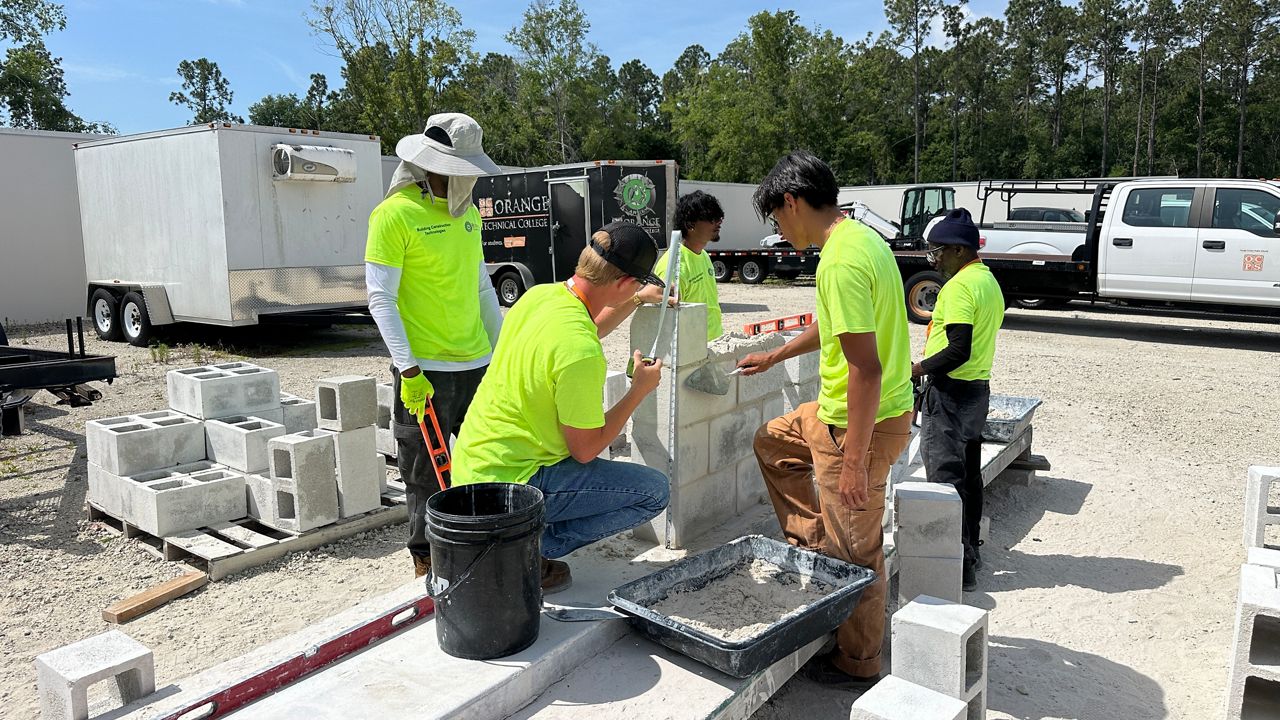
Scott Weidl is the senior director at Orange Technical College West Campus, where they offer several programs ranging from building construction technologies to HVAC.
“Plumbing, HVAC, welding, electricity, building construction technologies,” Weidl said. “So, they’re all under one roof so we can offer a better product for the public.”
OTC serves between 3,000 to 4,000 students a year, with the average cost for a certificate in the construction fields ranging from $3,000 to $5,000.
“Recently, getting out of the military, I kind of picked up the trade,” said Kiev McCray, who is enrolled in the building construction technologies program at Orange Technical College West Campus. “It just kind of became a thing during COVID. Everybody wants things done, and I turned it into a business. However, I came out to this program because I wanted to add a little extra to what I learned myself.”
Once students obtain their certificate, OTC works with them to help them find a job.
“They do start off in many times with very good wages, especially because the more credentialed you are, the more that you know and you know how to do, the more money you can make,” Weidl said.
For years, he said there was a stigma associated with career technical education that participants in those programs would be overlooked by those with a more traditional degree. But that is changing in 2026, as technical careers are more in-demand.
“That pendulum has swung the other way, and so, they have come to find out that career training is for everybody,” Weidl said.
Florida’s current labor market continues to grapple with a persistent workforce shortage. According to the U.S. Bureau of Labor Statistics, the state of Florida had 427,000 job openings in December of 2025. The state’s unemployment rate had risen to 4.7% as of March 2026.
“Statewide what we’re finding is a lack of, of that skills gap between what the jobs currently have out of the market and the talent pool that, that we have to choose from,” said Gustavo Henriquez said, the regional career services manager at CareerSource Central Florida.
Henriquez said the top three industries experiencing this labor shortage in Central Florida are construction, health care and hospitality.
“It’s really that skilled workforce where we’re seeing those gaps,” said Brian Yarborough, the business unit leader at DPR Construction. “So, whether that’s electricians, pipefitters, welders, equipment operators, it’s really those skilled trades within our industry where we’re feeling that shortage.”
Henriquez said there are several factors causing the shortage.
“We have really one in three individuals currently in Central Florida are seniors or 55 and older, so we have an aging population that’s coming out of the workforce,” he said. “And then also the other part about it, too, is that we have, currently our younger population aren’t as engaged as they once were.”
In March 2026, nine out of the 25 metro areas in Florida had over-the-year job gains. The area with the largest gains was the Orlando-Kissimmee-Sanford region, which added 12,400 new jobs. But construction companies say they still can’t keep up with the current demand to build in Central Florida.
“We’re trying to hire, and there’s not enough people to fill the qualified positions that we have, from the tradesmen to the supervisors and managers,” said Michael Waldrop, the chairman and founder of Blue Cord Design & Construction.
Waldrop said that to find skilled workers, they are trying to get creative and work with different programs that offer certificates and training.
“We’re finding ways to overcome it and being as innovative and industry leading as we possibly can. But it’s a challenge,” Waldrop said.
At OTC, Weidl said they are able to customize their training based on the needs of the companies they partner with.
“Because we have a good relationship with industry, they constantly tell us about what they need,” Weidl said. “So, not only is it a labor shortage, it’s also a shortage of skilled labor.”