
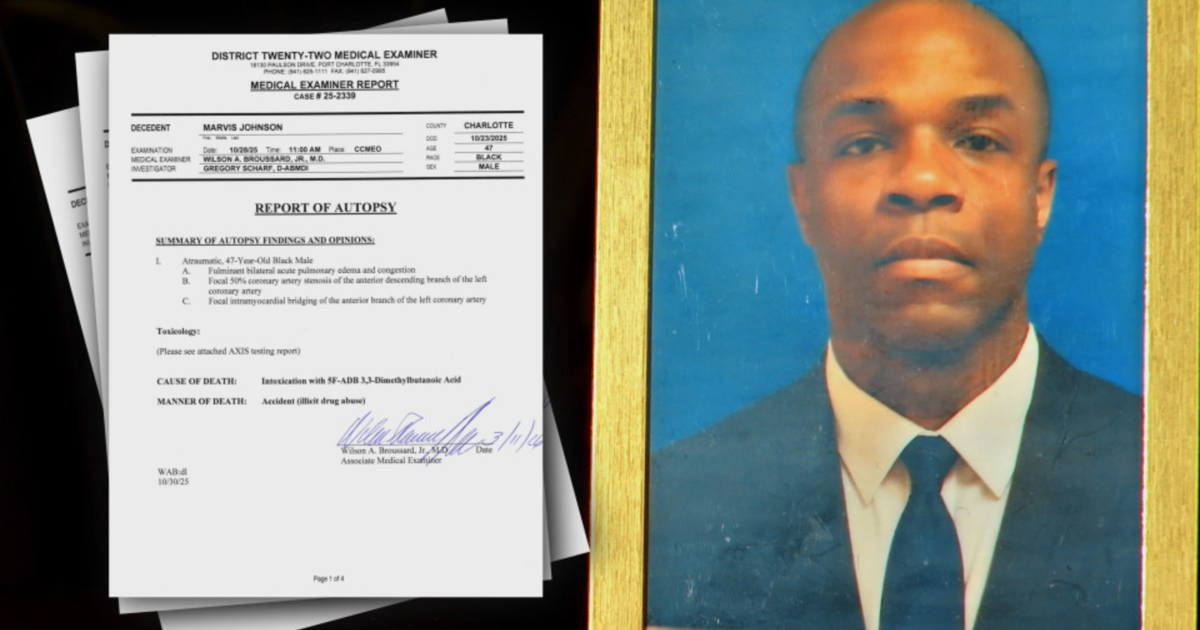
PUNTA GORDA, Fla. (WINK) — The family of Marvis Johnson spends their days re-reading the same stack of pages, trying to process words that feel too painful to be real.
For nearly three decades, Johnson had been serving a 30-year sentence for assault and battery at the Charlotte Correctional Institution in Punta Gorda. At 49, he was supposed to be released this year. Instead, he died in state custody—leaving his family shattered and demanding answers. WINK Investigates spoke with his aunts, Evangeline Lloyd and Yolanda Eugene.
The family recalls the devastating moment they learned of his passing. “We just got a call… ‘Marvis just passed away,’ and I just dropped the phone and ran to my bedroom,” Lloyd said. “You know, I just couldn’t talk.”
For five months, they say they faced a wall of silence, unable to secure an autopsy report from state officials. The report was finally released only after WINK Investigates began pressing the state for answers.
“I said they must know WINK News is on it because we would have never gotten that report,” Eugene said.
A Difficult-to-Detect Lethal Dose
The newly released autopsy report reveals that Johnson died from an accidental overdose of a synthetic cannabinoid.
Experts note that these types of designer synthetic drugs are notoriously difficult to detect, often requiring highly specialized toxicological testing that can drastically lengthen the autopsy process.
For Johnson’s family, the report provided little closure. Instead, it sparked a disturbing new question: How are these lethal drugs breaching prison walls?
While some inmates resort to desperate, improvised methods to manufacture substances inside—such as mixing toxic household chemicals like rodent spray and bleach—law enforcement officials warn that a sophisticated external pipeline is driving a full-blown contraband crisis.
Drones and Drug Rings: The Changing Face of Contraband
The crisis at Charlotte Correctional Institution stretches far beyond the prison yard. Only months before Johnson’s death, Florida law enforcement announced the takedown of an alleged prison drug trafficking kingpin.
Investigators claim an inmate named Carlos Martinez operated a major drug ring directly from inside Charlotte Correctional Institution. According to the Florida Attorney General’s Office, Martinez and his co-conspirators didn’t just smuggle drugs into the facility for inmate use—they allegedly used their network to push fentanyl back out into Southwest Florida communities.
Retired FBI Agent Rich Kolko explained that while contraband has plagued prisons for generations, technology has fundamentally shifted the power balance.
“Whether it’s guests that are visiting, supplies that are being delivered, or co-opting some of the people that work in the prison… contraband finds a way,” Kolko said. “And now, one of the latest ways they’re doing it—drones.”
State prosecutors confirmed that the Martinez ring utilized drone drops to bypass prison security entirely, delivering payloads of cell phones, heroin, and other dangerous contraband directly into the facility.
“Anything from heroin to a piece of paper like this that could have months’ worth of acid on it,” Kolko noted regarding the compact, high-potency nature of modern smuggled substances.
A Growing Threat to Local Communities
Advocates warn that the public cannot afford to view prison drug rings as an isolated problem. When high-potency narcotics enter a prison, they inevitably bleed back into local neighborhoods.
Denise Rock, Executive Director of Florida Cares—a nonprofit advocating for incarcerated individuals and their families—emphasized the public safety risk.
“Over 90% of people who are incarcerated in Florida are going to return home one day,” Rock said. “They’re going to return to our communities—they’re going to be my neighbor and my child’s neighbor.”
Charlotte Correctional Institution State Data Focus:
– Thirty inmate deaths have been investigated from 2020 to 2025.
– Marvis Johnson’s death case status: Officially Open.
*Note: Available state records do not publicly categorize the specific causes of death for these legacy cases.
A Family Demanding Accountability
The Florida Department of Corrections declined to answer specific questions from WINK Investigates regarding how Johnson obtained the lethal synthetic drugs or how many other inmates have overdosed on the same substance, citing an active, ongoing investigation.
Meanwhile, Marvis Johnson’s family acknowledges his past mistakes but maintains that his life still had value. They are now praying that investigators cut off the prison’s drug supply pipeline before another family is forced to bury a loved one.
WINK Investigates will continue to follow the state’s open investigation into Charlotte Correctional Institution.
For more WINK Investigates stories, click here.