
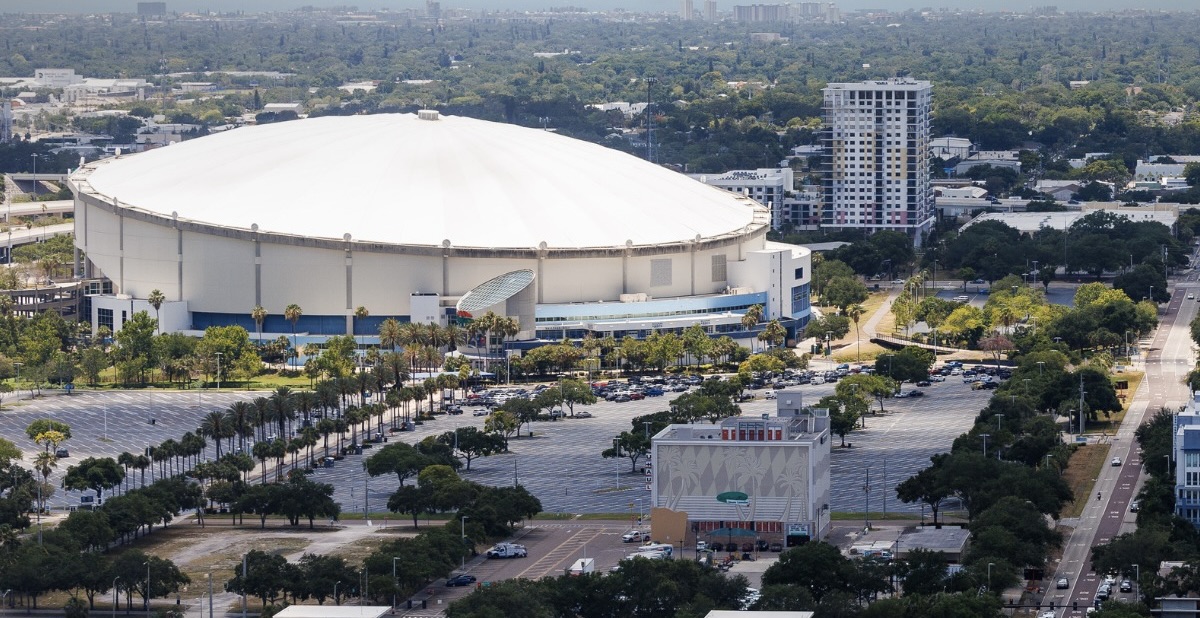
Urban Land Institute Tampa Bay executive director Lee Lowry and St. Petersburg Downtown Partnership CEO Jason Mathis spoke to developers and community members Tuesday about the Historic Gas Plant District redevelopment project.
The two organizations are collaborating on a study, with other local partners, that can provide guidance on the effort. It will be a two-phase project.
For more than 75 years, ULI has helped municipalities update neighborhoods, address housing affordability and enhance infrastructure. It previously worked with the City of St. Petersburg on the Realizing Resilience report.
Mayor Ken Welch has prioritized the redevelopment of the Historic Gas Plant District, which comprises approximately 86 acres. Currently, the City is exploring four shortlisted proposals from ARK Ellison Horus, Foundation Vision Partners, the Pinellas County Housing Authority and the Burg Bid, led by Blake Investment Partners and Related Group.
The Foundation Vision Partners proposal focuses on infrastructure first development, phased parcel sales and continued city ownership of the land.
Lowry explained at Tuesday’s meeting that the first aspect of the initiative is akin to a “research project.” A group of local individuals will review previous studies conducted on the Gas Plant District area, and bring all of the information together to find “common themes” and determine if “there is anything missing.” Additionally, stakeholder interviews will be conducted.
She added that this part of the effort should be completed by the end of next month. After the information is collected and evaluated, the ULI team will prepare a one-page report.
The second phase will involve an Advisory Services panel, which will feature national real estate, planning and design experts. “What we bring to the table is an unbiased look,” Lowry said.
This panel will spend multiple days in St. Petersburg and tour the Gas Plant District area. They will also conduct additional stakeholder interviews. The group will then discuss their findings and a report will be created. She estimates that Phase Two should be completed by the fall.
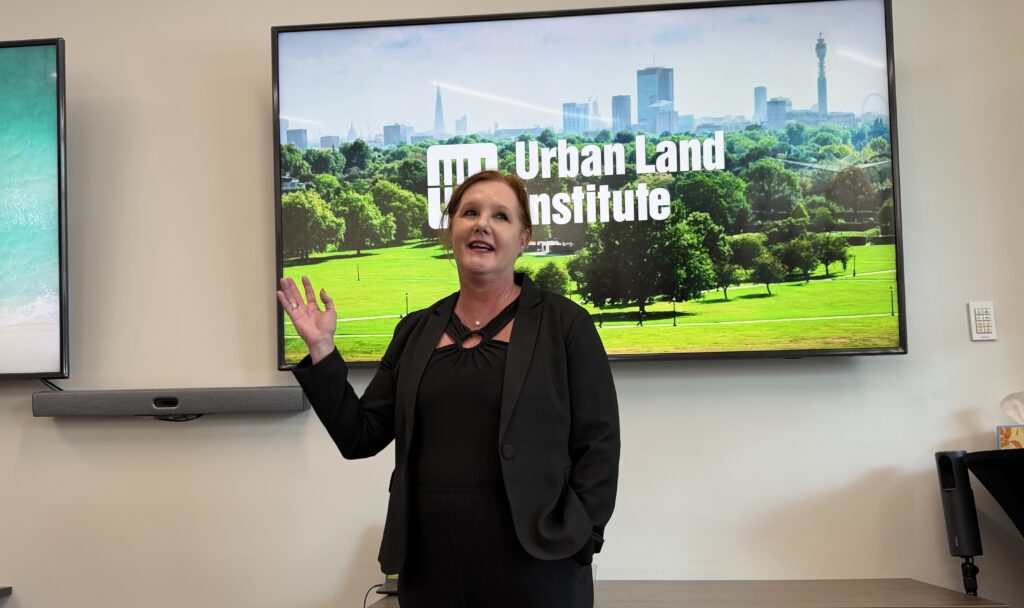
Urban Land Institute Tampa Bay executive director Lee Lowry speaking at the Tuesday St. Pete Downtown Partnership Developer’s Update meeting. Photo by Michael Connor.
“It’s people who have done major projects in other cities,” Mathis explained. “No one in our community has done a project of this scale before.”
The “advantage” is that these individuals “don’t have all the baggage that we carry around with us.” They don’t have “all of the emotion and connection that we might have,” he added.
The Gas Plant District has a storied history. This has been key to Welch’s desire to move forward on a redevelopment project. Before Tropicana Field was constructed, the predominantly African American neighborhood included a variety of Black-owned businesses.
Mathis said that the ULI Advisory Services panel will answer questions submitted by the Downtown Partnership and its partners.
Multiple organizations are involved in the effort including the St. Petersburg Area of Chamber of Commerce, the City of St. Petersburg, the Foundation for a Healthy St. Petersburg and the Pinellas County Urban League.
“We’re not going to weigh in on who should develop this land,” he added. The panel will focus on the development agreement between the chosen developer and the City.
Mathis said that questions are still being determined. One will be “how can we future proof the development agreement so that it allows for flexibility for the developer over time but also guarantees the greatest public benefit?”
Welch is scheduled to select a proposal next month. The Community Benefits Advisory Council will host two meetings in July to further discuss the mayor’s decision. One meeting will feature public comment.
Before a contract is awarded, the City Council will have to give approval. This will not happen until late 2026 or 2027. According to the City’s website, final steps for the redevelopment selection process have yet to be announced.
“I wish we had moved forward on this when Lee and I presented it last year,” Mathis said. “But, we didn’t and I still think that this process can help to inform the city and help us make choices in the long run. It’s not ideal, but it’s better than not doing anything at all and leaving it up to happenstance and hoping things turn out okay.”