
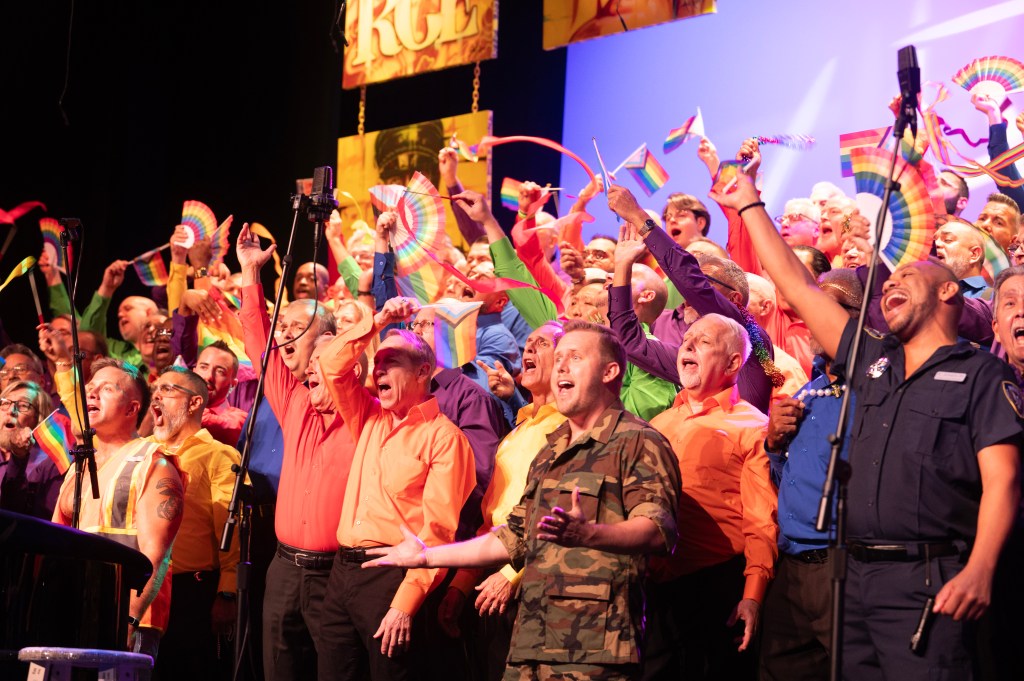
It was a terrible time. But now, a decade later, the timing may finally be right for a community to heal through music.
The 10th anniversary of the Pulse nightclub tragedy is Friday, June 12, and a week later — on Friday, June 19 — the Gay Men’s Chorus of South Florida (GMCSF) will perform the world premiere of “Amor Eterno: A Requiem for Pulse,” as part of “Invincible,” a concert at Fort Lauderdale’s Broward Center for the Performing Arts.
Chorus artistic director Gabe Salazar commissioned the work in early 2025, tapping Los Angeles-based composer Saunder Choi to create a special tribute for the Orlando attack.
“I am deeply moved to be working with Saunder Choi on ‘Amor Eterno.’ His music carries grief with tenderness and transforms it into something luminous,” Salazar said. “Bringing this work to life with our singers is an honor and a powerful act of remembrance and hope.”
Joining GMCSF onstage will be guest classical singers Elisse Albian and Enrico Lagasca, as well as the Symphony of the Americas and members of the Orlando Gay Chorus, Miami Gay Chorus and the Gay Men’s Chorus of Tampa Bay.
The second act of “Invincible” will feature popular anthems, including Katy Perry’s “Roar,” Gloria Estefan’s “Get On Your Feet,” Cynthia Erivo’s “Stand Up,” Kelly Clarkson’s “Invincible” and “Golden” from the movie “KPop Demon Hunters.” They will also sing African American hymns/spirituals “Lift Every Voice and Sing” and “Go Down Moses.”
Honoring past struggles
The timing of the show unites several historic milestones. June is Pride Month, when LGBTQ+ communities traditionally commemorate the 1969 Stonewall riots in New York City, a pivotal moment in gay and lesbian history. And with the performance falling on Juneteenth, a federal holiday that recognizes the abolition of slavery in the United States, it will commemorate the ongoing battles for freedom and equality and help nurture community solidarity, according to the GMCSF.
“Choi’s requiem serves as the artistic heart of the evening. The premiere honors those who lost their lives and celebrates resilience, fostering a sense of shared purpose and hope,” the chorus said in a statement.
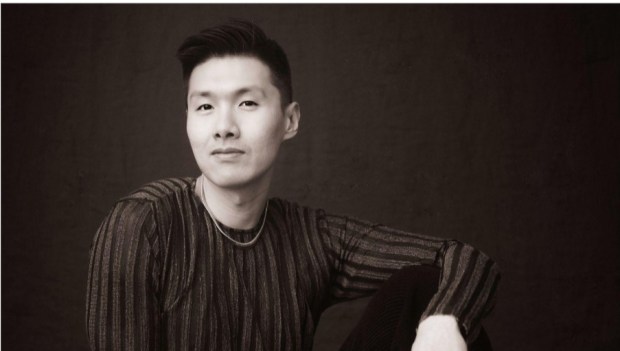
Pete Agraan
Saunder Choi is the composer of “Amor Eterno: A Requiem for Pulse.” (Pete Agraan/Courtesy)
The reason for the requiem
Pulse was an Orlando gay bar where, on June 12, 2016, gunman Omar Mateen shot and killed 49 people and wounded another 58. It was “Latin Night,” so many of the victims were of Hispanic descent.
The Pulse shooting is the deadliest attack against the LGBTQ+ community in U.S. history and the deadliest terrorist attack on U.S. soil since Sept. 11, 2001. Mateen identified himself as “Mujahideen” (a jihadi warrior), and the massacre was deemed an act of terrorism by the FBI.
Religion and mourning
Choi explains that a requiem Mass is a staple of the choral community and comes from Catholicism.
“You have versions from Mozart to Verdi,” Choi said. “These requiem settings are settings of the Mass in Latin. And the Mass, in its very Catholic nature, is really focused on … repose for the departed, to bring their souls from purgatory to heaven in the afterlife. And so a lot of these requiem Masses start with ‘Requiem aeternam dona eis, Domine,’ which is ‘Grant them eternal rest, oh Lord.’ ”
One choral master work in the 1800s broke out of this mold, he said, and focused more on the living. That was Johannes Brahms’ “A German Requiem.”
“Not only did he not say it in Latin — which is what was in vogue at that time; he said it in his native language of German — [but he also] picked out different texts from the Psalms. And instead of ‘Grant them eternal rest, oh Lord,’ he starts the entire requiem with ‘Blessed are they who mourn.’ It’s focused on the living.
“And so Brahms has this very humanist humanistic vision of the requiem. That kind of narrative arc of grief towards comfort, I think, is something that I wanted to aspire towards … in writing this requiem.”
The title’s Mexican roots
Choi collaborated with four poets from around the country: Andrea Assaf in Orlando, Brian Sonia-Wallace in Los Angeles, Amir Rabiyah in Philadelphia and Leo Herrera in New Orleans. It was Herrera’s contribution to the libretto in the first movement that inspired the title, according to Choi.
“I think he really wanted to quote the Juan Gabriel song, the Mexican song, which is also called ‘Amor Eterno.’ Juan Gabriel … wrote that song when his mom passed away. And so I think it’s a little bit of an homage to that. It’s a nod to Pulse, or Florida being home to a lot of the Latinx population. … And so Leo, I think, is very intentional in including that in his text. And for me, ‘Amor Eterno,’ coincidentally also patterns how most requiems start, which is requiem eternum, eternal rest, eternal love. Yeah, I work very well with parallelisms.”
He also relates to the immigrant part of the Pulse story, having emigrated from the Philippines at age 23.
“Like a lot of immigrants, it was the American dream, that version of the American dream, that led me to come here. It’s not illegal to be gay in the Philippines, but it’s certainly not celebrated as much as it is here. We don’t have marriage equality,” he said. “And you know, 2016 was only four years since I moved to America. … I still had a pretty good version of the American dream in my head. I was still just really happy, really grateful to be here, to be pursuing what I’m pursuing, to be able to date and love who I want to love as a gay man — a kind of freedom that I never really felt in the Philippines. Pulse was something that kind of broke that for me. …
“Because this mass shooting happened at a gay bar, it kind of broke something in me and I suddenly became so affected … I wrote a piece called ‘American Breakfast’ that kind of responded to the shooting; But also was a commentary on how frequent these things happen in America, that it’s just as regular as breakfast, like: Here’s your American breakfast served with a side of gun.”
Remembrance and healing
“Amor Eterno: A Requiem for Pulse” is different, he said. “I think there are two facets to this. I think that art really helps us process things, helps us process trauma in a healthy way. But also art memorializes. You know, at a time when queer stories, rainbow sidewalks, memorials, shrines, paintings, murals … at a time when they’re being erased, I think this is the time when we should be creating more art about queer lives. Because the more art we create, the more impossible it will be for these stories to be erased.”
It has not been easy, though.
“I am just really grateful and honored to be asked to write about this and to create this art. It’s really meaningful for me. [It] has been emotionally heavy for me the past year. But also I feel like I learned a lot and grew from it. There’s a lot of emotional growth that happened in writing this piece.”
The “Invincible” concert will take place at 8 p.m. Friday, June 19, in the Au-Rene Theater at the Broward Center for the Performing Arts, 201 SW Fifth Ave., Fort Lauderdale. Tickets range in price from $53.10 to $118. Visit browardcenter.org or call 954-462-0222.
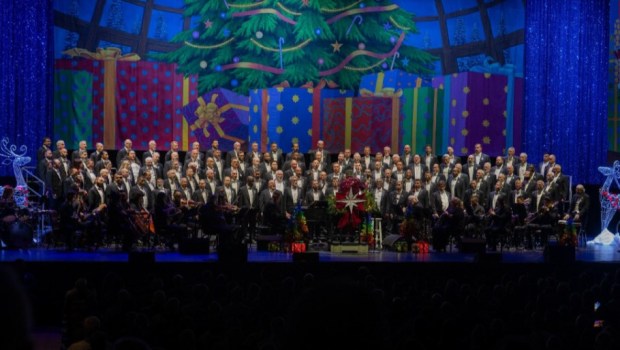
Ginny Dixon Photography
The Gay Men’s Chorus of South Florida will be joined onstage by guest classical singers Elisse Albian and Enrico Lagasca, as well as the Symphony of the Americas and members of the Orlando Gay Chorus, Miami Gay Chorus and the Gay Men’s Chorus of Tampa Bay. (Ginny Dixon Photography/Courtesy)