
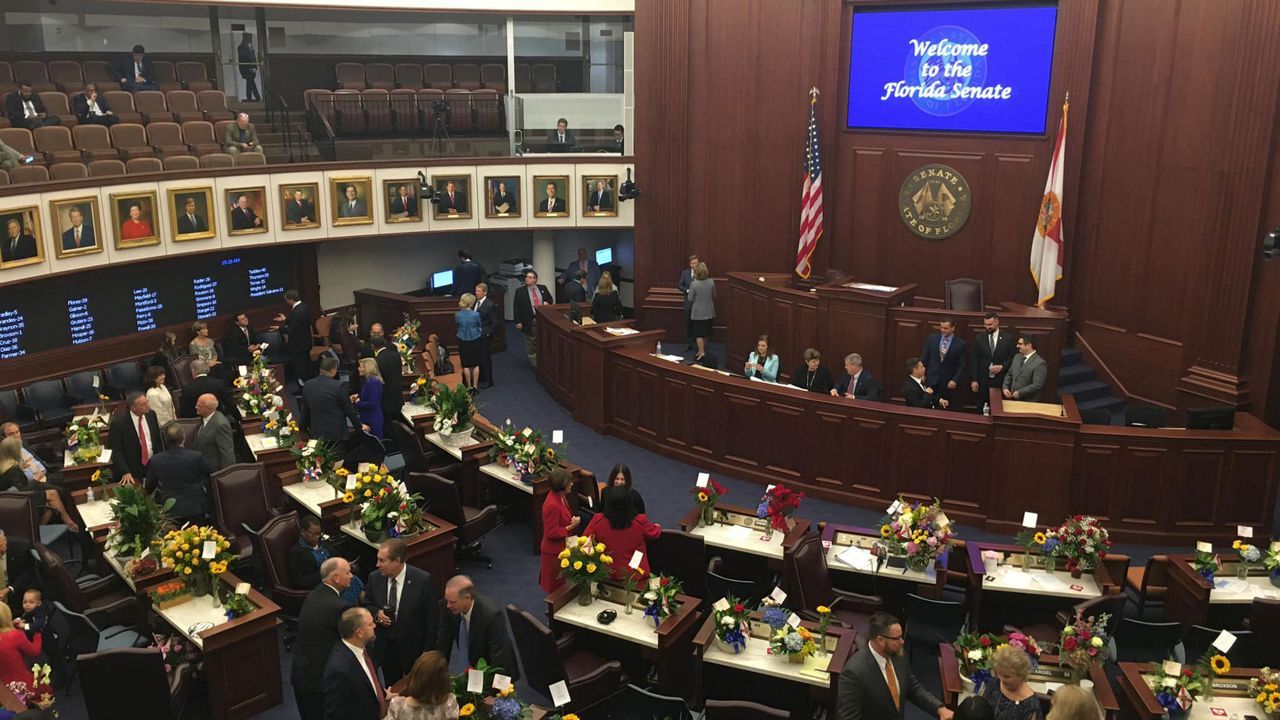
TALLAHASSEE, Fla. — Florida lawmakers in the House and the Senate passed the state budget Friday.
The overall budget included provisions for spending $114.5 billion, which is less than the previous year’s budget.
It’s also less than what the Senate wanted to spend, but more than what the House asked for during the regular session deliberations.
If that number holds, it would mark the second straight year the state has scaled back spending.
Speaker of the House Daniel Perez announced that the budget maintained $14 billion in reserves for as-needed state spending. That includes $8.6 billion in unallocated General Revenue reserves and $5.7 billion in the Budget Stabilization Fund.
“Floridians expect their government to spend responsibly and prioritize the issues that matter most to families across our state,” said Perez. “For the second year in a row, the Florida House has led the charge in passing a budget that reduces spending while continuing to invest in public safety, education, environmental protection, health care, and infrastructure. We’ve maintained strong reserves, protected taxpayers, and ensured Florida remains in a strong financial position for the future.”
Education spending was one of the issues that lawmakers disagreed on.
During the regular session, the Senate tried to change the state voucher program after a state audit showed major problems accounting for millions of dollars.
The House would not go along with reforms to how the state handles school choice vouchers.
Both chambers agreed to keep the $4.5 billion for homeschool and private school scholarships.
The House and Senate budget chiefs spoke about school voucher funding on Sunday night as lawmakers were finalizing the budget.
“This is a very simple concept. We want the money to be attached to the student, that’s it,” State Rep. Lawrence McClure said.
“Every district is having declining enrollment in the public school system. This will be a discussion that I think will occur every session. How we track the money and make sure the dollars follow the student,” State Sen. Ed Hoooper said.
Another education issue lawmakers struck a deal on is the transfer of USF Sarasota-Manatee to New College.
If approved, the deal would transfer ownership, leases, facilities and equipment from USF to New College. The House had asked for $23 million in state funding for USF to go to New College. That monetary transfer is not in the final budget proposal.
Will Weatherford, the outgoing chair of USF’s board of trustees, wrote on x that the deal makes sense.
“While we may no longer have the same physical footprint we do now, I know that USF can maintain a meaningful presence in the Sarasota-Manatee with opportunities for our university to continue delivering world-class academic programming,” Weatherford said.
However, Florida House Minority Leader Fentrice Driskell said today this deal is a “terrible transaction.”
“Capturing USF Manatee Sarasota really have been the governor’s pet project. New College has been the worst investment of our tax dollars for colleges and universities. It is the most expensive by far with outrageously high per-pupil spending. So my question is, why are we turning this college over to New College when they can’t even manage their own property … terrible transaction,” Driskell said.
Democrats also criticized the budget not including gas tax relief. There had been talk of suspending the state’s gas tax with prices soaring at the pump.
However, the final tax relief proposal in the budget did not include that.
It does, however, have about $150 million in tax breaks on things like hunting, fishing and camping gear, storm hardening and back to school supplies.