
Soon after Gov. Ron DeSantis unveiled his proposal to slash Florida’s property taxes, school officials across the state grabbed their calculators to estimate the potential impact.
Local property taxes make up just under half of the state’s education budget, which the Legislature approved Friday. They help pay for daily operations, salaries, student services, academic programs and more.
So the effect of cuts is expected to be noticeable.
“It would have a significant adverse effect on the quality of education here in Pasco,” superintendent John Legg said Friday.
But with the details somewhat murky — it’s not clear, for instance, whether voter-approved taxes would be included in the cuts or how the state might define “core public needs” such as education and schools — Legg and others hesitated to delve too deeply into the possibilities.
Still, they recognized that the revenue reductions could run into the hundreds of millions per district if the governor’s idea of increasing the homestead exemption to $250,000 (or higher) comes to fruition. And that has their attention, even if they don’t want to discuss what exactly might land on the chopping block if voters OK a constitutional amendment in November and an alternate funding source doesn’t emerge.
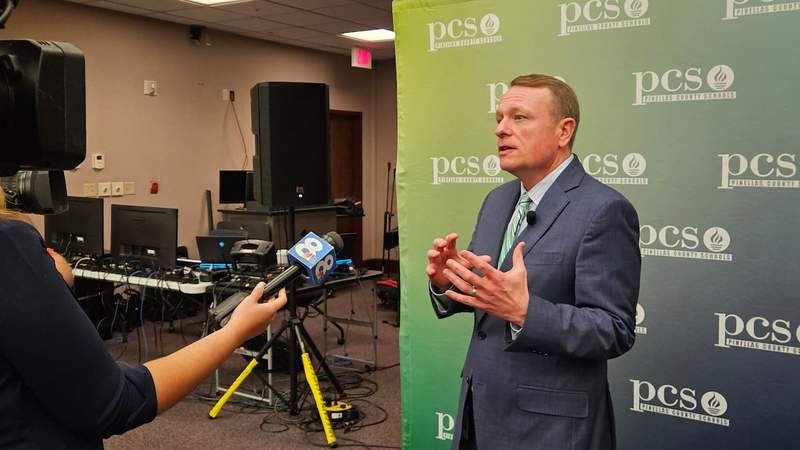
Pinellas County superintendent Kevin Hendrick said his initial ballpark figures suggested that his district could lose about $130 million annually from its general tax rate, with another $50 million from capital funds taxes and about $35 million from its local-option tax supporting employee pay.
His projections are close to Florida Policy Institute estimates released Friday afternoon. The non-partisan, left-leaning think tank, which was among the first groups to challenge lawmakers’ anticipated budget for universal school vouchers, pored over data available through the state to consider how schools districts and county governments might fare.
It figured that Pinellas would lose about $188 million as the DeSantis exemptions began to kick in, growing to $234 million by 2029, with the possibility of rising to $390 million if property taxes were fully eliminated for all homesteads.
For larger Hillsborough County, the group’s estimates came in at $248 million in the first full year, reaching $312 million by 2029 and $494 million with full elimination.
Its numbers for Pasco County were $123 million in the first year, $152 million in 2029 and $212 million if homesteads are not taxed at all.
Running the schools depends on having a stable, predictable funding source that leaders can plan their services around, said Hillsborough schools spokesperson Tanya Arja. About 39% of Hillsborough’s general operating funds come from property taxes.
“While this may reduce taxes for property owners, it would also reduce the taxable property base that school districts rely upon,” Arja said via email.
Such reductions would come on top of the job cuts and school closures that districts across Florida are experiencing as their enrollments decline. The base student allocation, one of the few line items districts can use without strings, is not set to match Florida’s rising cost of living.
“They’re already under duress trying to make sure our kids are educated well,” said Norín Dollard, a Florida Policy Institute senior policy analyst. “I don’t know how any good can come out of this.”
Using preliminary numbers from the Pasco tax collector’s office, Legg said he estimated a decline of $83 million if the state would implement the first step of DeSantis’ plan, a $150,000 homestead exemption.
“That’s a huge reduction,” he said. “It’s about an 18% decrease in teacher salary, to give you a scope of it.”
For some additional comparisons, the district’s current budget shows that it allocated $31.7 million in its general fund for district-level administration including central and fiscal services, $40.3 million for student transportation, and $56 million for services such as counseling.
Its self-insured health plan costs $152.8 million.
The Hillsborough district’s budget includes $81.9 million for transportation, $24.7 million for instructional media, $179 million for plant operations and $140.6 million for school-level administration.
All three local districts have voter-approved property taxes boosting employee salaries, by far the largest expense.
Pinellas superintendent Hendrick said it would be inappropriate to stoke fears based on what few specifics are available. The concerns were piling up, though.
“Are library media specialists extra?” he said. “Are buses extra? We can all go down the list.”
The district budget includes $21.3 million for guidance services, $36.7 million for energy expenses, $4.1 million for general administration and $27 million for maintenance.
Hendrick noted that Pinellas schools currently spend about $25 million on mental health services, but gets only about $5.5 million from the state for that expense. It’s similar for school safety expenses and other items that the public expects the district to provide, he added.
“I don’t think people think public schools are places of extravagance by any means,” he said, Residents haven’t been clamoring to pay teachers less or cut back on parks or other items paid for by property taxes to county government, he said.
“When we know all the rules, we will be very transparent about what it means,” Hendrick said.
The Tampa Bay Times Education Hub reports on Florida’s schools and universities and the students they serve. You can contribute to the hub through our journalism fund by clicking here.