
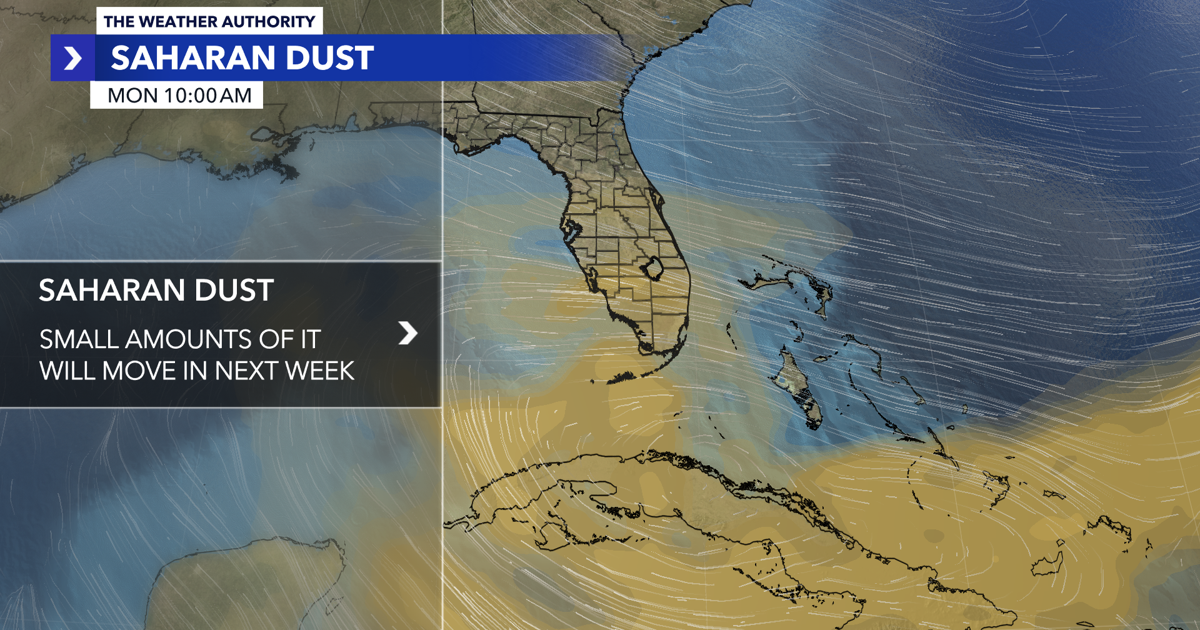
SOUTHWEST FLORIDA, (WINK) — It may sound surprising, but dust from one of the world’s largest deserts travels thousands of miles across the Atlantic Ocean and towards Florida, influencing weather conditions across Southwest Florida.
A small plume of Saharan dust is currently making its way across the Atlantic, with a portion expected to reach Southwest Florida next week.
During late spring and early summer, massive dust plumes originating in the Sahara Desert in North Africa can travel nearly 5,000 miles before reaching the southeastern United States.
The journey begins when seasonal weather patterns and monsoon activity over Africa lift tiny dust particles high into the atmosphere. Those particles are then carried westward by the Atlantic trade winds, eventually reaching Florida.
When the dust arrives, it can create hazy skies, reduce air quality, and produce especially vivid sunrises and sunsets. But its effects extend far beyond what we see in the sky.
Saharan dust can also play an important role during hurricane season. The dust is part of a larger mass of hot, dry air known as the Saharan Air Layer (SAL), which often suppresses tropical moisture, one of the key ingredients needed for tropical storms and hurricanes to form.
Tropical systems thrive in warm, humid environments. However, the Saharan Air Layer introduces dry air and stronger upper-level winds that can disrupt storm development and limit intensification. The dry air can weaken thunderstorms that fuel developing tropical systems, while increased wind shear can make it more difficult for storms to organize and strengthen.
Saharan dust activity typically increases in mid-June and often peaks between late June and mid-August, coinciding with the heart of the Atlantic hurricane season. The Atlantic hurricane season officially runs from June 1 through Nov. 30.
While Saharan dust can temporarily reduce tropical activity, it does not eliminate the threat of hurricanes. As dust outbreaks become less frequent later in the summer and ocean temperatures remain warm, conditions can quickly become more favorable for tropical development.
For Southwest Florida, Saharan dust serves as a reminder that weather patterns occurring thousands of miles away can have a direct impact on local conditions, sometimes helping to suppress tropical activity, but never replacing the need to stay prepared throughout hurricane season.