
Three days. That’s how much time Gov. Ron DeSantis has blocked out for the special session on property taxes.
The sixth special session in 18 months starts Monday in Tallahassee. The potential impacts of what’s being considered are impossible to fully calculate. If you have never paid any attention to what happens at the state Capitol, now is the time to do it.
DeSantis wants lawmakers to put a question before voters in November to expand the Florida homestead exemption in stages, first for all homesteaded properties taxed at $150,000 or less, then a year later on properties taxed at $250,000 or less. He also proposes reducing the annual increase in property tax assessments on non-homesteaded property from 10% to 5%.

Mike Stocker/Sun Sentinel
Steve Bousquet is a Sun Sentinel columnist who began reporting in Broward County in 1981.
The bill is Senate Joint Resolution 2-F, to be considered Monday afternoon by the Senate Appropriations Committee, in a three-hour hearing. Floor debate begins on Tuesday.
For months, DeSantis has denounced the evil of local property taxes, often falsely claiming that because of property taxes, “the government owns your home.”
DeSantis is poised to perpetrate the biggest tax shift in Florida history.
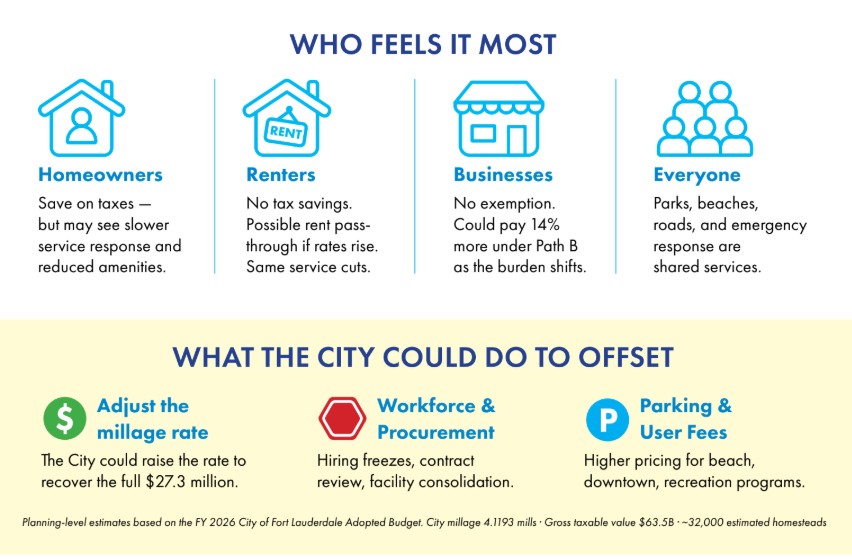
His proposal could be a financial disaster for the nearly 40% of Floridians who rent their homes, because they can’t afford to buy, and landlords, who won’t get a tax cut, would be forced to raise rents.
The far-reaching impacts — on renters, businesses, county and services — are not fully known, and they won’t be by the time this session adjourns Wednesday.
Because the tax question is a proposed amendment to Florida’s constitution, it must be approved by three-fifths of the members of both houses — 24 senators and 72 representatives.
Sadly, a prime co-sponsor of the tax shift is a Democrat, Sen. Mack Bernard of West Palm Beach. Any Democrat who supports this proposal makes it all that harder to defeat it.
Like DeSantis has done before on ballot questions involving abortion rights and marijuana use, he already has his thumb on the scale.
He wants the question to be exempt fron the 75-word limit that applies to other ballot questions in hopes of making it easier to pass.
He wants to require county property appraisers to send notices to homeowners, notifying them of the question — to make it appear, falsely, that local tax experts are cheerleading in support of the question. The notice would be written by the Department of Revenue, a state agency, and cannot be changed by property appraisers.
“Only one side of the story is going to be told: the potential cost savings in property taxes,” says a report for House Democrats. “No effort is made to discuss impact on local government budgets or services, or the need to offset lost property taxes with additional fees or assessments.”
This is unfair on its face, and Florida counties and cities are now prohibited from using any public funds to tell their side of the story.
An analysis by Broward County Property Appraiser Marty Kiar shows that the countywide impact of a first-year $150,000 homestead exemption would be $195 million. The impact of a $250,000 exemption would be $334 million. The memo says a typical homeowner’s tax savings would be $2,146.
As proposed, public safety — police, fire-rescue and EMS services — would be exempt from any tax impact, along with public schools, infrastructure, natural resources, public employee pensions and bond obligations.
But that leaves just about everything else: parks and recreation, code enforcement, homelessness, trash pickup, transit, and grants to nonprofits. An alert produced by the city of Fort Lauderdale lists possible consequences: a much higher tax rate, hiring freezes, higher taxes on small businesses and higher rents.
“This proposal would shift costs and service reductions onto residents, businesses and visitors who rely on safe streets, reliable emergency response, and well-maintained public spaces in Broward County’s urban core,” says a city of Fort Lauderdale memo to legislators. “Absent alternative revenue, the city may be forced to either raise millage on non-homesteaded properties or implement deep cuts that undermine public safety, economic vitality, and quality of life.”
Polls show strong support for cutting property taxes, driven largely by anxiety over the lack of housing affordability.
But there’s no guarantee that this proposal will pass in November.
For this tax shift to take effect, 60% of voters must approve. The last time voters were asked to approve an increase in the homestead exemption, it failed, when it received 58% support in the 2018 general election. It was Amendment 1 that year, sponsored by the Legislature — the only ballot question that failed that year.
Let’s hope that once again, Florida voters are smarter than Florida politicians think they are.
Every bill filed in the Legislature is analyzed by its staff for its fiscal impacts. The analysis for the property tax cut proposal describes the impact as “negative and indeterminate.”
Negative and indeterminate. That sums it up nicely.
Steve Bousquet is Opinion Editor of the Sun Sentinel and a columnist in Tallahassee and Fort Lauderdale. Contact him at sbousquet@sunsentinel.com or (850) 567-2240.