
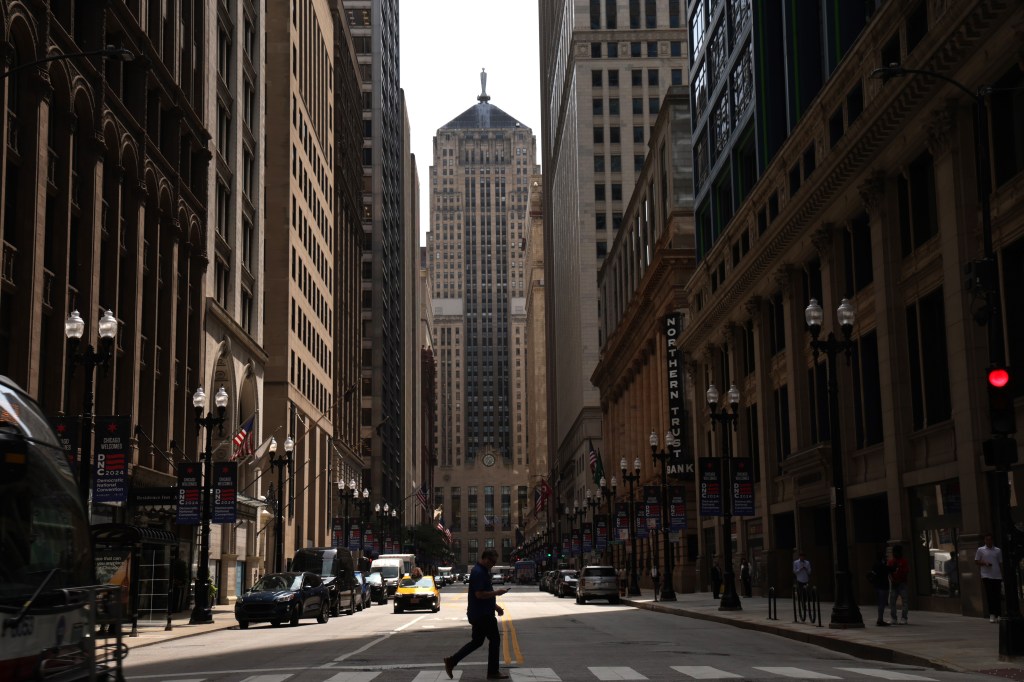
Chicago’s LaSalle Corridor Revitalization slowly is transforming dusty office buildings in the city’s longtime financial strip into up-to-date residential living spaces. Several have received city-sponsored financial support in exchange for providing affordable apartments, while other office towers are being redone with private funding.
At the same time, progress is afoot at the James R. Thompson Center, 100 W. Randolph St., one of downtown Chicago’s most ambitious gut-rehabs in the history of downtown Chicago. When tech giant Google’s local headquarters opens there next year, the LaSalle Corridor will have a massive new opportunity.
But here’s the rub: The competition is moving faster. A lot faster.
For decades now, Chicago has nipped at the heels of Wall Street, shaking up the New Yorkers with financial futures, stock options and other innovations borne of the LaSalle Street trading floors.
Today, Wall Street has pulled way ahead in an increasingly important arena: mixed-use neighborhoods with a financial past.
Where the LaSalle corridor is just starting to evolve into a place where Chicagoans can live, work, shop and play all at once, Lower Manhattan, the area that includes Wall Street, has moved far beyond its “all-business” past.
Residential conversions have made Lower Manhattan one of New York’s most sought-after neighborhoods to live in. The residential population has soared from about 24,000 just before 9/11 to 70,000 today, according to the Alliance for Downtown New York.
Similarly, the number of hotel rooms in the neighborhood has more than tripled during that period and about 240 additional retail outlets have opened. The city has added two transit centers at the Oculus and Fulton Center, giving the Wall Street area especially good access to transportation.
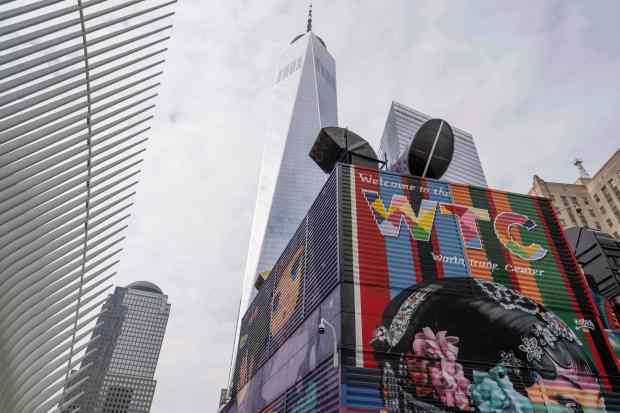 A general view on Feb. 25, 2026, shows 2 World Trade Center in New York, where American Express will build new global headquarters. (Yuki Iwamura/AP)
Finance accounts for about one-third of available jobs in the area, less than in years past, while cool opportunities in advertising, design, media and tech have skyrocketed. American Express just gave the neighborhood a vote of confidence, announcing plans to build an enormous global headquarters at 2 World Trade Center.
“The demography of the neighborhood is young and educated, leading to a lot of live/work/play energy here,” the alliance’s Christopher Nelson recently told us. “Things turned around.”
Friction persists between recently elected socialist New York Mayor Zohran Mamdani and financial titans like Citadel’s Ken Griffin, who famously moved his company’s headquarters out of Chicago several years ago. Those ongoing clashes could disrupt some of Lower Manhattan’s progress. To avoid the same mistake Chicago made in losing Griffin, Mamdani needs to make peace. He is smart enough to see this.
Still, unlike LaSalle Street, Wall Street already is far along in its reinvention. And New York is better positioned to thrive even if some of its philanthropists and job creators dislike its current civic leadership.
Similarly, Miami’s Brickell neighborhood (also now known as Wall Street South) is transforming into a financial center that attracts talented professionals by providing attractive lifestyle options. Citadel is one of many big-time financial players that have expanded in this tropical city, and Brickell is growing so fast that it is straining roads and other infrastructure.
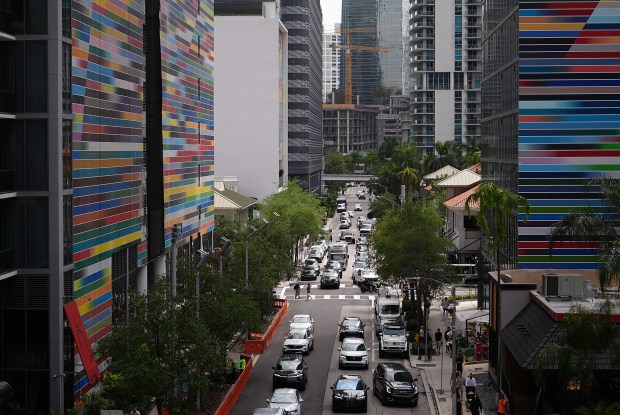 Cars drive through a commercial area in the Brickell neighborhood of Miami on April 2, 2026. (Rebecca Blackwell/AP)
At the Brickell City Centre, a Simon Property-owned mall in the heart of the neighborhood, upscale retailers like Coach and Zara do a brisk business. Unusual for any mall these days, vacancies are rare and the center’s restaurants and movie theaters are busy, partly because the mall is attached to a hotel, offices and residential buildings with hundreds of condos — the “live, work, shop, play” model in action.
“It has become such a global city now with all the investments. The whole area is booming,” Chris Valle, director of marketing at the City Centre, told us.
Along Interstate 95, a dozen construction cranes loom over Miami’s skyline, a testament to the real-estate boom under way. No wonder locals joke about cranes being the state bird.
In Chicago, construction cranes are painfully scarce these days. As the commercial-real-estate analysts at Newmark recently reported, the downtown Chicago office construction pipeline is practically at a standstill for the first time since 2012. The postpandemic hangover from excess office space continues to fester. Too many storefronts in the Loop remain vacant.
Meantime, those vitally important office-to-residential conversions are proceeding slowly — and expensively. The city of Chicago committed over $150 million in tax increment financing funds to redo four landmark buildings along Monroe and LaSalle streets. Predictably, the developer of 111 W. Monroe St. has come back asking for more.
We have supported the investments to date, but the city should be wary about taxpayers getting rolled for projects that are eating up the clock. At the rate it’s going, Chicago’s financial district will be playing catch-up with Manhattan and Miami for years to come.
Chicago must build on its strengths.
We’re more affordable and less congested than Manhattan and we don’t have bags of garbage routinely strewn along our sidewalks. Assets like our central location, strong transportation network and top universities outshine Miami by a mile, not to mention our arts and cultural attractions. Hurricanes, flooding and heat waves are a constant worry in southern Florida as well.
For the LaSalle corridor to regain its status as a place where talent wants to be, much more needs to be done. Under Mayor Brandon Johnson, the city’s singular focus on building up neighborhoods outside the Loop has often amounted to wishful thinking.
LaSalle Street, though, is the real deal.
Consider the iconic vista looking south from Monroe down the intact concrete canyon of historic buildings to the Chicago Board of Trade at the foot of LaSalle. Miami and New York have nothing quite like that.
If a plate of scrambled eggs can pass for Instagrammable on social media these days, surely Chicago can do more to promote this stunning view of a quintessentially American city. All we need is a platform for photo ops. And all LaSalle Street needs is a sense of urgency from City Hall to rise above the competition.
Submit a letter, of no more than 400 words, to the editor here or email letters@chicagotribune.com.